Environment
The plight of the Ganga: worse off than in 2014
It is now certain that mere chanting of Namami Gange has not done any good either for Ganga or its ecosystem. The holy river has lost even its normal glory
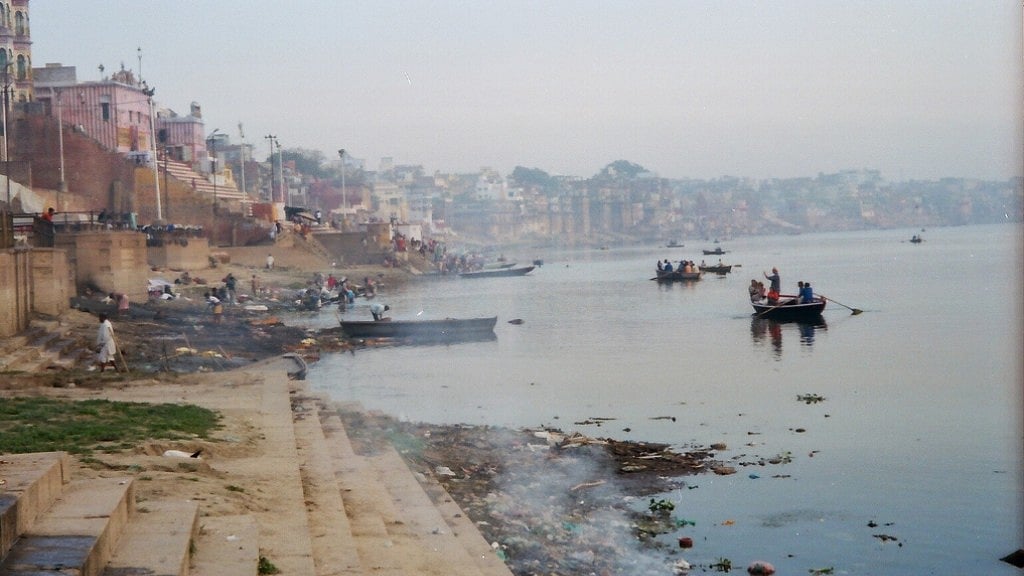
The primary significance of any river is the quality of its water and its ecological integrity. After the much hyped launch of Namami Gange, both components took backseat. Uma Bharti gave pravchans after pravachans over river Ganga incorporation terms like Aviral, Nirmal and many more, but Ganga even lost its normal glory. Now it is away from the ghats even at the Varanasi, the city known for its splendid Ganga Arti. The river Ganga got more polluted after 2014 and 10 of the animal species found in the river are on the verge of extinction. Now, a massive dredging is planned in Ganga to ease the transportation in the river from Allahabad to Haldia, which would further damage its ecology.
The Government this year approved the Jal Vikas Marg project, but environmentalists see it as a disastrous move for the ecology of the river. This World Bank aided project costs Rs 5,369 crore and expected to be completed in 2023.
The length of the stretch is 1,620 kilometres against the total length of 2,525 kilometres for the river Ganga. It requires large scale dredging of the river and it would adversely impact the habitats of all the aquatic life. In addition there are two important wildlife sanctuaries on the way – Kachhua (Tortoise) Sanctuary at Varanasi and Vikramshila River Dolphin Sanctuary after Bhagalpur in Bihar. Both tortoise and river dolphin are sensitive to human presence and noise. In addition, many animals including vital fishes would be killed by dredging equipment and later on by ships. It is obvious that ships would run on diesel, so instances of leakage cannot be overruled.
At least 10 species, including the Ganges river dolphin and the<i> gharial</i>, found in Ganga for centuries, are on the verge of extinction, according to new report released by the Ministry of Water Resources recently
Nitin Gadkari, Union Minister for Road Transport and Highways, Shipping and Water Resources says that river transport is cheaper than road transport and railways and it is more environment friendly. River transport is an emerging field except in Kerala, where it is already common.
It is certain that only on theoretical assumption it is said that river transport is cheaper. On the environment friendly part, Gadkari is totally wrong. River has got own specific ecology and it would be completely disturbed by shipping. Waves generated by ship movement would disturb the fish habitats and noise may induce behavioral changes in aquatic animals. Slow moving animals may collide with the ships easily and dredging would remove many animals on the river bed.
At least 10 species, including the Ganges river dolphin and the gharial, found in Ganga for centuries, are on the verge of extinction, according to new report released by the ministry of water resources recently.
While the dolphin is listed as an endangered species according to the International Union for Conservation of Nature (IUCN) Red list, the Gharial is critically endangered in the same list. The other species include birds such as the black bellied tern and Indian skimmer; turtles such as the northern river terrapin, three stripped roofed turtle, red crowned roofed turtle; and the golden mahaseer fish. The sarus crane, the mugger crocodile and the snow trout have been put in the vulnerable list.
The report says the Dolphin population, which was about 10,000 in late 19th century, reduced to 3,526 in 2014, adding that while the population of dolphins had stabilised between 2012 to 2015, it showed a drastic decline in recent years. The report said the dolphins are now restricted to the Ganga and its larger tributaries, but have disappeared completely from the Haridwar-Bijnor barrage, which is about 100 kms downstream of Haridwar.
The report said that gharials (fish-eating crocodiles) were on the verge of extinction in India by the mid 1970s, until a captive breeding programme was initiated during 1975 , taking the population to 1,200 by 1995. The report said the gharial population again showed a decline since 1999. “The presence of gharial is important for health of the river. It eats sick fish and disappearance of gharial from the ecosystem signifies collapsed ecosystem due to polluted water or drop in water levels,’’ the report said.
The species are affected when their habitat gets affected. It’s not just the pollution, it’s sand mining, dredging, building dams. It is certain that chanting of Namami Gange has not done any good either for Ganga or for its ecosystem.
Join our official telegram channel (@nationalherald) and stay updated with the latest headlines