World
UN secretary-general condemns Israel's strikes on Beirut
Iranian Parliament speaker Mohammad Bagher Ghalibaf says Beirut strike underscores Washington's inability to honour its commitments
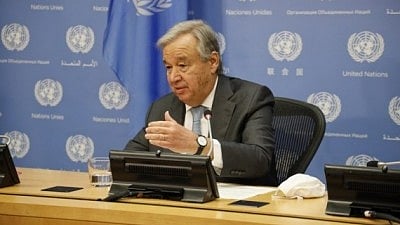
Amid growing hopes of a breakthrough in US-Iran diplomacy, United Nations secretary-general Antonio Guterres on Sunday strongly condemned Israeli airstrikes on Beirut, warning that the attacks risk undermining fragile efforts to bring peace to a region battered by months of conflict.
The strikes targeted Beirut despite an existing ceasefire and came at a critical juncture when Washington and Tehran are reportedly on the verge of finalising an agreement aimed at ending hostilities across the region.
"The strikes took place despite the ceasefire and at a time when the United States and Iran are expected to reach an agreement that will pave the way to a peaceful resolution of this conflict," Guterres said in a statement.
Describing the broader fallout of the war, the UN chief warned that the conflict was exacting a heavy toll far beyond the battlefield.
"This conflict is having a devastating impact on the world's economy," he said, urging all sides to step back from further escalation.
"I urge all parties to show maximum restraint at this crucial moment and I strongly hope for a successful outcome of the ongoing efforts by the United States and the Islamic Republic of Iran," Guterres added.
The Israeli military, however, indicated that tensions remain dangerously high. Following its strike on what it described as a Hezbollah command centre in Beirut's southern suburbs, the Israel Defense Forces (IDF) said it was preparing for possible retaliatory attacks within hours.
"The IDF remains on high alert and is prepared for both defensive and offensive scenarios," the military said after a security assessment led by chief of staff Eyal Zamir and senior commanders.
As a precautionary measure, Israel's Home Front Command imposed restrictions on public gatherings nationwide, limiting events to a maximum of 5,000 people. The move led to the cancellation of major stadium concerts scheduled in the Tel Aviv area on Sunday evening.
Iran responded with a fresh warning, signalling that any further Israeli military action would invite a significantly harsher response.
Tehran cautioned that any additional Israeli "aggression and malicious acts", including operations in southern Lebanon, would trigger a far more "severe and crushing" retaliation.
Iranian Parliament speaker Mohammad Bagher Ghalibaf also lashed out at both Israel and the United States following the Beirut strikes, arguing that the attack exposed Washington's inability to deliver on its commitments.
"Israel's new aggression against Beirut once again demonstrates that the United States lacks either the will or the ability to fulfil its commitments," Ghalibaf wrote on X.
"The bad cop and good cop game has become outdated. If you lack the will and ability to fulfill your commitments, speaking of continuing the path is not possible," he added.
The exchange of threats comes even as diplomatic momentum gathers pace around a proposed US-Iran agreement that could formally end months of conflict and reduce tensions across multiple fronts, including Lebanon. Yet Sunday's strike on Beirut underscored the fragility of the moment, with fears persisting that a single miscalculation could jeopardise the region's best chance for peace in months.
With IANS inputs
Join our official telegram channel (@nationalherald) and stay updated with the latest headlines