Nation
Since when is the acquisition of public land a ‘state secret?
Madhya Pradesh government’s allocation of coal block to Adani Group company comes under fire for forest land acquisition violations and ecological damage
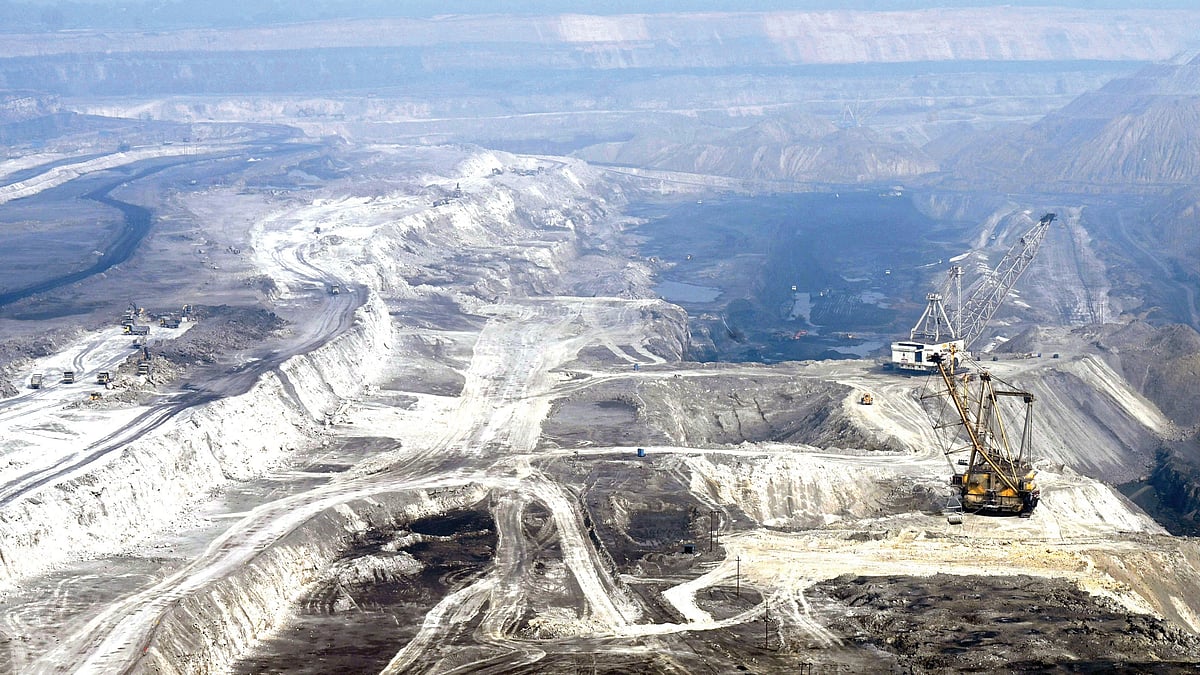
The Land Acquisition Act has been bypassed. Tribal communities, protected forests and elephant corridors have not been spared. Over 570,000 trees have already been cut down. These are just some of the things the Madhya Pradesh government would prefer to sweep under the carpet, even as concerns mount over its decision to hand over a vast coal block to Stratatech Mineral Resources Pvt Ltd, an Adani Group company.
At the heart of the controversy lies an alleged bypassing of the Land Acquisition Act, which mandates fair compensation, gram sabha consent and special rehabilitation provisions for Scheduled Tribes (ST) and Scheduled Castes (SC). Instead, the government invoked the Coal Bearing Areas (Acquisition and Development) Act of 1957—an outdated colonial-era law perceived as less protective of local rights. This manoeuvre allowed the government to circumvent critical safeguards for displaced communities.
The coal block, awarded in December 2020, spans 2,672 hectares, of which 54 per cent falls within reserved forests and elephant corridors, 25 per cent is government ‘revenue’ land and 21 per cent is privately held by 2,980 individuals. Nearly a third of the private owners come from ST and SC communities.
While the acquisition of private land was officially notified, acquisition of the remaining 79 per cent was kept a ‘state secret’ and never formally notified. Opposition leaders, notably Umang Singhar, have questioned this secrecy, emphasising that the Land Acquisition Act requires notification of all acquired lands as well as transparent rehabilitation plans.
Singhar, the leader of the opposition in the state and himself a tribal leader, highlighted that the state government’s failure to provide adequate resettlement and rehabilitation schemes for displaced tribal populations not only disregards due process, but also threatens the rights and livelihoods of thousands, deepening grievances among local communities.
These charges were first raised by the Opposition. On 10 December, a fact-finding committee comprising Congress leaders and workers visited the Dhirauli coal block, 70 km from Singrauli. The police stopped them from entering the forest, but Singhar managed to break through the cordon on his motorcycle and reach the spot where trees were being felled. Local media reported it; the state government ignored it.
The environmental stakes in this project are high. The Dhirauli coal block lies in a ‘very dense’ forest classified as being of ‘high conservation value’. Mature trees over 30 years old include species such as sal, teak, mahua, tendu, amla, harreda and baheda. These trees are deeply tied to the daily lives of communities like the Baiga tribe, who depend on them for food, medicine, livelihoods and cultural practices.
The forest is also the habitat of bears, hyenas, wolves, jackals, leopards and elephants. Critically, the area includes protected elephant and leopard corridors—natural pathways essential for the movement and survival of these wild animals. According to forest department rules, such lands cannot be diverted for mining unless no viable alternatives exist, and only after alternative corridors are established.
The Madhya Pradesh government has blithely permitted the largescale felling of over 570,000 trees in the first phase of the mining project. This massive deforestation will have drastic ecological consequences, disrupting wildlife habitats, threatening biodiversity and affecting the ecological balance in the region.
The Union government initially told Parliament that the coal block lay within a Fifth Schedule area, which carries constitutional protections for regions with significant tribal populations and distinct socio-cultural contexts. However, during the recent winter session of the Madhya Pradesh Assembly, the state government claimed the area does not fall under the Fifth Schedule. The Opposition alleges that the government deliberately removed the area’s protected status soon after the BJP’s 2023 victory. Such contradictory claims have intensified controversy over the legality and legitimacy of the mining project.
On 16 December, a day after Singhar and Madhya Pradesh Congress Committee president Jitu Patwari held a press conference in New Delhi, the Income Tax department raided the premises of a Congress leader (also a coal trader) in Chhatarpur. While Patwari alleged that more than a million trees were slated to be cut across roughly 4,000 hectares, the government is yet to place all facts in the public domain.
At the press conference, Singhar pointed out that the Adani Group had identified land for compulsory afforestation across four districts—Sagar, Raisen, Shivpuri and Agar Malwa. He said even the Union government had noted that some of this land fell within reserved forests and some within an existing elephant corridor. Why, asked Singhar, is the Group being allowed to conduct afforestation 300 to 700 km from the deforested area?
Patwari alleged that the state government is hiding facts from the people and at that at least 10 lakh trees will be felled for one coal mining project. Isn’t it time for the MP government to set the record straight?
Join our official telegram channel (@nationalherald) and stay updated with the latest headlines