Nation
Yogi’s missing Hindu voters claim sparks political turmoil in U.P.
Chief Minister's allegations put a question mark on BJP’s own defence of SIR, raises communal tensions and internal challenges in the party
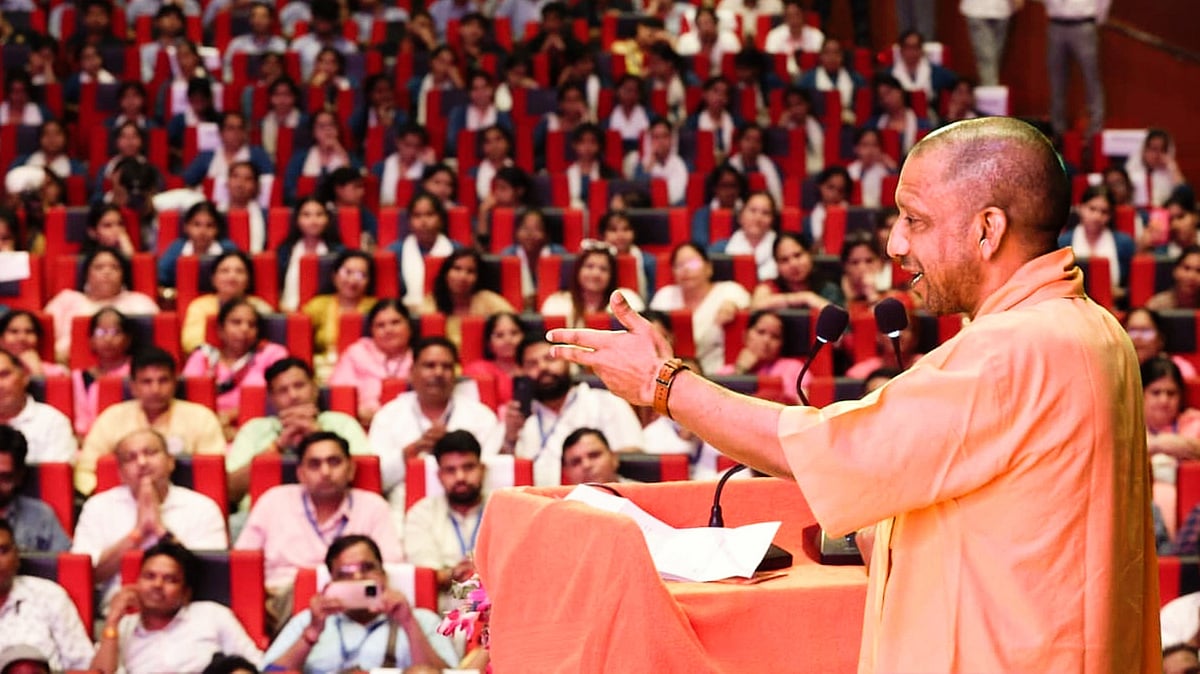
Uttar Pradesh Chief Minister Yogi Adityanath’s claim that 1.27 crore Hindu voters are missing from the state’s electoral rolls following the Special Intensive Revision (SIR) has triggered a fresh political controversy in the state ahead of the Assembly elections due next year. His assertion that the number of Muslim voters increased by 1.65 per cent after the exercise has drawn sharp reactions from opposition parties, which have accused him of giving a communal colour to an issue concerning the constitutional right to vote.
The controversy has also placed the Bharatiya Janata Party (BJP) in an uncomfortable position. While the party’s central leadership has consistently defended the Election Commission of India (ECI) and the SIR exercise against opposition allegations, the Chief Minister’s claim has raised questions about the credibility of the same revision process.
Adityanath, speaking at a Aaj Tak Panchayat programme, claimed that 1.27 crore Hindu voters whose names figured in Uttar Pradesh’s panchayat electoral rolls were missing from the Election Commission’s electoral rolls. He also cited 66 lakh voters whose names allegedly appeared in local electoral records, around 55 lakh Hindu beneficiaries of government welfare schemes and 4.5 lakh voters in the 18–19 age group.
The Chief Minister said the BJP had submitted a memorandum to the Election Commission seeking the inclusion of eligible voters whose names were missing. He questioned how such a large number of Hindu voters had disappeared from the rolls and who was responsible.
However, the breakdown cited by the Chief Minister has not been independently established through publicly available Election Commission data. The state’s electorate declined from approximately 15.44 crore before the SIR exercise to around 13.39 crore in the final rolls published on 10 April 2026, a net reduction of nearly 2.05 crore electors. The scale of the reduction has become a major political issue, but the overall figures do not, by themselves, establish the religion of those whose names are missing.
The Samajwadi Party (SP), the principal opposition party in the state, has questioned the basis of Adityanath’s figures, describing his allegations as confusing and unsupported by verifiable evidence.
The Samajwadi Party (SP), the principal opposition party in the state, has questioned the basis of Adityanath’s figures, describing his allegations as confusing and unsupported by verifiable evidence.
SP leader Udaiveer Singh said that if the Chief Minister believed there were serious discrepancies in the electoral rolls, he should hold the officials responsible rather than merely making public statements.
He questioned whether the SIR exercise had been conducted by state government employees and asked why the Chief Minister was not taking action against those responsible for alleged negligence in preparing the electoral rolls.
“If Yogi also feels that there are discrepancies in the electoral roll, he should join the INDIA bloc’s protest against the Election Commission and support the impeachment of CEC Gyanesh Kumar,” Singh said.
He argued that the Chief Minister’s allegations strengthened the opposition’s contention that the revision process had suffered from large-scale discrepancies. Singh also challenged Adityanath to explain the source and methodology behind his figures.
The Uttar Pradesh Congress has accused the Chief Minister of attempting to divide voters along religious lines. Congress leader Anshu Awasthi said the issue should not be viewed through the Hindu-Muslim prism, as the right to vote was guaranteed to every eligible Indian citizen irrespective of religion.
“This is not a question of whose names have been deleted from the electoral rolls, whether Hindus or Muslims. The real question is whether the name of any Indian citizen has been removed. The Constitution guarantees every eligible citizen the right to vote,” Awasthi said.
“The Chief Minister is giving it a communal colour to whitewash vote theft,” he added.
Awasthi further challenged Yogi to disclose the caste composition of the voters allegedly missing from the rolls. “If the Chief Minister has the data, he should also reveal the caste of the voters whose names have been deleted. Surely, Dalits and Brahmins would also be among them if his claim is correct,” he said.
The Congress leader maintained that the Chief Minister had not presented verifiable evidence to support his assertion, unlike the opposition, which had cited specific instances of alleged discrepancies, including those in Pilibhit.
Political observers believe the controversy also needs to be viewed against the BJP’s declining electoral performance in Uttar Pradesh since 2019 and the political uncertainty within the party ahead of the next Assembly election.
Senior political commentator Siddharth Kalhans said the BJP’s electoral graph in the state had been consistently declining since the 2019 Lok Sabha elections, and the party had failed to regain its earlier momentum.
“BJP’s electoral performance has been consistently declining in Uttar Pradesh since the 2019 general election. If this trend continues in the upcoming Assembly elections, the party’s top leadership could hold Yogi responsible for the debacle,” Kalhans said.
The electoral figures underline the change. In the 2014 Lok Sabha elections, before Yogi Adityanath became chief minister, the BJP won 71 of Uttar Pradesh’s 80 parliamentary seats. In the 2017 Assembly elections, it secured 312 of the 403 seats, forming a government with a commanding majority. Adityanath assumed office in March 2017.
The BJP’s Lok Sabha tally subsequently fell to 62 seats in 2019 and 33 in 2024. Although the party retained power in the 2022 Assembly elections, its strength declined from 312 seats in 2017 to 255. The figures have fuelled questions about the party’s ability to reproduce its earlier electoral dominance in the country’s most politically significant state.
Kalhans believes Adityanath’s latest remarks may also be connected to his political positioning within the BJP.
“Yogi has been signalling to his close associates since the 2024 defeat that the BJP’s top leadership does not want his political elevation. By claiming that a large number of Hindu voters are missing from the electoral rolls, he may be attempting to establish a position from which he can defend himself if the party performs poorly in the next Assembly elections,” he said.
He added that the chief minister appeared apprehensive about internal factionalism and his differences with the party’s central leadership, which could affect his political future.
Meanwhile, Mirzapur-based communist leader Mohammad Salim described the Chief Minister’s claim as politically motivated and demanded constituency-wise evidence.
“Yogi Adityanath should produce the data on missing Hindu voters, assembly constituency-wise. Without such evidence, his statement can only be seen as an attempt at communal polarisation, which has been his style of politics,” Salim said.
He argued that the claim could be an attempt to counter the opposition’s narrative that minorities and other vulnerable sections had been disproportionately affected by the revision exercise.
Salim added that opposition parties had cited specific instances when raising allegations of missing names or other discrepancies, whereas the CM’s assertion had yet to be backed by publicly verifiable, constituency-level figures.
The BJP, meanwhile, has maintained that Yogi’s concerns should be taken seriously. Party spokesperson Rakesh Tripathi said the party’s future course of action on the alleged discrepancies would be decided by its election management cell.
Join our official telegram channel (@nationalherald) and stay updated with the latest headlines