Opinion
A weaker West Asia suits the US and Israel
Is the illegal war on Iran really meant to divide and weaken the Muslim world?
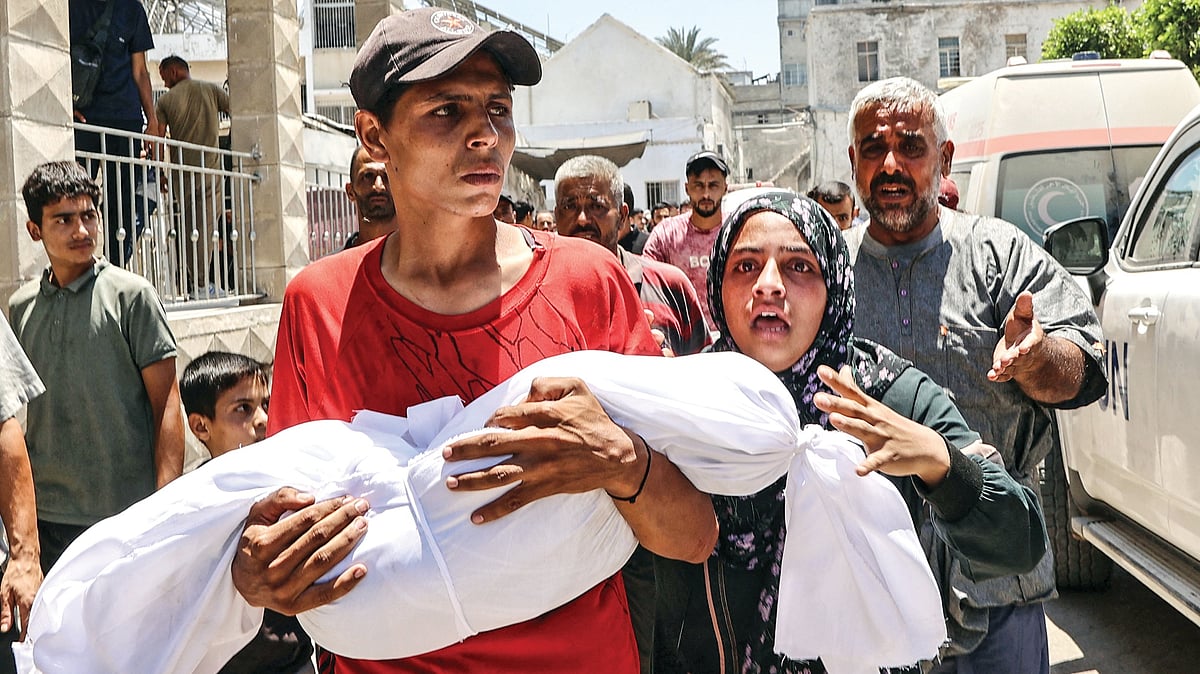
As the US-Israeli war on Iran enters the second month with its ultimate aim still shrouded in confusion, there’s much speculation whether it is part of a broader agenda to further divide and weaken the Muslim world. Though the war has set the globe a-jitter, its biggest collateral casualties have been Muslim countries.
Whatever the final outcome of this illegal war, one thing is blindingly obvious: a region already riven by rivalries, personality clashes and ideological differences is likely to emerge as an even more fractious and weakened bloc. Dragged into an unprovoked conflict launched on a whim, it faces a long period of internal strife, as well as economic and political uncertainty.
Fuelled by war rhetoric and its fallout, the Sunni-Shia divide on the one hand and intra-Arab irritants on the other will deepen. And this, some argue, is exactly what America and Israel want: a Muslim street more vulnerable to manipulation.
An immediate consequence will be the future of Palestinians — already forgotten by the world. Their dream of an independent Palestinian state — or whatever remained of it after Israel’s ruthless and disproportionate response to Hamas’s strike on 7 October 2023 — looks practically dead, a victim of the larger post-war geopolitical shift in West Asia. With Iran, their most vocal champion through Hamas and other proxies, on the backfoot, Palestinians are left with few friends.
The truth is that most Muslim countries never really cared much for Palestine. Their only interest in seeking a resolution of the ‘Palestinian problem’ has been to get rid of an estimated seven million displaced Palestinians living in Arab countries, seen as a huge drain on public services and a source of social tensions. Post-war realities will only further distract attention from the issue and increase Palestinian isolation.
This vacuum will allow Israel to have a free hand in its aggressive campaign of annexing the West Bank while simultaneously frustrating efforts to facilitate the return of the nearly two million displaced Palestinians who were forced to flee their homes over the past three years.
Nearly 55 per cent of Gaza remains under Israeli military control. Israel is in no mood to give Gaza up, nor does it face any pressure to do so either from the US or the international community.
Israel under Benjamin Netanyahu has never made any secret of its opposition to a two-state solution. He has publicly vowed not to allow an independent Palestinian state to become a reality. “There will not be a Palestinian state. It’s very simple: it will not be established,” he said in an interview with Abu Ali Express, a popular local Telegram channel, a few months ago.
Asked by the interviewer if his opposition holds even if it jeopardises normalisation with Riyadh — which insists on a credible plan for Palestinian statehood in exchange for such ties — Netanyahu said: “The answer is: a Palestinian state will not be established. It is an existential threat to Israel.”
A view echoed by his cabinet colleagues. Finance minister Bezalel Smotrich, for instance, who sparked a controversy in January when he declared that his government’s purpose in tightening its grip on West Bank is “to kill” the idea of a Palestinian state.
Israel fiercely resisted a United Nations Security Council (UNSC) resolution on the next phase of Trump’s Gaza ‘peace plan’ as a ‘credible pathway’ to Palestinian statehood. It has also long opposed the 2016 UNSC resolution declaring that Israeli settlements in the West Bank have ‘no legal validity’ and are in ‘flagrant violation’ of international law.
According to experts, there has been an alarming rise in the Israeli government’s authorisation of settlement expansions and infrastructure facilities, including building roads that will cut the West Bank in half. Previous US administrations tried to rein in Israel when its actions appeared to fall foul of international law, but that has changed under Trump.
Prominent British military historian and West Asia expert Max Hastings says that Trump has ‘empowered the Israeli leader [Netanyahu] to forge a Greater Israel’ by allowing him to fast-track his programme of the relentless annexation of Palestinian land for Jewish settlements. In an article in the Sunday Times, Hastings illustrates how ‘Jewish settler attacks on Palestinians’ are almost ‘never punished’.
He narrates the story of 14-year-old Palestinian Jad Jadallah, who allegedly threw a rock at Israeli troops, and was shot. The incident took place in a refugee camp last November. ‘Thereafter,’ Hastings writes, ‘a video shows soldiers standing around him, refusing access to ambulances, until he bleeds to death. To this day, for reasons that are unclear, the Israelis refuse to release Jad’s body’.
According to the UN, at least 40 Palestinian children were killed by Israeli forces in occupied West Bank in 2025. That’s one-fifth of all Palestinians killed in the territory over the same period.
The Palestinian Authority, at the best of times an impotent and corrupt body, has become a bit of a joke. It operates under Israeli military control and its president, Mahmoud Abbas, is widely despised by his own people, who see him as the western powers’ ‘useful idiot’.
With the Gaza Strip in ruins and its population facing one of the worst humanitarian crises in recent times, and with the West Bank reduced to a zombie zone, the dream of an independent Palestine couldn’t be farther from becoming a reality.
Palestinian expats, forced to flee their country after previous wars, expect more of their countrymen and women to leave and start a new life abroad. Old Palestine is history. And so is old Iran with its pan-Arab clout and its network of proxies drastically reduced. For all its resilience — which has taken America by surprise — Iran has suffered some heavy knocks which it will take years to recover from. Not to mention the diplomatic cost it may have to pay for annoying its neighbours, which it has targeted to punish Washington.
It will be more isolated — not only in the region but most likely domestically too — with anti-regime tendencies likely to feel more emboldened.
Sanam Vakil, head of the West Asia project at the London-based Royal Institute of International Affairs, has said that while the Iranian regime will survive this war in one form or another, “it’s the internal situation in Iran that will be unviable... They’re effectively screwed.”
The same can be said about its Arab and Gulf neighbours who have been thrown under the bus by Trump.
Join our official telegram channel (@nationalherald) and stay updated with the latest headlines