Opinion
Jamuna Tudu’s fight against the forest mafia
Women continue to be at the forefront of the movement to save forests. Recognition and awards are fine but they need far more substantial support in their crusade
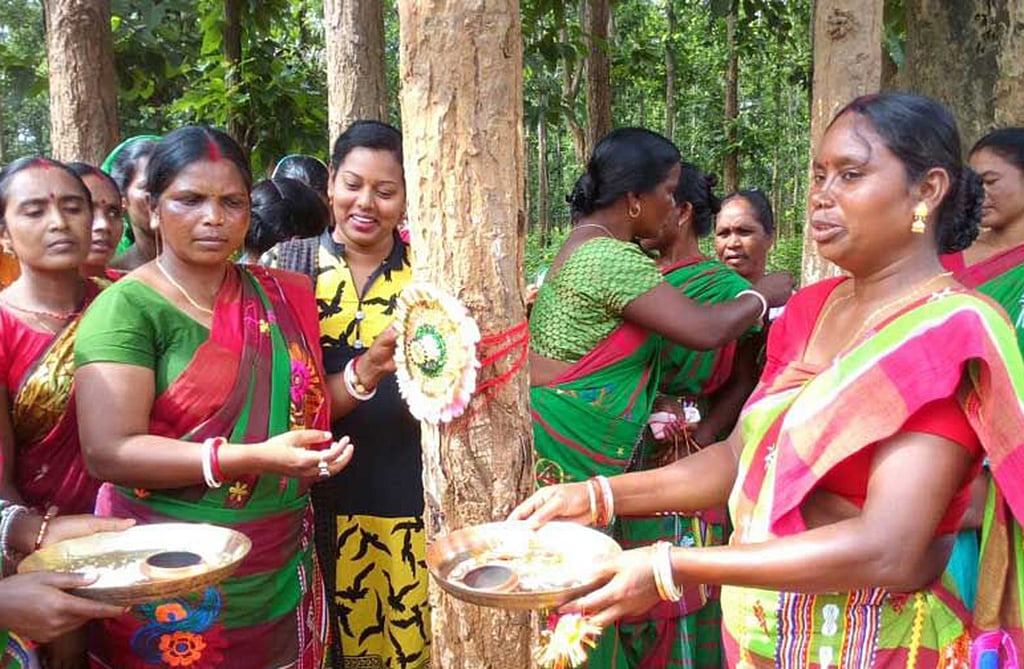
In an exceptional showcase of vigour, armed with just water bottles and sticks, a group of tribal women in Muturkham village of Purbi Singhbhum district of Jharkhand trekked miles to the Sal forest and successfully fended off the forest mafia.
Accompanied by just a dog for their safety, these women made frequent forays into the deep forest – with which they shared a symbiotic relationship – and have been able, over the years, to successfully conserve 50 hectares of forest land in the heart of a territory that has also been a battle zone between government forces and left-wing extremists.
The women were brought together by Jamuna Tudu, 37, who has spent the last two decades fighting against deforestation. It was in 1998, after her marriage, that Jamuna took up this challenge.
“A few days after my marriage, when my mother-in-law, sister-in-law and a few other women from the village took me to the forest to cut wood, I felt that this way, all our forests would soon be wiped out,” Jamuna recalled.
Today, her Van Suraksha Samiti (Forest Protection Group) has about 60 active women members who patrol the jungle in shifts thrice a day: morning, noon and evening. And sometimes even at night, as the mafia set fire to the forests in random acts of vandalism and vengeance.
Realising that she would get little help from authorities, who may well have been hand in glove with the mafia, she took matters in her own hands. The women initially resisted the idea and pointed out that they would have to fight the men in the village.
But Jamuna, who has studied up to Class X, foresaw a bleak green-less future for herself and her community with no trees and forests to sustain or protect them and vowed to lead the charge.
“I was brought up to love and respect Nature. My father used to plant numerous trees in our farms in Odisha. That’s where I learnt the importance of the environment,” she says.
Pointing out how the mafia was exploiting the wood to fund their alcohol needs, she said she was bewildered by the passive response of the community at their habitat being slowly destroyed.
Gradually, she mobilised a group of 25 women from the village and armed them with bows and arrows, bamboo sticks and spears, they marched into the forest to take on the intruders.
With time, many men also became part of the campaign.
“There were too many altercations with the village people initially, many scuffles with the mafia... and I told those women that in this journey, we would come across both good and bad times, but we have to struggle to keep the forest,” Jamuna recalled.
The group convinced the railway authorities to bar the plundered wood from being exported but were attacked on their way back. “Some time in 2008-09, we were brutally attacked by the mafia. They pelted stones at us while we were coming back from the railway station after speaking to the station master. Everybody got injured,” she recollected.
For obvious reasons, Jamuna was their main target and she and her husband suffered the most in the assault. “My husband got hit on his head as he tried to save me. It was dark and we somehow managed to escape narrowly.
Over 15 years and in the wake of several fierce encounters with the mafia, Van Suraksha Samiti has succeeded in protecting and conserving the 50 hectares of forest land surrounding their village and in the surrounding areas.
Tribal communities cannot survive without wood. They need it for various things — mostly to cook food. But they ensure that their requirements remain within sustainable limits and the community
“We don’t cut trees on purpose anymore and use the fallen trees and branches for all our needs,” Jamuna said. “The amount we are able to save up during the rains is sufficient for the whole year.”
The Forest Department has “adopted” her village, which has led to Muturkham getting a water connection and a school.
Jamuna’s fight has not gone unnoticed. The President of India has honoured her conservation efforts.
In 2013, Jamuna was conferred with the Godfrey Phillips Bravery Award in the ‘Acts of Social Courage’ category and this year in August, she was awarded with Women Transforming India Award by the NITI Aayog.
Today, she runs awareness campaigns through various forest committees in Kolhan Division. Around 150 committees formed by Jamuna, comprising more than 6,000 members, have joined her movement to save the forests.
She wants to do a lot more. “I wish to do a lot... to make a lot more difference, but I am bound by limited resources. I can’t in many ways afford to go beyond the villages in my state.”
But if I get more support, many more forests like ours can be saved, she declared.
Published: undefined
Follow us on: Facebook, Twitter, Google News, Instagram, WhatsApp
Join our official telegram channel (@nationalherald) and stay updated with the latest headlines
Published: undefined