Opinion
The return of the runaway leader
Faisal Mahmud tries to make sense of Sheikh Hasina’s announcement to voluntarily return to Bangladesh
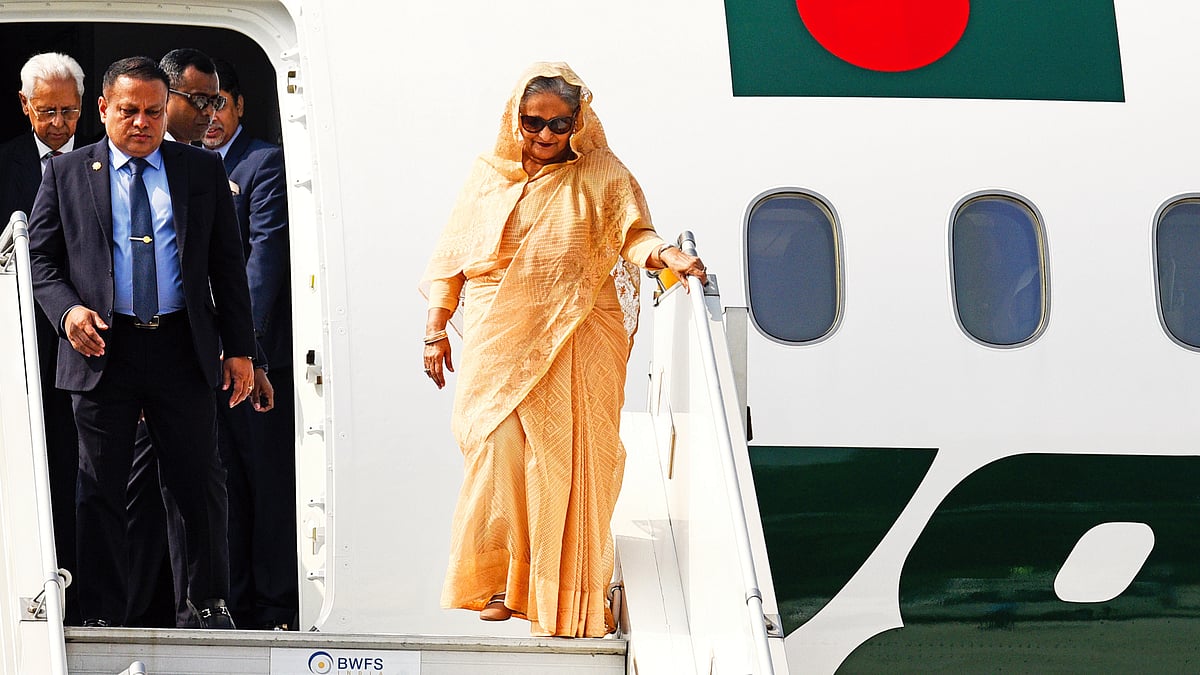
The sudden announcement by Sheikh Hasina, living in exile in India since August 2024, that she plans to return to Bangladesh by the end of the year was startling but not really a surprise. For nearly two years after fleeing Bangladesh in the face of a student uprising, she was still combative and tried hard to keep her banned Awami League party afloat. She spoke of returning and contesting elections again, but even her supporters knew that at the age of 78, chances of a political comeback were slim.
In her interview to Reuters, the ousted former prime minister acknowledged that she could be arrested, executed or even assassinated upon her return. Yet she insisted that she had no alternative. She explained that she wanted to die on the soil where her “parents were buried” and where their blood was shed.
The International Crimes Tribunal sentenced her to death in November 2025 for crimes against humanity linked to the deadly suppression of protests. Multiple murder and corruption cases followed. Dhaka repeatedly sent extradition requests to India, while New Delhi carefully avoided making any public commitment.
The Bangladesh government has welcomed the announcement. It has also warned that she will be arrested on arrival and sent to prison to stand trial. A government spokesperson suggested darkly that the former prime minister “should bring with her the world’s best lawyers” to argue her case.
India has officially said the request for extradition was being examined legally and that India’s approach has not changed. India has not formally granted Sheikh Hasina political asylum. Since her ouster in August 2024, she has been living in India under what officials describe as a ‘special guest’ arrangement, but her exact legal status remains deliberately undefined.
The announcement by the former prime minister in exile reveals how dramatically her political options have narrowed. For the first time since she escaped to India following the uprising, exile no longer appears sustainable. Mounting legal pressure from Dhaka, India’s delicate diplomatic dance, the collapse of her party structure and eroding support base have left her very little room for manoeuvre. The question is no longer whether Sheikh Hasina wants to return but whether circumstances are forcing her hand.
Hasina has even announced a tentative timetable, declaring that she intends to surrender voluntarily and said senior party leaders, including former home minister Asaduzzaman Khan Kamal, who was also sentenced to death, would accompany her. It’s hard to dismiss such a coordinated declaration as just political theatre.
India has consistently refused to reveal whether it intends to honour extradition requests. Responding to questions about her comments, external affairs ministry officials said there was no change in their position, that extradition was ‘a legal issue that would be handled accordingly’.
Diplomatic language often reveals as much through omission as declaration. New Delhi has avoided rejecting Dhaka’s requests outright. Equally notable is what it has not done: despite hosting her since August 2024, India has never publicly granted her political asylum. This is a crucial distinction. Asylum would amount to a commitment to shield her indefinitely.
Instead, she remains a sensitive guest whose presence complicates India’s effort to rebuild ties with the new administration in Bangladesh. India sent a big delegation to Prime Minister Tarique Rahman’s inauguration. The Bangladesh foreign minister later travelled to New Delhi in the most significant bilateral engagement since the change of government. Both countries have quietly resumed discussions on trade, connectivity and regional security.
Against that backdrop, indefinitely sheltering the most polarising figure in contemporary Bangladeshi politics is getting increasingly difficult.
****
For India, the dilemma is profound. For over 15 years, New Delhi invested heavily in Hasina’s administration. Her government became India’s closest strategic partner in South Asia, delivering unprecedented security cooperation against northeastern insurgents while expanding economic integration and regional connectivity. Abandoning that ally entirely risks damaging India’s credibility among partners across the region.
Yet continuing to protect a former leader sentenced to death for crimes against hu- manity also carries mounting diplomatic costs. The UN estimated that 1,400 people were killed during the crackdown on protesters that culminated in the collapse of her government. Although she rejects those findings, the scale of the allegations makes her a diplomatic liability.
Every extradition request from Dhaka increases that pressure. Every improvement in bilateral relations narrows New Delhi’s room for procrastination. This does not mean that India is already preparing to extradite her. The legal process is complex. Indian courts could weigh the possibility that she will receive a fair trial. But India will find its ambiguity hard to defend.
Few countries today would willingly accept a deposed leader facing multiple criminal convictions and repeated extradition requests. Western democracies are highly unlikely to invite diplomatic confrontation over someone accused of presiding over mass murder. Even Gulf monarchies have shown little appetite for hosting controversial exiled leaders.
Russia is a theoretical possibility but will likely baulk given Moscow’s desire to preserve relations with Bangladesh, particularly as big commercial projects approach completion.
Zahed Ur Rahman, information advisor to the Bangladesh prime minister, said they were trying to bring back Hasina and would welcome her. He rejected suggestions that her return could destabilise the country, insisting she no longer had a political future. The tribunal proceedings, he said, would be transparent and open to international observation. That confidence reflects how the political landscape of Bangladesh has changed since the uprising.
Before her fall, the Awami League appeared inseparable from the state. Two decades in power had allowed Hasina to centralise all key decisions. Institutions revolved around her personal authority. Her sudden departure exposed the consequences of that concentration. Many senior leaders fled the country. Others remain underground.
Hasina’s admission that practically all party workers would face legal proceedings and her proposed collective surrender could be an attempt to project solidarity and lift organisational morale after two years of continuous decline. Returning voluntarily rather than being extradited might help her retain political agency.
She’ll try to portray her surrender as a principled stand against political persecution rather than forced expulsion. But returning also means immediate arrest and imprisonment followed by criminal proceedings. The student deaths are still an open wound and public anger can easily become a security challenge. Yet, for Sheikh Hasina, her escape to India is now a dead end.
Join our official telegram channel (@nationalherald) and stay updated with the latest headlines