Opinion
Time to shed historical baggage
While no party in Bangladesh can afford to be seen as pro-India, the two countries cannot afford to remain adversaries, writes Jawhar Sircar
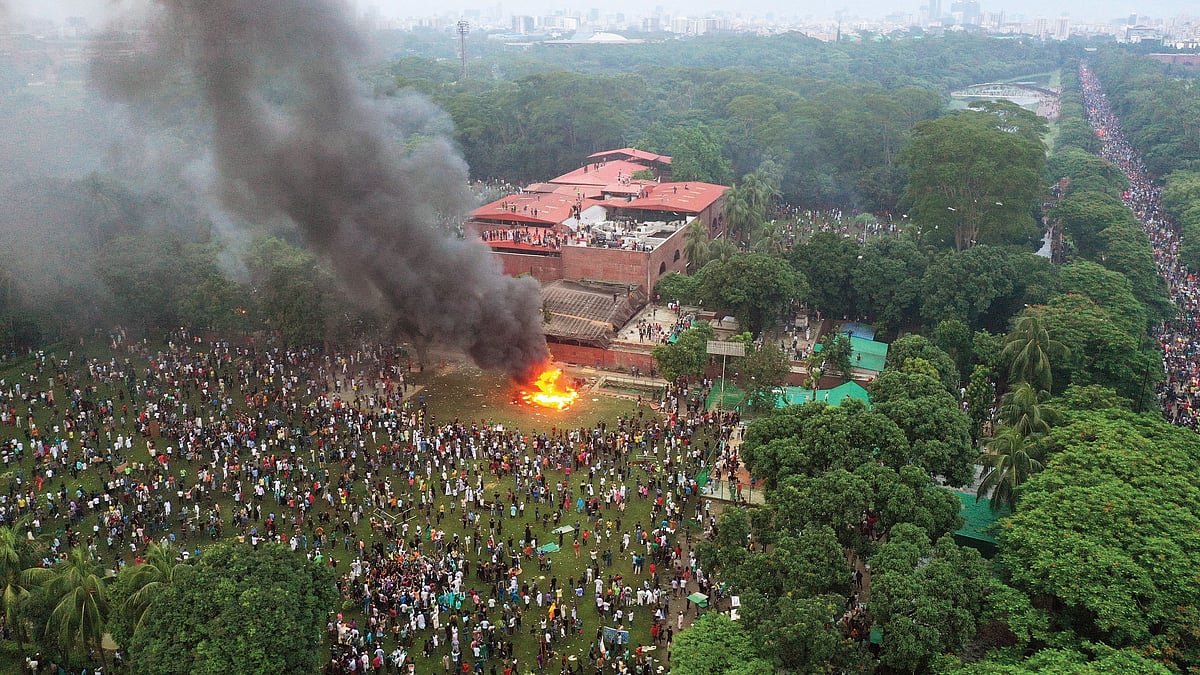
Sheikh Hasina’s downfall on 5 August 2024 was a chronicle foretold by all, except New Delhi’s ‘state operators’ who continued with their domineering agenda. A hastily put together interim government under Muhammad Yunus as ‘Chief Advisor’ worsened matters and a ‘reign of terror’ followed in Bangladesh.
As many as 400 police stations were torched. AI-assisted search results indicate ‘over 600 deaths from mob lynching, 250 from retributive violence and 40 extrajudicial killings since August 2024’. While there were a few Hindus among them, the overwhelming majority of victims were Muslims and Awami League supporters.
Patient diplomacy in this period could have paid India better dividends than outrage. India’s self-righteous wrath conveniently overlooked the fact that minority-bashing is an encouraged national pastime: in the last decade, more than 100 Muslims have been lynched in India (with 25 Muslims killed by mob violence in 2025 alone). The anti-Bangla fury that swept India was led by a largely tutored media.
The ruling Hindu Right’s irresponsibility was evident on social media, where hate was whipped up not only against Bangladesh and Bangladeshi Muslims, but also against Bangla-speaking citizens long domiciled in India. In Bangladesh, the death of popular student leader Sharif Osman Hadi on 18 December 2025 (six days after he was shot by two bike-borne assailants) reignited a fresh wave of anti-India sentiment.
The voters of Bangladesh have not yet shown their hand, and India has not yet officially ‘lost’ its only friend in the neighbourhood
It is a fact that the violence of 1947 triggered the exodus of Hindus from Bangladesh to India (Bangladeshi Hindus went down from 28 per cent to just 8 per cent of the population). It is also a fact that many Hindus (and Bengali Muslims) migrated seeking better economic opportunities.
Many Bangladeshi Muslims harbour a legitimate historical grievance against the Bengali Hindu bhadralok who, during two centuries of British rule, benefited disproportionately from the exploitative zamindari system and monopolised government jobs.
Many Indians grumble that Bangladeshis are not eternally grateful to India for their independence. It is worth remembering the sacrifices that Bangladeshis themselves made. There is no such thing as eternal gratitude in international relations. Vietnam, for instance, is now downright hostile to China, the country that was its staunchest ally in resisting America’s long drawn war.
The dice rolls on as do successive generations. Rescuer–victim persecutor role-playing ends up perpetuating cycles of blame rather than resolving underlying problems. Toxic elements on both sides of the border need their regular ‘fix’ to remain high on hate—India must refrain from reacting to every provocation. Any further missteps may exact a deadly, long-term price.
India made its first big mistake in January 1972 by foisting (an absentee) Mujibur Rahman on Dhaka, antagonising the likes of Zia-ur Rahman, who had actually fought Pakistan on the ground. The Mukti Bahini was excluded from witnessing the Pakistan army’s surrender to the Indian army in Dhaka on 16 December 1971.
This slight continues to rankle. India indulged Mujib’s authoritarian, allegedly corrupt rule, even as floods and a manmade famine ravaged Bangladesh in 1974–75. While official estimates place the death toll at around 27,000, independent studies suggest it may have been as high as 1.5 million. Indians ignorant of this reality are naturally shocked by the desecration of Mujib’s statues and memorials by incensed Bangladeshis, who hate India for Mujib’s failings.
Modi’s India also looked away when Sheikh Hasina repeated the pattern as prime minister between 2009 and 2025. The last three elections were rigged, but observers sent by India’s Election Commission turned in glowing reports of free and fair polls each time.
What hurt Bangladeshis even more was Sheikh Hasina’s kowtowing to a person despised by Muslims and the free world. They were aghast when she bent backwards in 2015 to enable India’s chief crony capitalist Gautam Adani secure a $1.7 billion deal to export power from his Godda coal plant.
Reports revealed that the Indian prime minister and his handpicked foreign minister engineered a heavily skewed Power Purchase Agreement, forcing Bangladesh to pay Adani $4.55 billion annually, regardless of whether any electricity is supplied. As an MP, I raised the issue of Adani’s excessive profiteering with our foreign minister. He prevaricated, until public agitations forced Adani to lower his prices.
Noted Bangladeshi economist Debapriya Bhattacharya estimates that Hasina’s regime siphoned $16 billion out of the country—every year. The number of dissenters (and criminals) who were tortured and liquidated by Hasina’s corrupt police is yet to be fully accounted for.
Modi’s India, however, ensured that Hasina continued in power. Rage against her excesses spilled over as vitriol against India for propping her up. The Islamic Right took full advantage of Hasina’s ouster. Many Bangladeshis saw Islam as a way to settle old scores with India and mark their opposition to India’s Hindu Right and state sponsored Muslim-baiting.
The voters of Bangladesh have not yet shown their hand, and India has not yet ‘lost’ its only friend in the neighbourhood. India must dial down its fixation on Sheikh Hasina. The Awami League—currently banned in Bangladesh—still commands a large chunk of the secular vote, and a word from Hasina will matter a lot to them. She must rise above party politics and demonstrate statesmanship.
At the moment, the only historically organised party with a nationwide network is the Bangladesh Nationalist Party (BNP), Awami’s bête noire. Founded by Zia-ur Rahman, who brought in key welfare measures, the BNP was led by his wife Begum Khaleda Zia after his assassination in 1981. She served twice as prime minister. Her death on 31 December 2025 has generated a massive sympathy wave for her son and heir, Tarique Rahman, who returned to Bangladesh after 17 years of exile in London, just six days before her passing.
Tarique has since taken over the reins of the BNP. The rise of the Jamaat-e-Islami—a die hard anti-India, anti-Hindu, pro-Pakistani rightist party that betrayed Bangladesh’s Mukti Yuddha and committed atrocities against freedom-fighters and women—has been dramatic. It has helped the BNP in the past, but never held power.
Flush with international funding, the Jamaat has declared that its moment has come. The National Citizen Party (NCP), formed by former student activists with Yunus’ blessings, lacks grassroots support. Its electoral alliance with Jamaat angered many young leaders, especially women, who resigned. The BNP or any other party’s anti-India stance is not the main concern—we’ve earned it.
What matters is the outcome of the February elections. The BNP, with its strong grassroots network and capable leaders, is likely to ride a sympathy vote. BNP has been no friend of India either, but Tarique Rahman may be the only leader capable of salvaging Bangladesh’s troubled polity. While no party in Bangladesh can afford to be seen as pro-India, the two countries cannot afford to remain adversaries.
JAWHAR SIRCAR is a former bureaucrat and Rajya Sabha MP
Join our official telegram channel (@nationalherald) and stay updated with the latest headlines