Opinion
The importance of being Garga Chatterjee
Attempts to discredit the Bangla Pokkho founder appear to be amplifying his appeal among sections of Bengali society
Within a week of taking over West Bengal’s administration, the new BJP government has unleashed a spate of high-profile arrests. On 11 May, the Enforcement Directorate (ED), powered by the state’s 'double-engine sarkar', arrested former West Bengal minister and Trinamool Congress (TMC) leader Sujit Bose.
Bose was arrested for his alleged involvement in a municipal recruitment scam where he, as vice-chairman of South Dum Dum Municipality, recommended nearly 150 candidates for various positions in exchange for financial benefits. The ED has alleged that "proceeds of crime" were laundered through Bose’s business ventures, including a restaurant and a dhaba, and is investigating charges of money laundering under the Prevention of Money Laundering Act (PMLA). A four-time MLA, Bose recently lost his Bidhannagar Assembly seat to the BJP's Sharadwat Mukherjee.
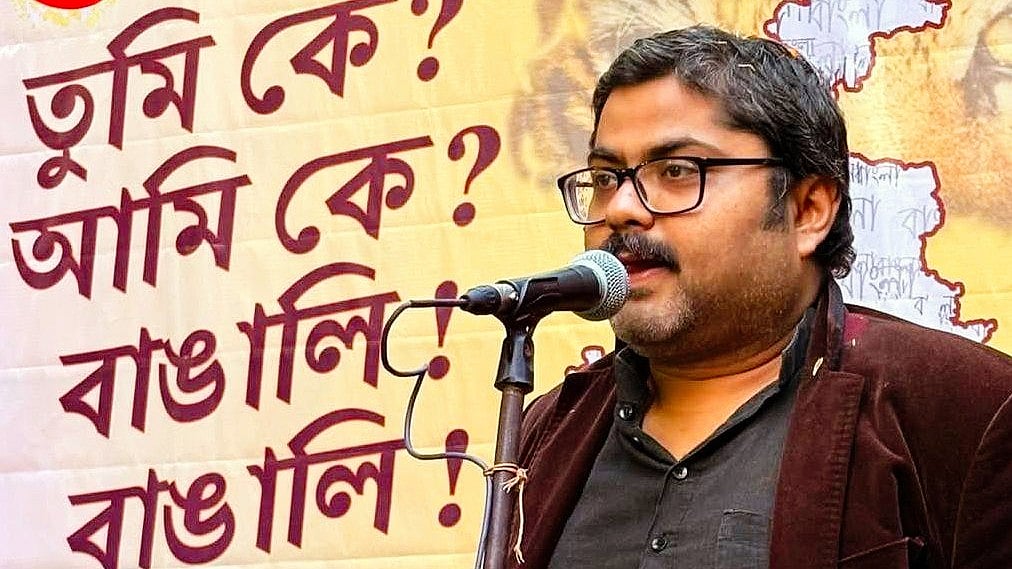
The second high-profile arrest was that of Garga Chatterjee on 12 May by Kolkata Police's cyber cell. Chatterjee is the founder of the ethno-linguistic organisation Bangla Pokkho, and authorities alleged he made provocative social media posts questioning the integrity of electronic voting machines (EVMs) and the counting process, leading to complaints by the district election officer of Kolkata North and the Election Commission of India. The police arrested him after he reportedly failed to appear in response to two previous summons.
Social media went berserk over the arrest. The prevailing narrative was that Chatterjee had been arrested with 20 rounds of ammunition, something Kolkata Police commissioner Ajay Nand later denied and clarified. According to Nand, no ammunition was found on Chatterjee, and itm was the personal security officer from Baruipur Police assigned to his security who was in possession of the ammunition. By the time the clarification came, Chatterjee’s emergence in the social media narrative as a villain was complete.
This was not Chatterjee's first brush with the law. In August 2022, Kolkata Police arrested him following a directive from Gauhati High Court, in a case related to certain remarks Chatterjee had made on social media in 2020 concerning the founder of Assam’s Ahom dynasty, which were deemed offensive to the Assamese community. He was later released on transit bail.
There are fundamental differences in the way the two arrests are playing out in a state that is in the process of coming to grips with its new political landscape and power equations.
Bose’s arrest — he being the quintessential politician with his usual band of supporters and detractors — has not triggered much indignation. He is regarded as a leader who has made his fortune by means fair or foul and has also done some work, as expected, in his constituency.
His opulent Durga Pujas and other seasonal festivals, attended by millions, have long been the talk of the town, while also setting tongues wagging over the source of such opulence. His beaming photographs alongside soccer legends like Diego Maradona and Lionel Messi projected his larger-than-life image, while simultaneously raising serious questions about his alleged backroom manoeuvres.
He is one of several TMC heavyweights being investigated on various charges. The question of political vendetta versus the administrative uprightness of the new government is part of this familiar narrative.
This is where Chatterjee’s arrest differs from Bose’s. Chatterjee comes with a background that Bengalis regard as premium. Apart from founding his pro-Bengali advocacy organisation, Chatterjee comes with an elite academic pedigree.
He earned his MBBS from Kolkata Medical College before shifting his focus to cognitive science. He holds a PhD from Harvard University in the Cognition, Brain and Behaviour programme, where his research specialised in visual perception and face cognition. He furthered his academic career with postdoctoral research at Massachusetts Institute of Technology, and has served as a faculty member in the Psychology Research Unit at the Indian Statistical Institute in Kolkata.
In 2018, Chatterjee founded Bangla Pokkho and began campaigning for the use of Bengali in administration, banking and signage within West Bengal. He advocated 90 per cent reservation for 'sons of the soil' in state government jobs and the private sector. He was a vocal critic of what he terms 'Hindi imposition' and frequently campaigned against the influence of the BJP, which he characterises as a party of 'outsiders'.
The core of Chatterjee’s movement is the allegation that Central government employees, including those in the armed forces stationed in West Bengal, are predominantly staffed by individuals from other states who do not understand local culture or language. He labelled the SSC-GD (Staff Selection Commission-General Duty) examinations as a tool for Hindi imposition and demanded that all recruitment examinations for Central forces be conducted in Bengali as well as English and Hindi.
Chatterjee eventually went a step further, organising and leading protests at recruitment centres, claiming that candidates from other states use fraudulent domicile certificates to steal seats meant for Bengal's youth. While his advocacy contributed to the Union government's 2023 decision to allow CAPF exams in regional languages including Bengali, Chatterjee continued to protest, arguing that the implementation was flawed and biased.
Which is why the two arrests differ in their inherent messaging. While Bose’s arrest is about corruption, the evolving social media narrative around Chatterjee’s arrest is shaping up as a projection of power by a parochial state against the activism of a brilliant academic.
Indeed, it is interesting to watch how Chatterjee’s arrest is playing out on social media — protests against the arrest itself often accompanied by a disclaimer. 'While I do not agree with his methods, I condemn his arrest' is the prevailing refrain.
Condemnation with a disclaimer indicates that it is becoming difficult for fence-sitters, who would otherwise prefer to keep Bangla Pokkho and Chatterjee at arm’s length, to remain aloof. It is resurrecting memories of Jadavpur University professor Ambikesh Mahapatra, who was thrown into jail by Mamata Banerjee’s TMC government in April 2012 for forwarding a cartoon on email.
For Chatterjee’s supporters, the arrest is an attempt to silence his aggressive 'Bengal for Bengalis' message. For now, silencing the message by undermining the messenger does not seem to be working, as Chatterjee emerges as a freshly minted martyr.
Sourabh Sen is a Kolkata-based independent writer and commentator on politics, human rights and foreign affairs. More of his writing here
Join our official telegram channel (@nationalherald) and stay updated with the latest headlines