POLITICS
Masterstroke that backfired
Why Bhagwant Mann must be ruing his new anti-sacrilege law
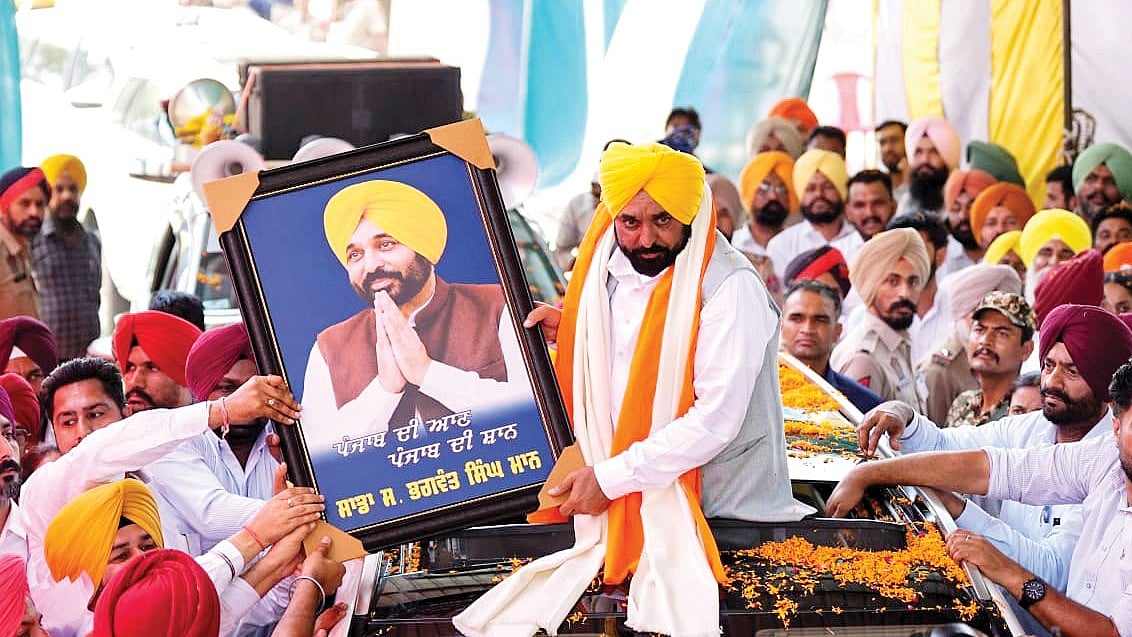
Bhagwant Mann thought it would be a masterstroke. On Baisakhi, 13 April, the Punjab chief minister convened a special session of the Vidhan Sabha, with a single-point agenda: to pass the Jaagat Jot Sri Guru Granth Sahib Satkar (Amendment) Bill, 2026, which introduces much stricter punishments for acts of sacrilege (beyadbi) against the Sikh holy text. The amendments substantially expand a 2008 Act, which primarily regulated the printing and handling of the Guru Granth Sahib.
The symbolism was unmistakable. Beyadbi is an emotionally charged issue in Punjab and Mann chose, on one of Sikhism’s most sacred days, to position himself as the leader who finally delivered what successive state governments had promised but failed to implement.
The new law prescribes a minimum punishment of 10 years in jail, extendable to life imprisonment. It imposes fines of Rs 5–25 lakh, makes the offence cognisable and non-bailable and empowers authorities to confiscate the properties of those accused of conspiring to incite communal unrest through sacrilege.
Mann thought the move was politically foolproof. No political party in Punjab could afford to oppose such a law — and they didn’t. The Bill sailed through, with unanimous support from the ruling AAP, the Congress, Shiromani Akali Dal (SAD) and the BJP. Governor Gulab Chand Kataria was equally prompt with his consent.
But the celebration lasted barely 24 hours. Opposition parties started distancing themselves. They questioned the intent of the law, and the haste over its passage. Opposition leaders alleged that MLAs had not been given advance copies of the legislation. Bills are normally circulated beforehand to allow scrutiny, but the compressed timeline of this session meant the entire process was allowed no more than a few hours.
The Akal Takht, the highest temporal seat of Sikhism, further sharpened the attack. Jathedar Giani Kuldip Singh Gargajj said the draft itself had been prepared as late as the night of 11 April.
“The unseemly haste was proof that the government was not serious about wider consultation,” said Prof. Manjit Singh, a keen observer of Punjab politics.
By 14 April, leaders across the political spectrum had started questioning the lack of consultation with Sikh religious institutions and legal experts. The Congress said the law needed broader debate. BJP leaders argued that religious organisations should have been consulted. Even sections of the SAD started aligning with the objections of the Sikh clergy.
Then came a bigger blow. As Bhagwant Mann launched his much-publicised ‘shukrana yatra, a statewide ‘march of gratitude’ to brag about the new law, the Akal Takht formally rejected several key provisions. Mann now found himself presiding over state overreach into Sikh religious affairs.
****
The Akal Takht’s objections were sweeping. The clergy argued that only the Akal Takht and institutions like the Shiromani Gurdwara Parbandhak Committee had the authority to frame rules relating to the maryada and sanctity of the Guru Granth Sahib. A state legislature, they argued, could not regulate matters traditionally governed by the Sikh Panth.
The sharpest criticism centred around the law’s requirement for a central digital registry and Unique Identification Number (UIN) for every bir (volume) of the Guru Granth Sahib. The clergy termed it intrusive, dangerous and an invitation to ‘mischievous elements’. Some even went on to argue that assigning identification numbers to the Guru Granth Sahib was to defile it.
The provisions relating to ‘custodians’ — including granthis, pathis and gurdwara committees — generated further resentment. Critics argued that instead of protecting devotees, the law effectively criminalised them by making the custodians legally liable for violations, including accidental ones.
The terminology also became controversial. Sikh scholars asked why the term ‘bir’ had been replaced with ‘saroop’, and criticised the use of bureaucratic expressions like ‘storage’ and ‘supply’ in relation to the holy scripture.
Jagrup Singh Sekhon, a former professor at Guru Nanak Dev University, also panned the idea of the state policing blasphemy. Sacrilege, he said, had become a political instrument in Punjab with “political parties trying to outdo each other in projecting themselves as protectors of the Panth”.
Tarlochan Singh, a former chairman of the Minority Commission and another critic of state meddling, says: “In Sikhism, ‘shabd’ is the Guru, and the word of God cannot come under the scrutiny of a government or the law.” He sees the move as an extension of vote-bank politics.
The Akal Takht escalated matters by summoning Punjab Assembly speaker Kultar Singh Sandhwan. Following the meeting, the Jathedar issued a 15-day ultimatum to the Punjab government to remove clauses “against the Guru Granth Sahib, the Khalsa panth and Sikh sentiments”.
The symbolism was devastating for the AAP government. Mann’s carefully scripted ‘shukrana yatra’ was renamed ‘ahankar (arrogance) yatra’ by the Akal Takht.
****
Over the last decade or so, sacrilege has become an emotional-ly explosive issue in Punjab. The 2015 Bargari desecration incident — involving torn pages of the Guru Granth Sahib — fundamentally reshaped the state’s politics. The subsequent police firing at Behbal Kalan and Kotkapura, which killed two protesters, further intensified public anger and badly damaged the credibility of the then SAD-BJP government.
Since then, every political party has tried to position itself as the true defender of the Sikh faith.
According to Punjab Police data, around 597 sacrilege-related FIRs have been registered in the past ten years. Punjab leads the country in such cases, with Goa a distant second. Yet the conviction rate is a shockingly low 7–9 per cent.
Bhagwant Mann’s masterstroke has clearly boomeranged. It has created a new schism between the state and the Sikh clergy. And that is rarely a battle any government wins easily.
Join our official telegram channel (@nationalherald) and stay updated with the latest headlines