POLITICS
Bihar Council polls see steady early voting as JD(U) rift sharpens Patna contest
Saran Teachers’ constituency leads turnout in the first two hours of polling for eight seats; counting is scheduled for 27 October
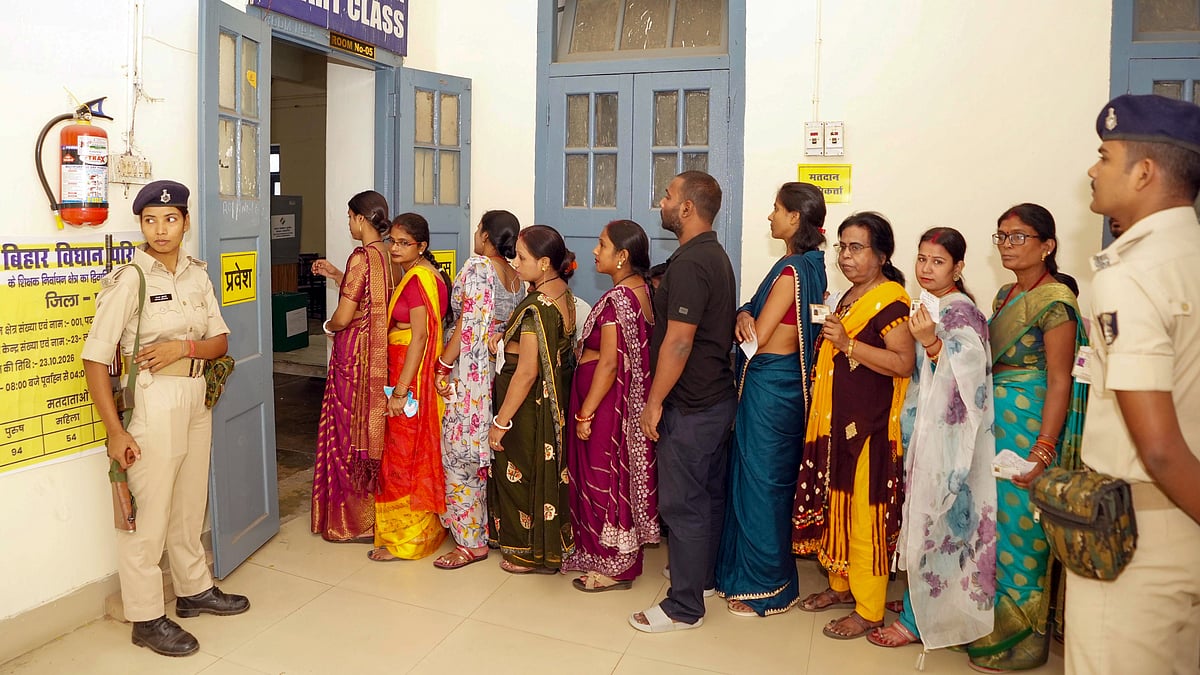
Voting is under way for eight Bihar Legislative Council seats, with 150 candidates contesting and more than 5.32 lakh eligible voters
Saran Teachers’ constituency records the highest turnout in the first two hours at 13.56 per cent; polling remains peaceful
The Patna Graduates contest draws attention as JD(U) MLA Anant Singh backs Jan Suraaj’s candidate against his party’s nominee
Polling for eight Bihar Legislative Council seats began on Friday, with Saran Teachers’ constituency recording the highest turnout in the first two hours as a split within the JD(U) added political interest to the Patna Graduates contest.
Voting opened at 8 am and will continue until 4 pm across 933 polling stations. A total of 150 candidates are contesting the biennial elections, with 5,32,847 registered voters eligible to participate, including 1,46,611 women and 37 third-gender voters. Votes will be counted on 27 October.
According to the chief electoral officer’s office, Saran Teachers’ constituency recorded 13.56 per cent polling in the opening two hours, followed by Patna Teachers at 12.88 per cent, Darbhanga Teachers at 12 per cent and Tirhut Teachers at 5.88 per cent.
Among graduates’ constituencies, Darbhanga led with 8 per cent turnout. Patna recorded 5.5 per cent, Kosi 5.14 per cent and Tirhut 4.81 per cent. Average turnout stood at 11.08 per cent across teachers’ seats and 5.86 per cent across graduates’ seats.
An election official said polling had remained peaceful.
The Patna Graduates seat has emerged as a closely watched contest after JD(U)’s Mokama MLA Anant Singh extended support to Jan Suraaj Party candidate Anuj Singh instead of his own party’s nominee, Neeraj Kumar.
Kumar, a former minister considered close to former chief minister Nitish Kumar, is seeking a fourth consecutive term. Anant Singh has claimed that Kumar worked against him during last year’s Assembly elections.
Speaking to reporters, Singh expressed confidence that Anuj Singh would win by a substantial margin, saying voters would ultimately determine the outcome.
Asked about Nitish Kumar’s brief meeting with Neeraj Kumar on Thursday, Singh remarked that the JD(U) chief “goes wherever they take him”. Singh and Jan Suraaj founder Prashant Kishor have repeatedly claimed that Neeraj Kumar lacks Nitish Kumar’s support.
JD(U) leader Shyam Rajak, meanwhile, said voting was proceeding smoothly and claimed there was strong support for the ruling NDA.
Teachers’ pay and employment security also featured prominently among voters’ concerns. Murli Manohar Srivastava, an early voter in Patna Teachers’ constituency, told PTI Videos that staff in unaided educational institutions needed a formal pay scale, pensions and social security.
Bihar’s 1981 Non-Funded Education Policy was modified in 2008 under the Nitish Kumar government to introduce performance-linked grants. Under this arrangement, private or community-run institutions, which depend largely on student fees, receive government assistance linked to results. Their staff do not have a regular pay scale, leaving incomes uncertain.
Srivastava credited BJP candidate Nawal Kishor Yadav with persistently raising the issue and said he had secured an announcement from the Samrat Choudhary-led government. Yadav has represented Patna Teachers’ constituency for the past 30 years.
The BJP and JD(U) are contesting four seats each. Three sitting BJP MLCs are seeking re-election: Nawal Kishor Yadav from Patna Teachers, NK Yadav from Kosi Graduates and Sarvesh Kumar from Tirhut Graduates.
The BJP has nominated Narendra Kumar Singh for Tirhut Teachers, currently represented by Sanjay Kumar Singh of the CPI, a member of the opposition INDIA bloc.
Jan Suraaj is contesting all eight constituencies. It revised its original nominations, replacing Bhushan Jha with Shyam Nandan Yadav in Tirhut Teachers and Ravindra Yadav with Mohammad Imtiyaz, also known as Noorani, in Darbhanga Graduates.
The eight seats comprise Patna, Darbhanga, Tirhut and Kosi Graduates, alongside Patna, Darbhanga, Tirhut and Saran Teachers. The sitting members’ terms expire on 16 November.
Voting in these constituencies is restricted to specially registered electors. Graduates’ constituency voters must reside in the relevant constituency and have held a recognised university degree for at least three years. Teachers’ constituency voters require at least three years of teaching experience in secondary schools, colleges or universities and must be enrolled on the relevant electoral rolls.
With PTI inputs
Join our official telegram channel (@nationalherald) and stay updated with the latest headlines