POLITICS
DUSU polls: Jantar Mantar casts shadow as hostel crisis dominates campus
With the Satya Niketan collapse and student protests fresh in mind, hostel shortage, safety and basic facilities dominate campaign
Sanjay Kumar is from Vaishali in Bihar. A second-year LLB student at the faculty of law in Delhi University's north campus, he says hostels are a major concern. “Barely 1-2 per cent of students studying at the faculty of law manage to get hostel accommodation. Most students live in rented rooms, and there are safety concerns too,” he says.
Sanjay himself pays Rs 10,000 a month for a rented room, which he shares with a roommate to reduce the financial burden. “My father is a vegetable seller and he is the one who sends money for my education,” he says. Despite trying to cut costs, his monthly expenses come to around Rs 15,000. “A hostel facility on the university campus would have given students a lot of relief,” he says.
On the afternoon of Thursday, 17 September, north campus bore the unmistakable air of election season. Large numbers of students were present at the arts faculty, Daulat Ram College, Miranda House and the faculty of law, even as student organisations continued their round of events, including pool parties and lunches following late-night DJ parties.
The posters and banners had disappeared from the campus walls, and the ‘Wall of Democracy’ was covered with scraps of paper. Yet stickers and pamphlets scattered across the roads offered evidence that DUSU elections were under way.
Following the collapse of a PG building in Satya Niketan, the hostel question is now on almost every student's mind. Even those unwilling to speak on camera acknowledge that housing is an issue.
AISA's presidential candidate Ananya Raturi says the organisation has been raising the hostel issue for years. “We have been raising the hostel issue for years. Students recognise that today and understand the problem. There is a different kind of enthusiasm among Gen Z about this election, and they feel there could be a change this time,” she says.
AISA is contesting the DUSU elections in alliance with SFI this year. “The hostel struggle is paramount, but we also want women's representation in DUSU, drinking water in hostels and on campus, and an end to FYUP (four-year undergraduate programme) and NEP,” Raturi says.
The hostel issue also features prominently in the manifestos of different student organisations. The NSUI has promised a ‘Rent Control Act’ with regular inspections, landlord accountability and action for violations. It has also promised a common DU portal covering verified PG accommodation, licensing, rent caps, ratings and a grievance redressal system.
Its other promises include Metro concession passes, a five-day academic calendar, two days of menstrual leave a month for women students and changes to the four-year undergraduate structure under the National Education Policy.
The manifesto also promises clean drinking water across campuses, libraries open 24/7, wi-fi with better connectivity and subsidised 24/7 canteens.
NSUI's panel comprises Vijay Shankar Meena for president, Veer Chatrath for vice-president, Namrata Chaudhary for secretary and Gopal Chaudhary for joint secretary. They are taking on a panel from the RSS-affiliated Akhil Bharatiya Vidyarthi Parishad (ABVP), which has fielded Yash Dabas for president, Ishu Maurya for vice-president, Riya Chhawri for secretary and Lakshya Raj Singh for joint secretary.
Housing is also a prominent issue in the ABVP manifesto. The organisation has promised new hostels at DU colleges, along with a housing cell and helpline. It has also promised separate hostels for women students at all colleges and safety audits of PGs and hostels.
The importance attached to the hostel issue was underscored by Delhi chief minister Rekha Gupta's announcement, just days before voting, of hostel construction for 10,000 students at the university.
Questioning the announcement, NSUI national president Vinod Jakhar said: “This announcement was made just two days before DUSU voting. Where will these hostels be built? What is the deadline for completing them? How much budget has been allocated? What will the fee structure be and what will the eligibility criteria be? Without answers to these questions, the announcement raises concerns that it is an attempt to influence voting.”
Students, however, say the problem extends beyond housing. Ravindra Singh, who was at the arts faculty, says the absence of hostel accommodation for every DU student reflects the failure of DUSU. “Why have students not got hostels despite having a union for years? Because ‘Thar culture’ dominates the university. Why would the son of a millionaire or billionaire father worry about a Rs 10,000-12,000 PG?” he asks.
He also points to the shortage of drinking water and poor wi-fi on campus. “Wi-fi exists only in name. Just understand how much the student union has done,” he says.
Student Ayesha says whoever wins must ensure basic facilities. “Whoever wins, students should get facilities. Classrooms should have ACs. There should be good wi-fi, not something that exists just for show. There should be adequate water. These are basic things, but even those are not available,” she says.
On Metro concession passes, she says: “That is a long way off. When basic facilities are not available on campus, what is the point of talking about a Metro pass?”
Campaign turns contentious
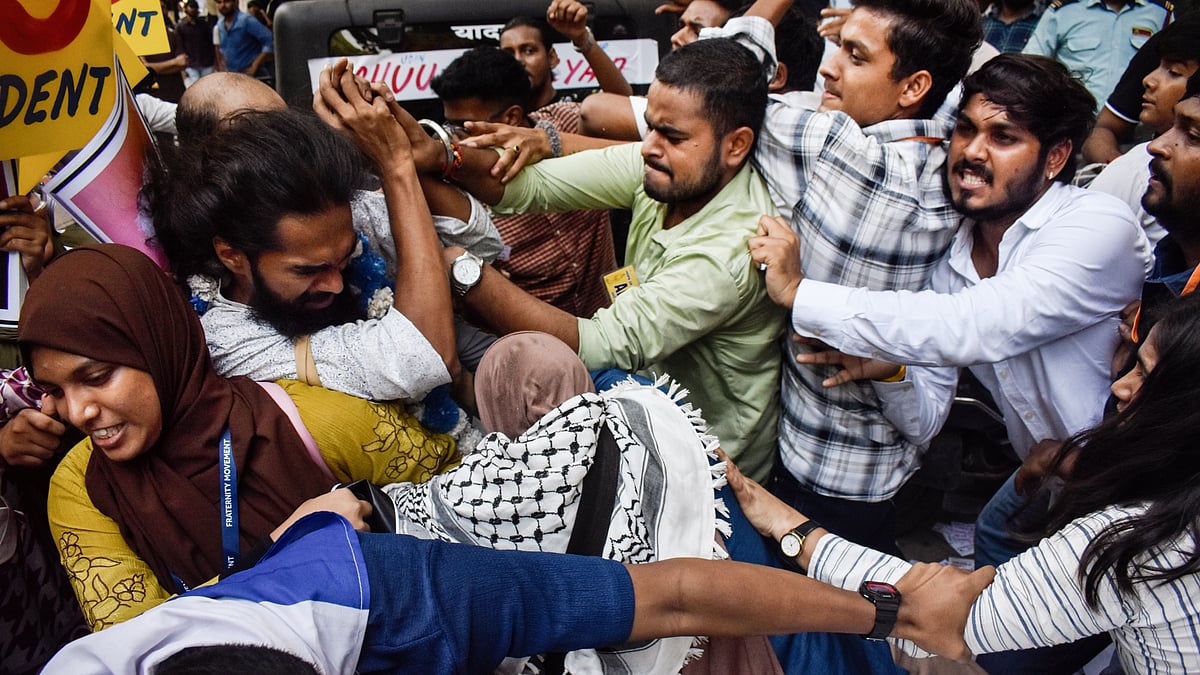
The campaign has not been entirely peaceful. On the final day of campaigning, 16 September, NSUI alleged that an Adivasi student activist associated with the organisation had been attacked outside Motilal Nehru College by ABVP members.
On 17 September, NSUI issued another statement condemning alleged late-night attacks at the residences of its candidates Vijay Shankar Meena and Gopal Chaudhary. The organisation alleged that around 200 ABVP workers targeted its candidates as part of an attempt to intimidate them.
ABVP and representatives of the Aam Aadmi Party's student wing ASAP were also reportedly involved in a clash outside Motilal Nehru College on Tuesday evening.
According to The Hindu, a student who spoke on condition of anonymity said: “50 to 60 ABVP workers entered the campus, even though the rules allow no more than five students to enter. Both groups attacked each other, and the police did not stop them even though they were fighting in front of the police.”
There was also a reported altercation between two students at Satyawati College, in which both were injured. According to reports, two vehicles were damaged and 19-year-old Ansh and Bhavishya Chaudhary were taken to Deep Chand Bandhu Hospital for treatment.
Protest echoes on campus
The atmosphere on campus has also been shaped by the student and youth protest at Jantar Mantar demanding accountability over paper leaks. In the wake of the movement, students and organisations appear to be reassessing the issues and politics of the university.
That change is particularly visible in the diverse north campus. On the day after campaigning ended, with the campus relatively quiet, Sanjay says the student movement and the Satya Niketan incident have generated sympathy among students for some organisations.
“The decision will be made through the vote. Today, it cannot be said who will win and who will lose. But the message that comes out of DU will be heard at the national level,” he says.
Join our official telegram channel (@nationalherald) and stay updated with the latest headlines