POLITICS
‘Jantar Mantar is a police cantonment; no freedom of expression here any more’
Once Delhi’s central venue for dissent, Jantar Mantar is increasingly difficult to access as police tighten barricading and protest rules
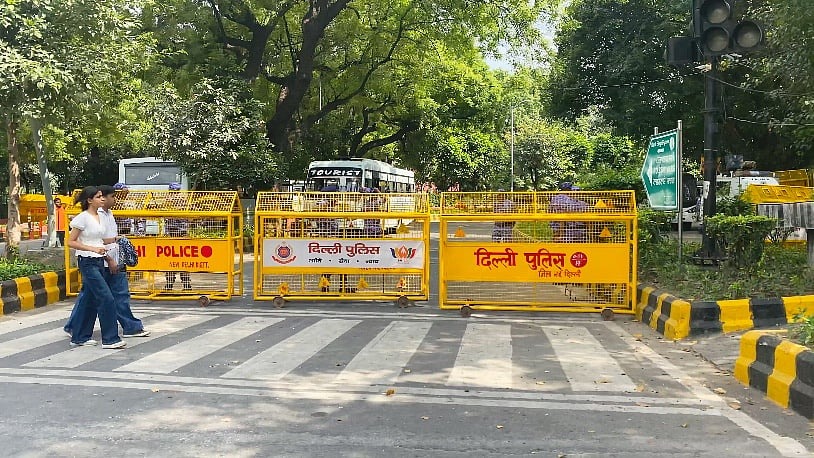
Barricaded protest site: Multiple routes to Jantar Mantar were blocked on 25 September as police and RAF personnel restricted access.
Tighter rules, greater scrutiny: Activists say obtaining permission, submitting lists of protesters and volunteers, and navigating multiple checkpoints have made demonstrations increasingly difficult.
Police tactics under scrutiny: Protesters allege that police routinely detain demonstrators in buses and have increasingly sought to push journalists away while protests are being dispersed.
If you live outside Delhi-NCR and want to join a protest at Jantar Mantar, getting there may no longer be as simple as showing up.
On 25 September, a large gathering led by CPI(ML)-Liberation general-secretary Dipankar Bhattacharya, socio-political activist Yogendra Yadav and senior lawyer Prashant Bhushan arrived at Jantar Mantar to demand the resignation of chief election commissioner Gyanesh Kumar. They found the protest site barricaded and effectively sealed off.
Every road leading to Jantar Mantar was blocked. Police were stationed at the barricades, with the Rapid Action Force also deployed. Access routes were restricted, and on the day of the protest, those trying to enter faced heightened searches and questioning.
"Jantar Mantar is no longer a protest site; it has become a cantonment of the Delhi Police," says Bhattacharya. "This is a matter of concern not just for civil movements, but also for peaceful protests that may take place in the future."
The barricading has been intensified following the student-youth movement led by the Cockroach Janata Party (CJP). It now appears as though the entire area has been fortified.
In August, the Delhi High Court had questioned the use of Jantar Mantar as a protest site. Justice Amit Mahajan had said, "Delhi should not be unnecessarily held hostage." He made the observation while hearing a petition filed by the All India Dalit Christian Rights Protection Committee. The high court’s observation came after the Supreme Court on 8 August directed the Centre to recognise Ramlila Maidan instead of Jantar Mantar as the primary site for protests.
Jantar Mantar is located in central Delhi, a short distance from Parliament. For the past three decades, the road has been a central venue for expressing democratic dissent and protest. The protest site is, in fact, a road opposite the 18th-century astronomical observatory Jantar Mantar, after which the road is named. Before this, protests in Delhi were held at the Boat Club.
The location of the protest site is significant: every voice raised here can be heard in Parliament, while politicians can easily step out of Parliament and come onto the streets. According to a report in The Hindu, ‘there is no official notification declaring Jantar Mantar a protest site, but over time, administrative practice has effectively given it that status.’ In 2003, Delhi Police issued a standing order identifying Jantar Mantar and Ramlila Maidan as official venues for protests, rallies and processions.
Routes to the main protest site
If you want to reach Jantar Mantar by Delhi Metro, the nearest station is Janpath. You can exit through gate no. 2 and head for Jantar Mantar, but there are now barricades here and police personnel are stationed there. On protest days, searches and questioning are intensified, with security personnel questioning those entering or leaving the area.
Even if you manage to get through this route, you will encounter two levels of barricading on the winding Jantar Mantar Lane, just before the main protest site. During the CJP protest, a large number of police personnel were stationed here, along with machines for checking belongings. People were allowed to proceed after being checked, but on 25 September, the route was completely closed.
Another option is to approach from Parliament Street. At the T-junction of Tolstoy Marg and Parliament Street, you will find police stationed behind barricades. This is the main route to Jantar Mantar, but it now remains closed.
The alternative is to take the winding passage in front of Parliament Street police station that leads toward Kerala Bhavan. On 25 September, there were barricades at two points along this route, making it impossible to reach the main protest site.
During the CJP movement, it was easy to reach the stage through this route, and most leaders and social activists used it. On normal days, the police do not barricade the passage because people also use it to reach their offices.
If you take this route, you can reach Kerala Bhavan. At the T-junction, you will see the Janata Dal (United) office. On the left are two or three food outlets, one of them famous for its dosa.
The police have now barricaded these shops as well. Two levels of barricades have been erected directly in front of them, enclosing the area. The barricades have been welded together so that they remain in place like a wall. But to reach this point, you first have to cross the first line of barricades, which is not possible.
On 25 September, the police also parked a bus directly in front of these barricades. This meant that a crowd could not reach the main protest site.
During the CJP protest, the police had created checkpoints between these barricades through which members of the public were allowed to enter. That route has now also been closed.
A third way to reach Jantar Mantar is from in front of Kerala Bhavan. During the CJP protest, the police had erected barricades directly in front of Kerala Bhavan, but these have now been removed. If you enter through this route, you can reach the JDU office, but moving ahead from there will be difficult.
AISA (All India Students' Association) national president Neha Bora says, "During the anti-CAA movement, protests were being held at Jantar Mantar all the way up to Kerala Bhavan and UP Bhavan, and people from various organisations were joining these protests. But since the lockdown during Covid, Jantar Mantar has been sealed off with barricades.
"Then came the Supreme Court directive saying that if you want to protest, you can protest at Jantar Mantar or go to Ramlila Maidan. Gradually, an elaborate procedure began to emerge around Jantar Mantar, under which written permission has to be obtained 10 days in advance for a protest. The police ask for lists of volunteers and VIPs. They also ask for the names of those who will be providing security to them. In this way, protesting at Jantar Mantar has been made complicated."
In July 2018, the Supreme Court had said "protests at Jantar Mantar or Boat Club cannot be completely prohibited". The court directed authorities to formulate guidelines that balanced the rights of protesters with those of local residents. That same year, Delhi Police, through standing order 10, designated Jantar Mantar for protests of up to 1,000 people. Larger gatherings are permitted only at Ramlila Maidan.
It is worth noting that during the farmers’ movement too, farmers from across the country had sought permission to travel to Jantar Mantar or Ramlila Maidan to protest. However, the Central government did not even allow them to enter Delhi, and the farmers remained camped at the Delhi-Haryana border for at least 12 months without being allowed to enter the city.
Neha says, "When people’s fundamental rights are violated, protesting is a constitutional right of the people. A system has been created to find ways of taking away this right without appearing to take it away. This is something we are seeing in Delhi and across the country."
Police methods of dispersing crowds
The way the police used force to suppress the protest on 25 September has drawn criticism. As soon as the police saw that people who had gathered for the protest were speaking to the media, groups of four or five policemen began dragging individuals away and putting them into buses. As soon as one bus was filled, another would be brought in, and police personnel would continue picking people up and putting them inside. This has become a familiar method of bringing a protest to an end, the Hindu report says.
Most protests at Jantar Mantar are peaceful. But if an activist starts shouting slogans loudly while speaking to the media, police personnel enter the crowd, pick up the individual and put them into a police bus.
Police permission is now mandatory for demonstrations anywhere in Delhi. Raza Ahmed, associated with the Indian Youth Congress, says, "Even if we want to hold a protest inside our own office, police permission is mandatory." On 24 September, the IYC was preparing to march to the Election Commission office, but the police erected barricades at the main entrance.
Over the past year, as a reporter, I have seen this approach by the police dozens of times, even when Delhi Police itself has granted permission for a protest. When Congress workers stage a protest outside their headquarters, the police announce, ‘Section 163 of the Bharatiya Nyaya Sanhita is in force at this location, and you do not have permission to protest. Stop your protest.’ When the protest does not stop, the police pick up the activists, put them into buses and then drop them off somewhere else.
It is not only its treatment of protesters that has changed; Delhi Police’s approach towards the media has also changed. Media personnel are present at virtually every protest to cover it. Naturally, the number of journalists has increased in the age of social media.
On 25 September, when the police had put protesters and political and social activists into buses and sent them away, they began blowing whistles loudly to drive the media away. This approach by the police has been seen repeatedly over the past few months.
The police have never hesitated to take action against journalists, but they are now resorting to whistles to obstruct their work — so that neither questions can be heard nor answers given. What better expression could there be to describe the attitude of the current establishment?
Join our official telegram channel (@nationalherald) and stay updated with the latest headlines