POLITICS
Tamil Nadu: Making space for a new seat of government
Why must the new seat be located at Foreshore Estate? That question does not have any good answers
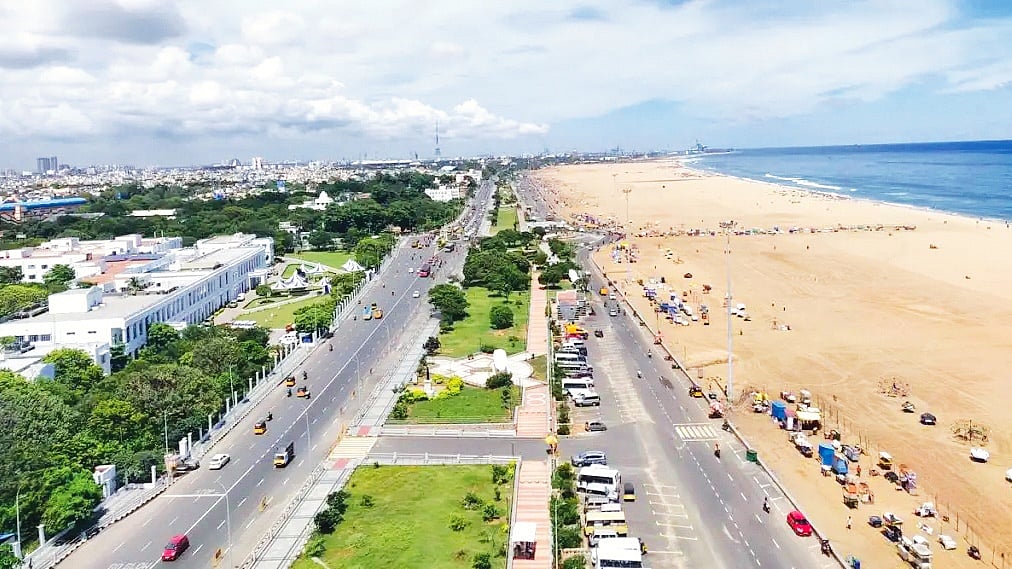
A new proposal to shift the seat of government in Chennai from Fort St George, the 17th century fortress built by the British East India Company, which was later transformed into the political headquarters of the Madras Presidency and Tamil Nadu, has run into an early storm.
Soon after coming to power, chief minister C. Joseph Vijay took the stand that the present secretariat cannot be expanded or modernised within the heritage constraints of Fort St George, a sizeable portion of which is controlled by the Union defence ministry and another portion by the Archaeological Survey of India.
The Joseph Vijay government has proposed a new Assembly and secretariat complex in Foreshore Estate at the edge of the city’s famous Marina Beach. The proposed new complex will be spread over 25.55 acres, with 20 lakh sq. ft of built-up space, and cost an estimated Rs 1,200 crore.
The plan, announced in the state Assembly by Vijay on 3 September, is controversial because the proposed new site raises questions of ecology and livelihoods. At the centre of the row is the question: must the new secretariat come up at this very location by the sea, threatening a highly fragile marine environment and the livelihoods of the fishing communities that live nearby?
Fort St George, founded in 1639, was the nucleus around which colonial Madras grew. After Independence, it became the home of the legislature and government of Tamil Nadu. The Madras Legislative Council began meeting there in 1921, and for decades the Assembly chamber became the setting for some of the most consequential political changes in the state.
In 2010, M. Karunanidhi’s DMK government shifted the legislature to the Omandurar Government Estate complex, citing the same reasons — the lack of space in Fort St George to expand. But on her return to power in 2011, Jayalalithaa shifted the assembly and secretariat back to Fort St George, and the Omandurar complex was converted into a big government hospital.
Foreshore Estate is not just another tract of government land. It lies at the southern end of the Marina coastline and is an old coastal settlement of fishing communities.
The fishers in Pattinapakkam and Srinivasapuram, where their hamlets are concentrated, have a different relationship with the land. They have produced old government documents and cited a 1957 government order to claim that portions of the site were originally acquired from Mullikuppam fishing families under a rehabilitation scheme. They argue that land acquired from their community for a specific purpose cannot now be treated as surplus government land on which to build a major administrative complex.
For the fishers, access to the sea is the other big concern. The Marina coast supports boat landing, net repairs, fish sorting, drying and the local fish trade. Fishing families say a large secretariat, security arrangements, roads and parking will cut deeply into the areas where they operate. These spaces have already shrunk due to urban expansion, they point out, and are threatening to protest if the project is not dropped.
DMK chief and Vijay's predecessor M.K. Stalin has backed the fishers and warned of a major protest if the project proceeds without addressing their concerns.
G. Sundarrajan of the Chennai-based environment NGO Poovulagin Nanbargal (Friends of the Earth) told National Herald that the fishers’ concerns cannot be brushed aside. “The government must first commission a study by experts in coastal ecology, marine biology, disaster management and livelihoods. It must assess consequences before taking a final decision.” Any large construction project, he said, should first establish how it will affect fishing access, boat parking, net drying and repairs, marine ecology, drainage and the area’s vulnerability to cyclones, flooding and sea-level rise.
Justice (retd) K. Chandru has raised similar questions.
The TVK (Tamilaga Vettri Kazhagam) government argues that neither Fort St George nor other available facilities are adequate for a modern secretariat. That argument deserves consideration, but the need for a new larger secretariat does not automatically make Pattinapakkam the right site.
It appears the decision to shift here is not set in stone. On 8 September, the Vijay government issued an in-principle approval for the Foreshore Estate proposal, but it has since clarified that a final decision has not been taken. Apparently, a detailed project report and further feasibility assessments are to be undertaken before a final decision. The state government has also indicated that alternative locations are being explored.
The Madras High Court has, meanwhile, been approached by the fishing community. Their petition questions the 8 September government order, raising concerns over the impact on fishing communities and questions of coastal regulation and environmental impact.
Join our official telegram channel (@nationalherald) and stay updated with the latest headlines