POLITICS
The mystery of the book that never was
What makes General Naravane’s ‘unpublished’ memoir so terrifying for the Government of India?
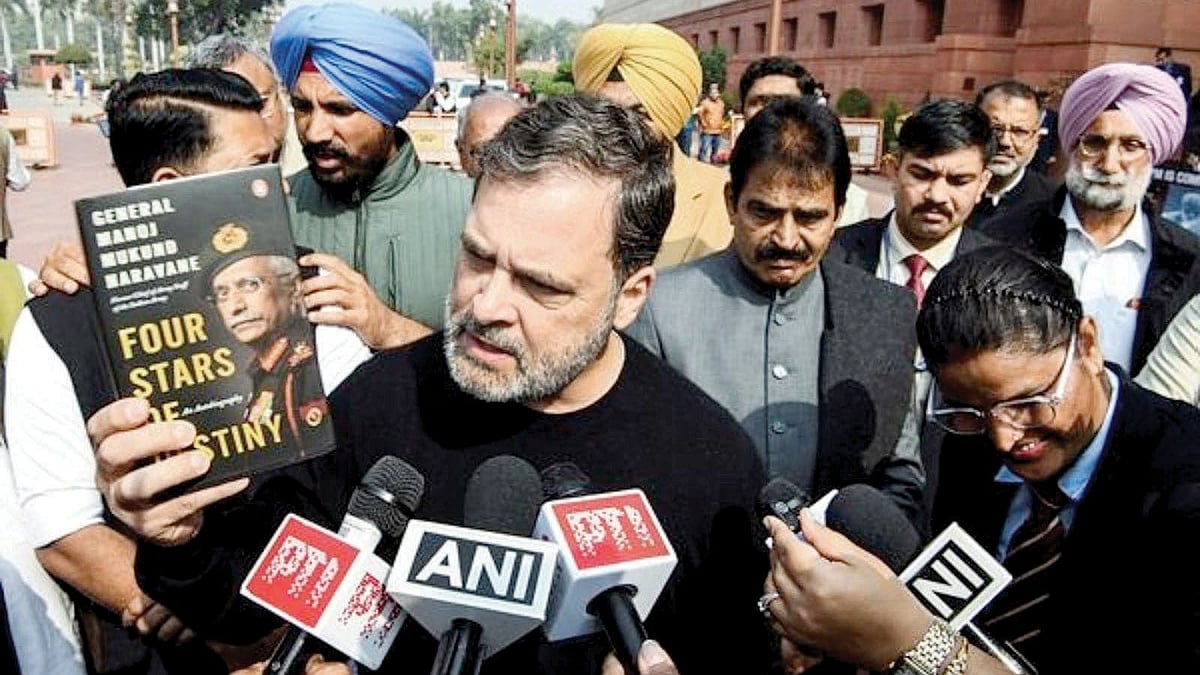
Barely two minutes after Rahul Gandhi began speaking in the Lok Sabha on2 February, a visibly agitated Rajnath Singh leapt up. The House had been quiet until the Leader of the Opposition began reading a few lines from an article based on the memoirs of former Army chief General M.M. Naravane.
“When four Chinese tanks entered Indian territory, the general writes…” is all Gandhi could say before the defence minister, flanked by Prime Minister Narendra Modi and home minister Amit Shah, sprang to his feet and cut him short.
There was no such book! The Speaker must disallow reading unsubstantiated content!
Over the next 10 minutes, Singh rose at least four times to make the same point: The book the LOP is referring to was never published… I have only one question: where is the book he is quoting from…? If he has the book, let him lay a copy of the book in the House… This book was never published… let him produce a copy of the book…
On 4 February, Rahul Gandhi heeded the call and brought a copy of the book with him. Holding it up to cameras, he said: “Every youngster in India should see that this book exists.”
When Congress MP K.C. Venugopal sought to draw the Speaker’s attention to the fact that the LOP was reading from a magazine article — ‘Naravane’s Moment of Truth’ by Sushant Singh, published in Caravan, February 2026 — Amit Shah countered: “Magazines can publish anything… If the book has not been published, how can it be quoted?”
When Rahul Gandhi insisted the content was “one hundred per cent authentic”, Speaker Om Birla ruled him out. The raksha mantri had spoken, and that was that. The book did not exist.
Turns out it did. Gen. Naravane’s Four Stars of Destiny was clearly listed by publisher Penguin Random House — publishing date: 30 April 2024, print length: 448 pages, weight: 650 grams, ISBN numbers: 10-0670099759 and 13-978-0670099. It was also listed by online retailers like Amazon and Flipkart.
These online traces were scrubbed clean in less than 48 hours. With physical evidence in hand, Gandhi challenged the government: “If the prime minister comes to the House — I doubt he will — I would like to present the book to him… The home minister said… the book did not exist; the defence minister and the government said the book was never published, but here it is…”
The essay that Gandhi was prevented from quoting begins with an extract that was released by PTI in December 2023 and carried by The Print on 18 December 2023. Details have been in the public domain for the past two years. Yet the government went blue in the face to shush it up in Parliament.
“What is written in it that they are so scared of? If they are not scared, they should allow me to read it. Why are they so scared?” asked Gandhi.
****
Gen. Manoj Mukund Naravane (retd) was chief of army staff between December 2019 and April 2022. This was the period when Indian and Chinese troops clashed in Galwan Valley, Ladakh; 20 Indian soldiers were killed in hand-to-hand combat.
This was also the period when India’s first chief of defence staff (CDS) was appointed, Gen. Bipin Rawat, who presided over all three arms of the defence forces. A consequential period, which saw Chinese incursions in eastern Ladakh and the loss of Indian territory — that the current government seems reconciled to — and the rollout of the controversial Agnipath scheme, which, Naravane writes, came as a bolt from the blue and was resisted by the Army.
Sushant Singh, lecturer at Yale University, and consulting editor with Caravan, is a former Army man himself. He based his essay on a typed manuscript of Naravane’s book. He writes: ‘Here’s why this essay on Naravane’s memoir matters… it sheds light on Chinese aggression, the decisions that led to the loss of Indian lives and territory, and the troubling absence of political accountability at a moment when the country stood on the brink of war.’’
Singh begins with a reference to what happened after the Army chief received a phone call at 8.15 pm on 31 August 2020. It was eleven weeks since the hand-to-hand combat at Galwan. Indian and Chinese commanders were in disengagement talks at the Line of Actual Control. The informal China Study Group headed by national security advisor (NSA) Ajit Kumar Doval had held several rounds of meetings.
There was consensus, Naravane writes, that India needed to do something. However, he was instructed not to open fire on the Chinese unless a clearance was given ‘from the very top’. The Army pushed back. Given the events at Galwan, the Army needed autonomy to act if provoked. It was eventually decided ‘that as a last resort, if our own physical security was at stake, that detachment and that detachment alone could open fire in self-defence’.
The phone call on 31 August was from Lt Gen. Y.K. Joshi, who headed the Northern Command. Four Chinese tanks had started moving towards the India-held position at Rachin La on the Kailash Range. Warning flares fired by Indian troops were being ignored. India held the advantage of height, artillery and heavier tanks. Gen. Joshi wanted permission to open fire to stop the advancing Chinese. Naravane called CDS Gen. Rawat, defence minister Rajnath Singh, NSA Ajit Doval, MEA S. Jaishankar, with the question: “What are my orders?”
In his account, quoted in the extracts released by PTI and in the Caravan essay, Gen. Naravane writes he was kept hanging until 10.30 pm. That’s when Rajnath Singh finally called to pass on PM Modi’s directive: “Jo uchit samjho, woh karo (do what you think fit)”.
Naravane writes, ‘I had been handed a hot potato. With this carte blanche, the onus was now totally on me.’ He told Joshi that India should not fire the first shot, and asked him to ensure that heavier Indian tanks were positioned at the edge of the ridge with nozzles pointed towards the Chinese tanks below.
If the prime minister was truly unavailable to the defence minister, the NSA, the CDS and the MEA for over two hours at such a critical moment, the government has a lot of explaining to do. Communication channels to the prime minister are open 24 hours a day and, under security protocols, he is never left alone. So — what happened on the evening of 31 August 2020? Will we ever know?
****
Rajnath Singh’s admission in the Lok Sabha on 3 February that clearance to Naravane’s book was withheld because of ‘factual inaccuracies’ has added to the mystery. Could the book have been printed and published without clearance? Could it have been listed by Amazon, for pre-orders (which were then cancelled)? Could an extract have been released by PTI? Above all, if the book was never published, how did the physical copy appear and from where?
The former Army chief himself seems not to know of the government’s decision to withhold clearance; perhaps the decision was never communicated to him? On Aaj Tak and at the Khushwant Singh Literature Festival (KSLF) in Kasauli in October 2025, he was pointedly asked why the book had not yet been released.
At KSLF, Naravane said, “My job was to write the book and give it to the publishers. It was the publishers who were to get permission from the Ministry of Defence. They gave (the book) to them. It is under review … for more than a year now.”
The general also sought to allay suspicions of any foul play by pointing out that the vetting process may actually involve more than the MoD. While he had written about military operations, the contents, he said, might affect the external affairs ministry, defence production etc., and so the vetting process could drag. While it’s still unclear when clearance was denied, Naravane has clearly not been informed.
****
Both serving and retired Army officers are required to seek clearance for any book they write. Books dealing with operational matters undergo a three-stage vetting process (Army HQ, MoD and cabinet secretariat).
In an interview to India Today, Lt Gen. K.J.S. ‘Tiny’ Dhillon (retd) — whose Operation Sindoor: The Untold Story of India’s Deep Strikes Inside Pakistan was also published by Penguin Random House in September 2025, barely three months after the operation — listed three scenarios.
One, nothing objectionable is found and the book is cleared. Two, if objections are raised, the author is invited to explain his point of view and clearance granted after edits. Three, if the book gives out operational secrets that might affect national security, clearance is denied.
****
While the government’s directive “jo uchit samjho, woh karo” has been interpreted by spin masters as giving the Army a free hand, what it suggests is an abdication of political responsibility. The government failed to convene the Cabinet Committee on Security (CCS) — the highest policy-making body in matters of national security — and give clear directions to the Army. By leaving the decision to Naravane and refusing to own it, were the political masters giving themselves room for plausible deniability?
Join our official telegram channel (@nationalherald) and stay updated with the latest headlines