


Kaifi Aur Main: When poetry, politics and love share the stage
IPTA’s staging revisits the lives of Kaifi and Shaukat Kaifi through memory, music and ideological companionship
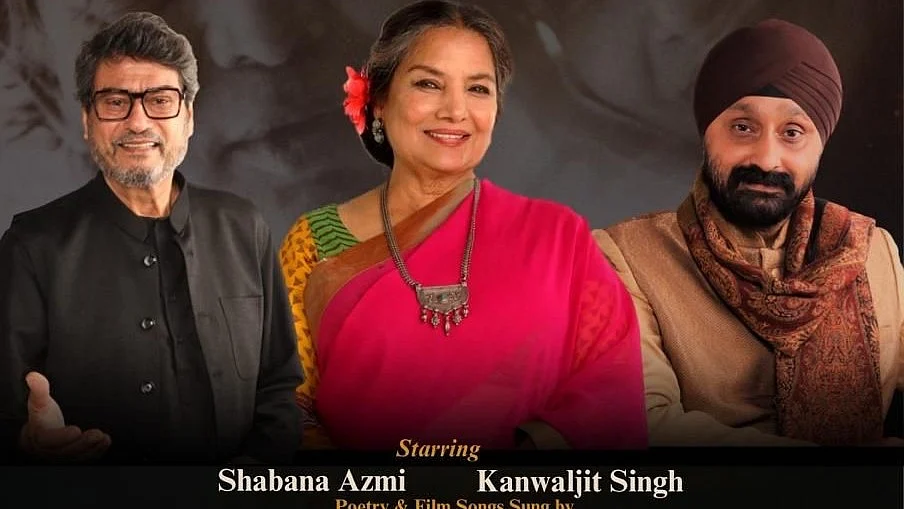


The staging of Kaifi Aur Main by Indian People’s Theatre Association (IPTA) at Mumbai's Mukkti Auditorium on 23 May was far more than a conventional theatrical production. It unfolded instead as an elegantly layered act of remembrance — a deeply felt tribute to Kaifi Azmi, Shaukat Kaifi, and the artistic-political world they helped shape over decades.
Anchored by the commanding presence of Shabana Azmi and Kanwaljeet Singh, and enriched by Jaswinder Singh’s soulful renditions of Kaifi’s immortal songs, the evening transformed memory into performance with uncommon grace, warmth and restraint.
What gives Kaifi Aur Main its enduring resonance is that it is not merely the story of a marriage; it is the story of a partnership that evolved alongside some of the most important cultural and political movements of twentieth-century India. Drawn from Shaukat Kaifi’s memoir Yaad Ki Rahguzar, the play revisits the couple’s shared life through an intimate and affectionate narrative voice — one shaped by a daughter who understands both the private tenderness and public commitments of her parents.
That perspective gives the production its emotional depth. Rather than reducing its protagonists to iconic cultural figures, the play enters the texture of their everyday lives: the struggles of survival, the anxieties of artistic commitment, the endurance of companionship and the sustaining force of shared conviction.
Kaifi Azmi emerges not only as one of Urdu poetry’s most celebrated modern voices and Hindi cinema’s most distinguished lyricists, but also as a committed progressive intellectual deeply invested in questions of justice, equality and social transformation.
Equally significant is the portrayal of Shaukat Kaifi, who appears not as a secondary presence but as an artist, memoirist and cultural participant in her own right. The production’s greatest strength lies in its insistence that their marriage rested as much on intellectual and ideological companionship as on affection.
Shabana Azmi carries the emotional weight of the evening with remarkable control. In a commemorative production where sentiment could easily slide into excess, her performance remains measured, humane and deeply authentic. Her portrayal of Shaukat Kaifi feels inhabited rather than performed — affectionate, observant, witty in moments, and profoundly moving when required.
Kanwaljeet Singh complements her with an understated portrayal of Kaifi Azmi that captures the poet’s gentleness, moral seriousness and quiet charisma. His restrained performance suits the public image of Kaifi: a poet whose conviction rarely needed theatrical flourish.
The chemistry between the two actors becomes central to the success of the evening because the production relies less on dramatic confrontation and more on emotional resonance. Their exchanges recreate not simply a marriage, but an entire ecosystem of ideas — the hardships of early years, the courage of dissent, the intimacy of comradeship and the persistence of hope.
The production’s mehfil-like atmosphere further strengthens this effect. Instead of pursuing spectacle or dramatic intensity, the staging remains intimate and conversational, allowing the emotional and intellectual world of the couple to emerge gradually through memory, poetry and dialogue.
Jaswinder Singh’s live renditions serve as far more than musical interludes; they form the emotional architecture of the performance itself. Songs written by Kaifi Azmi for Hindi cinema — including timeless classics such as 'Waqt Ne Kiya Kya Haseen Sitam' and 'Tum Itna Jo Muskura Rahe Ho' — acquire renewed meaning within the narrative structure of the play.
Placed alongside spoken recollections from the couple’s life, these songs function almost as emotional documents, reminding the audience that the lyricist behind these enduring compositions was also a poet shaped by struggle, discipline and radical imagination. The transition between poetry, memoir and music is handled with sensitivity, enabling the personal story to expand naturally into a larger cultural memory.
The musical arrangements by Kuldeep Singh and the direction by Ramesh Talwar ensure that the production remains emotionally coherent and aesthetically uncluttered. The sparse staging proves particularly effective because it refuses to overwhelm the writing with unnecessary theatricality. Instead, the evening remains attentive to cadence, voice and remembrance — qualities deeply aligned with Kaifi Azmi’s poetic sensibility and Javed Akhtar’s script.
Indeed, Akhtar’s writing performs the difficult balancing act of weaving together memoir, poetry, political history and family remembrance without allowing the production to become didactic. At its finest moments, the script creates an effortless conversation between the personal and the historical.
The worlds of Aligarh, Hyderabad, the Progressive Writers’ Association, IPTA, communism, Urdu literary culture and Bombay cinema all enter the narrative organically, creating not just the portrait of a couple but of an entire intellectual generation shaped by artistic idealism and political commitment.
This is also where Kaifi Aur Main distinguishes itself from mere nostalgia or sentimental homage. The play does not reduce Kaifi Azmi to a sanitized cultural icon. Instead, it restores his layered identity as poet, Marxist, dissenter and deeply human figure. The recurring use of his own words allows that complexity to survive even within the celebratory tone of the production.
If the play occasionally feels closer to a staged homage than a sharply conflict-driven drama, that too becomes part of its appeal. Kaifi Aur Main is ultimately designed to honour a shared life, and it does so with sincerity, intelligence and emotional generosity.
The audience leaves not merely admiring Kaifi Azmi’s poetry, but sensing the lived reality behind it — the companionship, ideological commitment, sacrifice and imagination that sustained both Kaifi and Shaukat across decades of artistic and political engagement.
That perhaps explains why Kaifi Aur Main continues to retain its cultural relevance nearly two decades after its premiere in 2006, and why its revival in Mumbai still commands attention not merely as a theatrical performance but as a significant cultural event.
In an age increasingly shaped by fleeting visibility and instant applause, the production offers something far more enduring: a tender yet intellectually rich reminder that poetry can be a way of living, and that love itself can become a form of political imagination.
Hasnain Naqvi is a former member of the history faculty at St Xavier’s College, Mumbai. More of his writing here
Join our official telegram channel (@nationalherald) and stay updated with the latest headlines