


The God debate that went viral
Shabnam Hashmi defends the salience and timing of a debate between Javed Akhtar and Mufti Shamail Nadwi
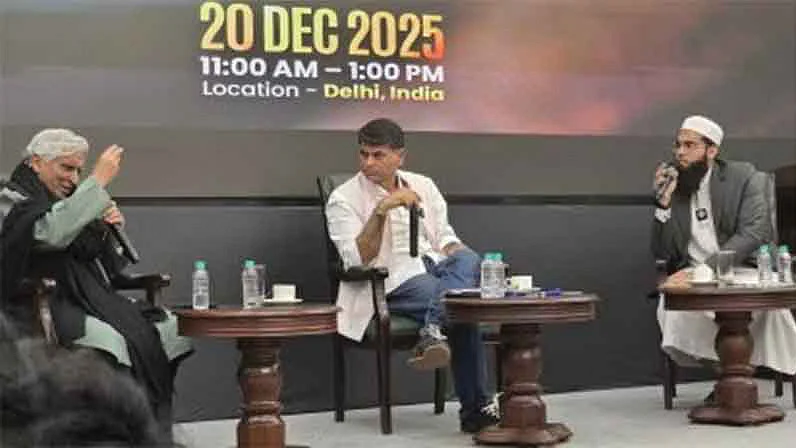


At a time when ‘scientific temper’ — that well-worn phrase made popular by India’s first Prime Minister Pandit Jawaharlal Nehru — feels like a forgotten footnote in the Indian Constitution, a recent event at the Constitution Club in New Delhi has ignited a firestorm of engagement.
The debate, titled ‘Does God Exist?’, between celebrated poet-lyricist Javed Akhtar and Islamic scholar Mufti Shamail Nadwi, was not an academic indulgence, as some public intellectuals would have us believe; it was an act of reclaiming public space for critical thought.
There is a section of the intelligentsia and civil society that argues this was not the time for such a discussion. With unemployment, inflation and communal violence tearing at the social fabric, questioning the existence of God is a luxury, they argue. My question is: when is the ‘right’ time?
Organised by the newly formed Academic Dialogue Forum and the Wahyain Foundation, the event has inspired hundreds of video reels and shorts, dissecting the arguments that have lain dormant in the Indian public sphere for way too long. Even the fact that these short videos of the debate have garnered millions of views is some kind of validation of its salience in an era when ‘virality’ has top billing.
For a civil society often told that there are “more pressing issues” than questioning faith, this debate proved that the interrogation of dogma is not a distraction — it is the very foundation of the resistance against authoritarianism.
The attack on ‘scientific temper’ is not separate from the most urgent political and social crises India faces today. When a society stops asking ‘why?’, stops demanding evidence, it becomes susceptible to authoritarianism in all its forms. The current surge of communalism, caste-based hatred and the ‘fascist’ ideology associated with the RSS is deeply inter-connected with the weaponisation of religion.
We are witnessing a proliferation of new-age gurus and babas, who are spreading conservative, often regressive, ideas cloaked in spiritual verbiage. These poseurs and godmen exploit the most marginalised sections of society, selling the promise of a better ‘afterlife’ as recompense for the miseries of this one.
In this context, debating the existence of God is not an abstract theological dispute; it is a direct challenge to the structures of power that rely on blind faith to maintain control. To safeguard our democracy and secularism, we must exercise our ‘scientific temper’; that exercise is its best defence.
The urgency of this debate is underscored by the palpable fear that rationalism instils in the hearts and minds of right-wing fundamentalists. We mustn’t forget that the right-wing fears the rationalist more than the political opponent. The assassinations of Narendra Dabholkar, Govind Pansare and M.M. Kalburgi were not random acts of violence; they were targeted strikes against men of reason, against the spirit of inquiry.
This pattern is not unique to India. In Bangladesh and Pakistan, we have seen a similar, brutal silencing of bloggers and rationalists who dared to question religious dogma. The objective is always the same: to create an environment where the rational mind is too terrified to speak.
Also Read: Faith under fire
This fear of the unknown — and those who seek to illuminate it — resonates globally. Consider the tragic case of Nuno Loureiro, a lauded theoretical physicist and fusion scientist who joined MIT in 2016. While the investigation into his recent killing continues, his life’s work serves as a poignant reminder.
He operated in the realm of the unknown, challenging the boundaries of what we accept as reality. Irrespective of who killed him or why, scientists like Loureiro threaten static belief systems; they push humanity away from comfortable myths, nudging them towards uncomfortable truths.
A defining moment in the Akhtar–Nadwi debate was the passage on the suffering of innocent civilians, the killing of children in Gaza.
When challenged to account for how a merciful God could allow the massacre of thousands of children, Mufti Shamail’s defence was chilling in its theological detachment. He argued that God is not just merciful but also ‘Al-Hakeem’ (omniscient), and that we see only a ‘pixel’ of the full picture. As if to justify the horror, Mufti Shamail said: “If there is no evil in this world, then what is the meaning of ‘the trial’?
Quite aside from the merits of the arguments made on both sides, that the debate should have unleashed a torrent of questions is proof it was timely.
One of the reels gone viral captures this awakening perfectly: “We were always taught that faith is fragile and must be protected from questions, but this debate showed us that truth has nothing to fear from inquiry.”
Shabnam Hashmi is a social activist and human rights campaigner
Join our official telegram channel (@nationalherald) and stay updated with the latest headlines