


Iran war: China’s BYD confident of growth without relying on US as global demand rises
BYD leads expansion beyond US market, cites strong orders in Europe, UK and emerging economies
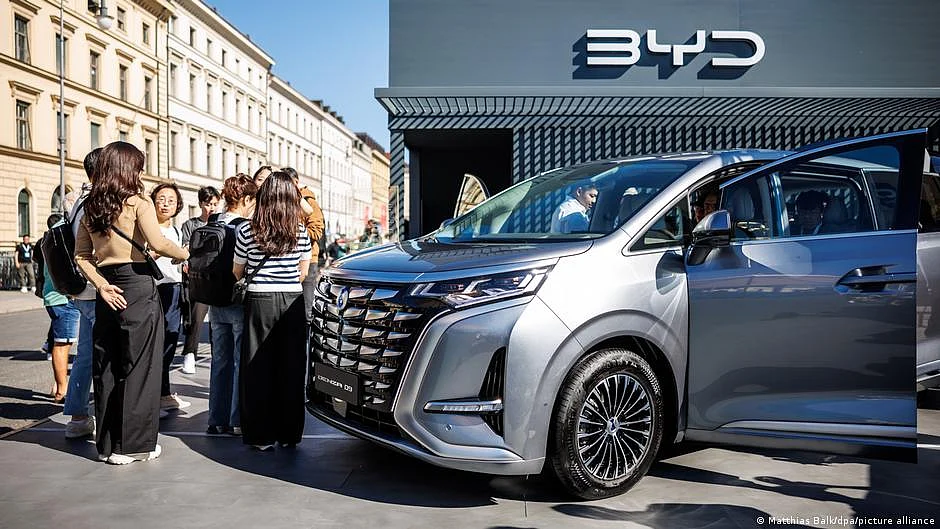


A rise in global fuel prices linked to Iran war has boosted demand for electric vehicles, with Chinese manufacturers — led by #BYD — capitalising on increased interest across Asia and Europe.
China, the world’s largest EV producer, is seeing its automakers expand overseas even as access to the United States market remains limited due to tariffs and regulatory scrutiny.
Industry executives say higher oil prices are prompting consumers to shift towards EVs for long-term savings.
“Consumers feel the daily savings when oil prices increase. EVs help them save money every day,” Stella Li, executive vice president at BYD, said at the Beijing Auto Show.
She added that demand is currently outpacing supply. “Our demand is much higher than what we can supply,” Li said.
Chinese EV makers remain largely excluded from the US due to trade barriers and concerns over subsidies and data security.
However, companies like BYD are reporting growing traction in markets such as Brazil, the United Kingdom and across Europe.
“We survive and are successful without the US market today,” Li said, indicating a strategic pivot towards alternative regions.
Technology push and innovation
BYD is betting on new “flash charging” technology, which it says can add hundreds of kilometres of driving range within minutes—addressing one of the biggest barriers to EV adoption.
Chinese automakers are increasingly competing on technology rather than just pricing, with advancements in batteries, charging infrastructure and software integration.
At the Beijing Auto Show, the scale of innovation was evident, with over 1,400 vehicles on display and companies showcasing developments beyond cars, including robotics and future mobility solutions.
Rising competition and global partnerships
Foreign automakers such as Volkswagen, Toyota and Ford are increasingly partnering with Chinese firms to stay competitive in the EV space.
Examples include collaborations on battery technology, driver-assistance systems and joint EV development.
At the same time, competition within China remains intense, with multiple manufacturers engaged in price wars and rapid product rollouts.
Despite global expansion, Chinese EV makers face challenges at home. BYD has seen domestic sales decline in recent months amid pricing pressure, even as its sales in Europe rose sharply in early 2026.
Li indicated that consolidation in the sector is likely as competition intensifies.
“History suggests not all will survive,” she said.
The shift towards EVs has accelerated globally amid energy price volatility and climate concerns.
China’s dominance in EV manufacturing, supported by supply chains in batteries and components, has positioned its companies to benefit from changing global demand patterns, even as geopolitical tensions shape market access.
Join our official telegram channel (@nationalherald) and stay updated with the latest headlines