


India vs Pakistan: Meet Imran Khwaja, the low profile peacebroker of ICC
The 64-year lawyer, vice chairman of the Council who presents Singapore, betrays a neutral image in the community
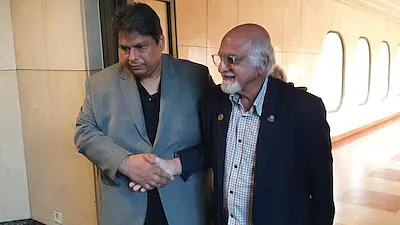


A day after it was officially announced that the India-Pakistan game on 15 February is on after much drama, the last has not yet been heard on the subject—with most involved parties claiming a moral victory. However, a key figure who again went under the radar was the diminutive Imran Khwaja, the long serving vice chairman of International Cricket Council (ICC) and their key troubleshooter.
It’s not the first time that Khwaja, the 64-year-old lawyer with Pakistan origins who represents Singapore on the ICC board, has been thrust with such a responsibility. With the eyes of the cricketing world staying rivetted on the Lahore meeting between the ICC delegation and Mohsin Naqvi, chairman of Pakistan Cricket Board (PCB), the spotlight was on Khwaja as he carried the mandate of the world governing body with him.
However, it was more than a week before that he was entrusted with the responsibility of opening backchannel talks with PCB supremo Naqvi, with whom he enjoys a good personal equation. Ever since the Pakistan government announced on it’s X handle on 1 February that they would take part in the T20 World Cup but not the India game, alarm bells started ringing loud and clear for ICC—who had been over-leveraging on this single match in every multi-nation tournament for nearly 15 years.
The ICC, in keeping with the dignity of global body, didn’t take recourse to any rhetoric regarding possible sanctions but took a smart move of engaging Khwaja on the job—as an acceptable person in all quarters and a champion of the associate member nations’ cause. Reacting to Pakistan’s decision, ICC concluded in a press release: “The ICC hopes that the PCB will consider the significant and long-term implications for cricket in its own country as this is likely to impact the global cricket ecosystem, which it is itself a member and beneficiary of.”
While the pressure from the Sri Lankan government on Pakistan is already well documented, UAE (Mubashir Usmani), which represents the associates on the ICC board also swung into action. The Gulf state, which played the ‘home’ for Pakistan cricket for a decade when no international countries were touring them since 2009 after the terror attack on Sri Lankan team in Lahore, is also believed to have pressurised PCB to save the biggest game of the tournament.
At a time when the global perception is the ICC means India, thanks to it’s financial clout, Khwaja’s apparently neutral background made him a credible choice to open the communication channels. He was second in command to India’s Shashank Manohar when the later was the ICC chairman for two terms from 2016-2020, a period during which Manohar tried to reverse the council’s plans to introduce the ‘Big Three’ model of profit-sharing between India-England-Australia.
A lawyer by profession, the 64-year-old has been part of the ICC’s inner circle since 2008 and deputy chair since 2017. He has chaired and served on some of the organisation’s most influential committees—Finance & Commercial Affairs, Nominations, Membership, and Development—and was a key architect of the ICC’s modern constitution which reshaped voting power and gave associate nations a stronger voice.
When Manohar stepped down in 2020, he took over as interim chair, guiding the organisation through a pandemic-disrupted calendar. Later that year, he contested the chairmanship itself, losing narrowly to Greg Barclay after two rounds of voting.
Khwaja was re-elected as an Associate Member director at the ICC AGM in Colombo earlier this year and continues to be ICC’s deputy chair—serving as the experienced counterweight beside Jay Shah.
Join our official telegram channel (@nationalherald) and stay updated with the latest headlines