


Robin Smith: 'The Judge' with a savage square cut and spunk against pace
Rock of England’s middle order in the 1980s & 1990s passes away at 62 after a battle with mental health
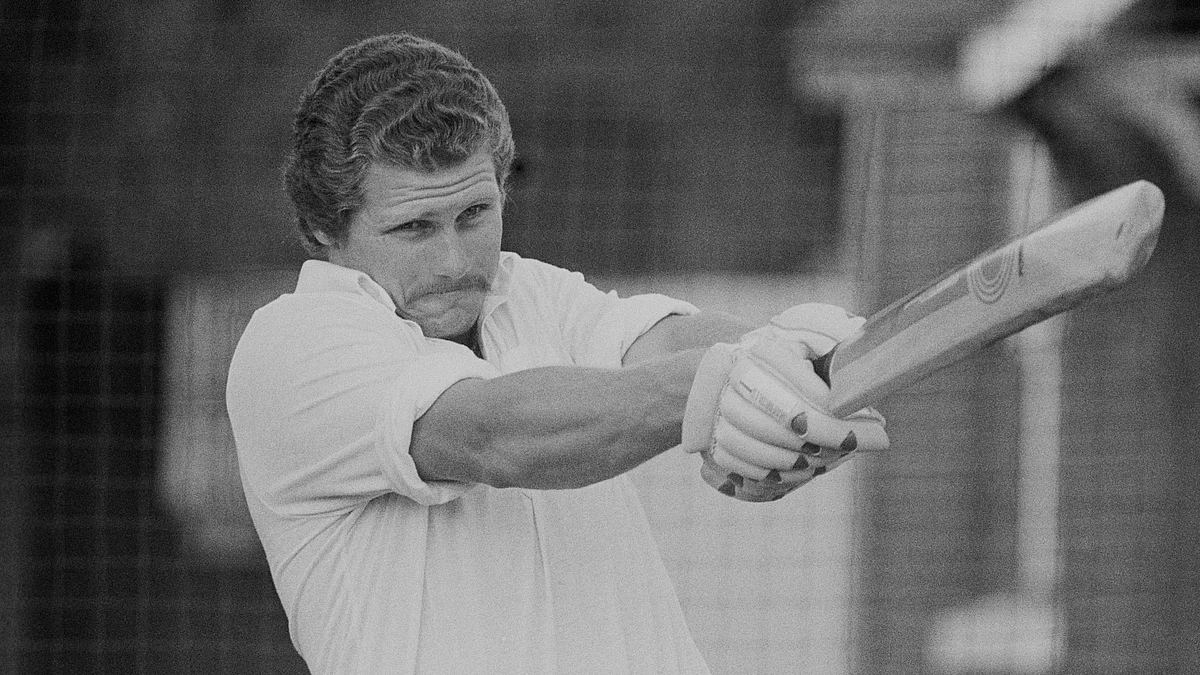


It’s somewhat unfortunate that Robin Smith, the rock in England’s middle order from late Eighties to mid Nineties, has not been celebrated enough as one of their greats.
Nicknamed The Judge, the South Africa-born batter stood out for the character and counterattacking methods he showed during a Test career of over eight years - during which he played 34 of his 62 Tests against the mighty Australia and the West Indies.
The end came in somewhat unfortunate circumstances when Lamb, 62, suddenly passed away at his Perth home on Monday. The cause of his death is not yet known but it’s been common knowledge that Lamb, who relocated to Australia after retirement in 1996, had been struggling with mental health and alcoholism for several months last year.
‘’It is with the deepest and most profound sense of sadness that we announce the passing of Robin Smith,’’ his family said in a statement. ‘’Robin rose to fame as one of England’s most charismatic and popular players. A brave and dashing batsman, he excelled both for Hampshire and his adopted country, collecting legions of admirers and friends along the way.’’
An aggregate of 4,236 runs in 62 matches, including nine centuries and the way he took the Caribbean trio of Malcolm Marshall, Curtly Ambrose and Courtney Walsh, earned him a special place among his peers.
Here’s what Nasser Hussain, former England captain and Smith’s teammate, told New York Times: “When I was growing up, I either wanted to play the David Gower square drive or the Robin Smith square cut. Then I ended up in the same dressing room as the bloke and he could not have been nicer to me.
“He was an incredible player, especially of fast bowling,” said Hussain, now a TV pundit. “There was no greater sight than seeing The Judge either taking on a fast bowler or ducking and weaving out of the way of the fastest bowling.’’ The beefy wrists and the power behind the square cuts are something that stays in one’s memory after having watched a lot of his innings – the swagger often resembling with Allan Lamb, his England peer with South African origins.
A looks at Smith’s Test average of 43.67, vis-à-vis some of the other celebrated batters of England, is telltale. It compares favourably against men like Graham Gooch (42.58), Alec Stewart (39.54), Michael Atherton (37.69), Hussain (37.18), Allan Lamb (36.09), Mike Gatting (35.55) and Graeme Hick (31.32). Only David Gower (44.25) and the late Graham Thorpe (44.66) averaged higher.
An aggressive customer who embraced the shorter form of the game, he was a member of England’s ODI squad who reached the 1992 World Cup final against Pakistan. His unbeaten 167 against Australia at Edgbaston in ‘93 stood as England’s highest ODI score for 23 years until it was eclipsed by Alex Hales in 2016. Not surprisingly, Smith was not happy at missing out on a berth in the playing XI in the ’92 final even after being declared fit after the semis – leaving the England fans to ponder a what-if scenario.
Born in Durban, South Africa, Smith and his older brother Chris moved to England and were stalwarts at Hampshire, helping the county win three domestic one-day trophies over his time at the club. Robin, a one-county man, captained the team from 1998 to 2002.
There is a perception that Smith was not as efficient against high class spin bowling and in ‘93, after averaging only 24 in India before being dismissed seven times in 10 innings by either Shane Warne or Tim May in the Ashes, the scanner was on him about his utility in the sub-continent.
Smith had an operation after that summer on the nagging shoulder injury which destroyed his bullet-like throw from the boundary, but did not flourish under the man-management of Mickey Stewart's replacement Keith Fletcher or new chairman of selectors Ray Illingworth.
Injuries earned Smith a recall against West Indies in 1995 - which included a fractured cheekbone courtesy of Ian Bishop — and a tour ticket to South Africa that winter, but he continued to feel publicly undermined by Illingworth - who was now doubling up as coach after Fletcher’s sacking.
After they crashed out of a chaotic 1996 World Cup on the sub-continent, Smith’s England career was over at the age of 32.
Join our official telegram channel (@nationalherald) and stay updated with the latest headlines