


T20 World Cup: Gambhir’s high risk, high reward approach pays in the end
You don’t fear to lose a game of cricket to win a game of cricket, says the taciturn India coach
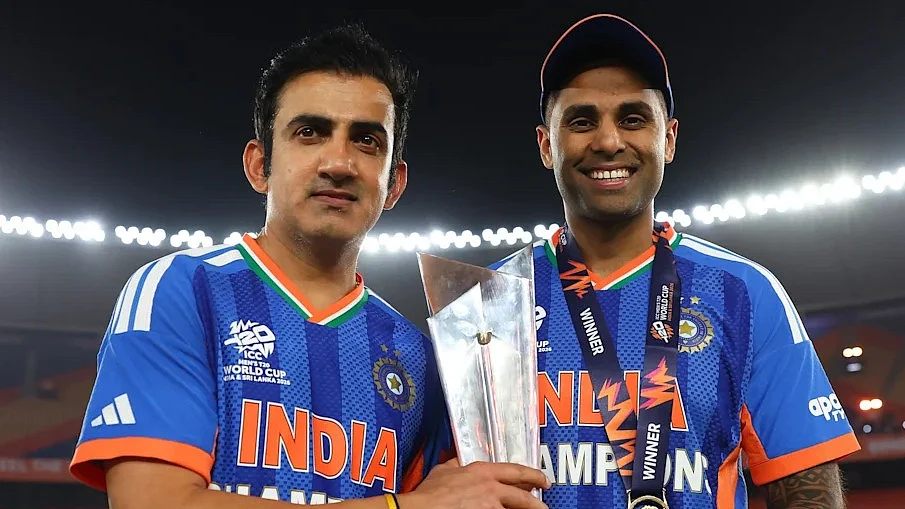


Gautam Gambhir was wearing a broad smile after quite a few months on Sunday night. The recent journey had not been a smooth one, as the 2-0 Test series whitewash against South Africa at home late last year raised questions about his future as the red-ball coach — but those areas of criticism will have to wait for now.
The ICC T20 World Cup trophy was the second major silverware of his tenure after the Champions Trophy in the UAE last year. It also made him the first Indian to win two white-ball World Cups as a player (the 2007 World T20 and the 2011 ICC World Cup) and then cap it with another one as a coach on a balmy night in Ahmedabad on Sunday. The future now looks secure for him, and the normally taciturn ‘GG’, as he is called, can turn his attention to an assault on the elusive ODI World Cup next year.
Having been appointed as the national team coach after three seasons as a mentor in the IPL, Gambhir admitted that he was short on experience in guiding an international team. However, he sought to build the side around certain ethos, including a team-first philosophy and a ‘high risk, high reward’ approach to white-ball cricket.
Asked about the kind of conversation he had with T20 skipper Suryakumar Yadav while drawing up the blueprint for the campaign, Gautam Gambhir said: “The plan was very simple, as I am a different kind of character. Every person sees cricket differently. It’s not fair to compare what kind of team I have built. I have always believed that ‘high risk, high reward’ is the only way to play the T20 format, and you cannot fear losing a game of cricket if you want to win one.”
Speaking during a lengthy media interaction after the triumph alongside Surya, Gambhir added: “If you start fearing losing a game of cricket, you will never win. That’s why, as I said earlier, my ideology with the captain was very simple. We were not going to play for totals of 160–170. I would rather accept getting all out for 100 because 150–160 takes you nowhere.
“So if you play high risk, that’s when you can score 250 or 260 runs. There will be days like that, and it can happen in the future as well. We lost a match against South Africa by 100 runs, but that ideology never changed. That mindset never changed, and I never thought that we should play a little subdued. After the South Africa game, all our matches were must-win matches,” the coach said.
There has never been any doubt about Gautam Gambhir’s understanding of the nuances of the white-ball game. However, it was the previous regime of Rohit Sharma and Rahul Dravid that decided to change the template of India’s T20 approach after the severe mauling at the hands of England in the semi-finals of the 2022 World Cup. While Gambhir singled out his predecessor Rahul Dravid for his support, along with VVS Laxman and chief selector Ajit Agarkar, he was conspicuously silent about the aggressive approach Rohit adopted on the pitch — a style that players like Sanju Samson and Abhishek Sharma have since built upon.
“Look, first of all, I think I should dedicate this trophy to Rahul Bhai and then to Laxman,” Gambhir said. “What Rahul Bhai has done to keep Indian cricket in such good shape — I have to thank him for everything he did during his tenure. Then VVS Laxman, for doing so much for Indian cricket unconditionally, especially behind the scenes, because the COE remains the pipeline for Indian cricket.
“And third is obviously Ajit Agarkar, because he does take a lot of flak, but the amount of honesty with which he has worked is commendable,” he added.
Join our official telegram channel (@nationalherald) and stay updated with the latest headlines