


Three cheers for India, but is cricket having one World Cup too many?
Back-to-back T20 World Cup triumph in less than two years is a testament of India's strength in the format, but many feel it may have come too soon after 2024
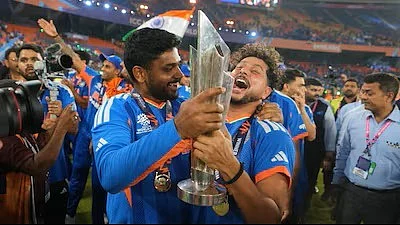


It’s been two days since India became the first country to win back-to-back T20 World Cups—but the social media is still agog with reels, interviews and expert comments on the architects of the triumph. The plethora of felicitations must be round the corner, much as one would expect, but there is also a sneaky feeling that the buzz this time had been significantly less than the euphoria that Rohit Sharma & Co had created when they ended a 13-year drought of a ICC World Cup in 2024.
A matter of perception one may say, but you can’t help getting a feeling that it could be a case of one World Cup too many which may have diluted the impact of the emphatic manner in which the Men in Blue exorcised the ghosts of the 2023 heartbreak in Ahmedabad. Mind you, the recent campaign had it’s ups and downs and did not lack in drama either when India’s semi-final chances were in jeopardy but one could still question whether another World T20 was thrust too soon among us.
The unpopular question is this—has the ICC’s decision to have a T20 World Cup every two years set the law of diminishing returns in motion? A figure of an unprecedented 65.2 million peak concurrent viewers during the India-England semi-final, released by broadcasters Jio Hotstar, may tell a different story, but one has to remember that the level of contest in that game was that of a virtual final.
The match also generated 619 million views on Jio Hotstar, making it the ‘most streamed’ T20 international ever.
Point taken. While one should not take away anything from the grit often showed by the associate countries against the superpowers in the only World Cup they can hope to qualify, but how sustainable is it on the long run? Just ponder this: there will now be three World Cups in a span of four years (2024, 2026 T20 World Cups and 2027 ODI World Cup), along with the revived Champions Trophy which took place last year in the UAE and Pakistan.
Touching upon the subject, former England captain and TV pundit Michael Atherton said he found himself conflicted over the number of World Cups the ICC has on offer—in an era when the appeal of international cricket is under threat of being undermined by the random growth of franchise cricket all over the world. Acknowledging that the World T20 offers a primary platform for the associate nations to showcase their talent, Atherton said: “It’s why I’m a bit conflicted about the number of World Cups that we have. In a way, you think there’s going to be the law of diminishing returns.
‘’If you have a World Cup virtually every year, well, there’s essentially three World Cups every four years with the biennial T20 World Cup and then the quadrennial 50-over World Cup… that makes three out of every four years.”
If you have a World Cup virtually every year, well, there’s essentially three World Cups every four years with the biennial T20 World Cup and then the quadrennial 50-over World Cup… that makes three out of every four yearsMichael Atherton
There is no gainsaying that the four-year hiatus between any two editions of a sporting extravaganza—be it the FIFA World Cup, Euro football, Rugby World Cup or Olympics (the World Athletics is a bi-annual event though)—makes the air of anticipation far greater. It’s a different ballgame though in cricket, the only sport with three official formats, and it’s world governing body is insistent that a World T20 every other year is the only way to drive it’s growth—not to speak of honouring the broadcasters’ terms as it’s the most lucrative format for monetization.
Speaking at a media interaction when the ICC rolled out it’s events calendar from 2024 to 2031, ICC CEO Geoff Allardice argued: ‘’I think the decision to play T20 World Cups every two years is a conscious one to try and position T20 as the growth format of the game across all of our members. The tournament we’ve just finished in the UAE and Oman was the first one in five years which, given the amount of T20 international cricket being played and the fact that so many of our members are playing that format, is too long. The aim is to get it on a two-year rotation so that in terms of event that becomes a more consistent frequency.''
It was, however, the pandemic which extended the gap between the 2016 and 2021 edition of the World T20. Thereafter, the sequence of World T20 had been as follows: 2021, 2022, 2024 and now 2026. Under the circumstances, what was the pressing need for the ICC Champions Trophy, which was revived after eight years despite the ODI format fighting for a battle of relevance? The ICC CEO felt that tournament is a ‘’focal point’’ for ODI cricket midway the four-year World Cup cycle.
‘’In terms of the Champions Trophy it’s a very popular, well-supported event. I think it’s short and sharp and you know, high entertainment in the ODI format and it also provides a focal point for ODI cricket in the midway between the Cricket World Cup cycle of four years,” he had said.
Well, too much of a good thing (read: white ball cricket), as they say, may not often be that good!
Join our official telegram channel (@nationalherald) and stay updated with the latest headlines