


India’s wholesale inflation stays negative in November as price pressures ease
Fall in food and fuel prices keeps WPI in contraction zone; RBI sees benign inflation outlook


India’s wholesale price inflation remained in the negative zone in November, reflecting easing price pressures across key commodities, official data released on Monday showed.
Inflation based on the Wholesale Price Index (WPI) stood at (-) 0.32 per cent in November, compared with (-) 1.21 per cent in October and 2.16 per cent in November last year, according to figures from the Ministry of Commerce and Industry.
The ministry said the continued negative reading was largely driven by a decline in prices of food articles, mineral oils, crude petroleum and natural gas, basic metals and electricity.
Retail inflation, measured by the Consumer Price Index (CPI), was estimated at 0.71 per cent in November, marginally higher than 0.25 per cent in October, according to data released earlier by the Ministry of Statistics and Programme Implementation.
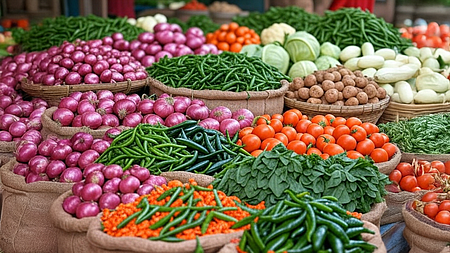
Food inflation remained firmly in negative territory at (-) 3.91 per cent in November, marking the sixth consecutive month of year-on-year decline. Officials said the sustained fall in food prices has provided relief to household budgets and helped anchor overall inflation.
The broader inflation outlook remains benign. The Reserve Bank of India has lowered its forecast for inflation in the 2025–26 financial year to 2 per cent, down from 2.6 per cent projected in October, citing sharply lower food prices and the impact of GST rate cuts.
RBI Governor Sanjay Malhotra recently announced a 25 basis point cut in the repo rate to 5.25 per cent, saying the easing inflation environment had allowed monetary policy to focus more on supporting economic growth.
Malhotra described the combination of strong growth and moderating inflation as a rare “Goldilocks period” for the Indian economy, noting that economic growth accelerated to 8.2 per cent in the second quarter of the current financial year while inflation fell sharply.
“The Monetary Policy Committee noted that headline inflation has eased significantly and is likely to remain softer than earlier projections, primarily due to exceptionally benign food prices,” he said, adding that inflation projections for 2025–26 and the first quarter of 2026–27 had been revised further downwards.
The governor also pointed out that core inflation — excluding food and fuel — remained largely contained in recent months despite pressure from precious metals. Excluding gold, core inflation eased to 2.6 per cent in October.
Food supply prospects have improved due to higher kharif output, healthy rabi sowing, adequate reservoir levels and favourable soil moisture conditions, Malhotra said, while noting that global commodity prices, barring some metals, are expected to soften going forward.
With IANS inputs
Join our official telegram channel (@nationalherald) and stay updated with the latest headlines