


Delhi’s air quality deteriorates again, AQI rises to 319 in ‘very poor’ category
Pollution continues across the NCR, while weather forecasts indicate little immediate relief, with no rainfall expected until 15 November
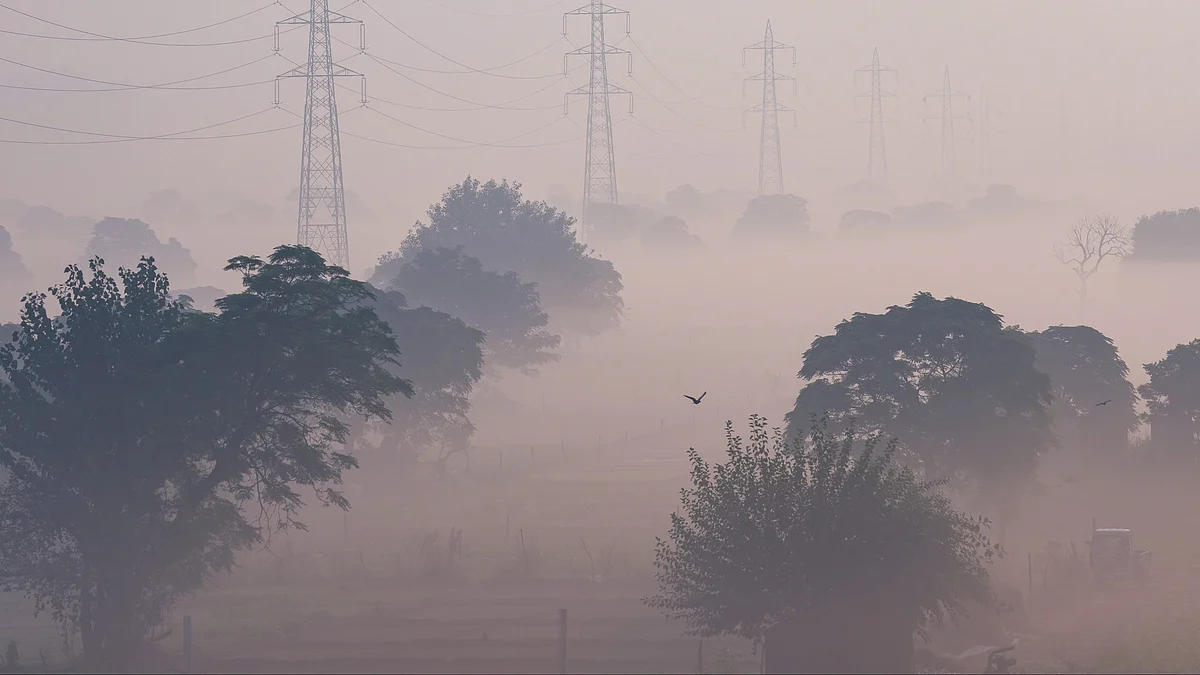


Delhi's AQI rose to 319 on Thursday, returning to the 'very poor' category, with several areas recording levels above 350
Pollution continues across the NCR, while weather forecasts indicate little immediate relief, with no rainfall expected until 15 November
Delhi's PM2.5 levels were the highest in three years for the week before Diwali, with AQI peaking at 376 on 8 November
Delhi's air quality deteriorated on Thursday, ending a brief period of improvement as the city's overall Air Quality Index (AQI) climbed to 319, placing it back in the 'very poor' category.
According to the latest readings from air quality monitoring stations, several parts of the national capital continued to experience dangerously high pollution levels. Pusa and NSIT Dwarka recorded the highest AQI of 388 each, followed by Chandni Chowk at 387 and JNU at 380.
Other severely affected areas included Punjabi Bagh (373), Chhawla (369), Aya Nagar and CRRI Mathura Road (366 each), and Talkatora Garden (365).
High pollution levels were also reported in Jahangirpuri (342), Wazirpur (336), Ghummanhera (334), Tikri Kalan (322), Anand Vihar (319), Ashok Vihar (317), Burari (316) and Bawana (316). Meanwhile, Nangloi recorded 297, Sonia Vihar 298, Maidan Garhi 290, Karala 258 and Ghoga 232.
Pollution remained elevated across the wider National Capital Region (NCR) as well. Gurugram recorded an AQI of 300, while Noida registered 284, Ghaziabad 280 and Faridabad 270.
Weather conditions are unlikely to bring significant relief from pollution in the coming days. According to forecasts, Delhi's maximum temperatures are expected to remain between 27 and 30 degrees Celsius, while minimum temperatures are likely to range from 14 to 17 degrees Celsius until November 15.
On Thursday, the maximum temperature is expected to settle between 27 and 29 degrees Celsius, with the minimum ranging from 15 to 17 degrees Celsius. Similar conditions are forecast for Friday and Saturday, with daytime temperatures likely to remain between 28 and 30 degrees Celsius.
The India Meteorological Department (IMD) has forecast no rainfall in Delhi between November 10 and 15. Although a Western Disturbance is approaching, no significant change in temperatures is expected.
Delhi's air pollution had started worsening even before the Diwali celebrations. An analysis by the Centre for Science and Environment (CSE) found that the average PM2.5 concentration during the week preceding the festival reached 236 micrograms per cubic metre, the highest level recorded for the corresponding period in three years.
The concentration was 97 per cent higher than the 120 micrograms recorded in 2025 and 32 per cent above the 179 micrograms reported in 2024.
Pollution levels rose further around Diwali, with the city's average AQI reaching 376 on November 8, compared with 345 during Diwali in 2025.
According to reported Central Pollution Control Board (CPCB) figures, Delhi's AQI subsequently stood at 344 on 9 November, 299 on 10 November and 313 on 11 November, before rising again to 319 on Thursday.
The latest readings highlight the persistent air pollution challenge facing Delhi and neighbouring NCR cities, with weather conditions offering little immediate prospect of improvement.
With IANS inputs