


Norwegian envoy highlights environment cooperation: Norway's climate investments in India at a glance
Norwegian ambassador highlights forests, oceans and plastic waste cooperation; says investments in India’s green initiatives will deepen through joint projects
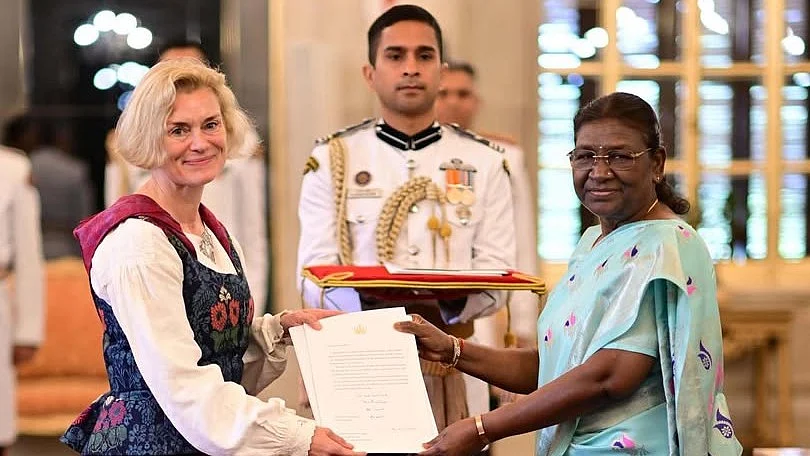


Environmental protection and climate action remain central to Norway’s engagement strategy with India, Norwegian Ambassador May-Elin Stener said on Thursday, underlining growing cooperation on forests, oceans and nature-based solutions as both countries expand bilateral climate partnerships.
Speaking to the press on the sidelines of the World Sustainable Development Summit 2026, the envoy said developing countries could significantly scale up nature-based solutions through international collaboration backed by sustained financial and technical support. The 25th edition of the World Sustainable Development Summit is being held from 25–27 February at the Taj Palace, New Delhi, under the umbrella theme: Transformations : Vision, Voices, and Values for Sustainable Development.
“Norway is a strong supporter of nature-based solutions, and we are happy to work internationally on these solutions. We have two big tracks in which we are working -- forests and oceans,” she said.
Highlighting the broader framework of ties with New Delhi, Stener said environmental protection and climate action formed one of the core pillars of bilateral cooperation. “Among the four to five pillars of our cooperation with India is the protection of the environment and combating climate change. That will continue to be a core component of our cooperation,” she said.
Referring to global conservation efforts, the envoy pointed to Norway’s support for rainforest preservation through initiatives such as the Tropical Forest Forever Facility. “We will continue to support preservation of the rainforests because they are crucial to the climate in the world,” she said.
Describing Norway as an “ocean nation like India”, Stener said both sides were expanding collaboration under blue economy partnerships. “We have a task force on the blue economy and an overall oceans cooperation with India. We are working internationally to preserve the oceans and to look ahead for better solutions for nature and to combat climate change,” she said.
She also referred to Norway’s marine pollution initiatives aimed at reducing plastic waste along India’s coastlines. “It is an initiative to combat plastic waste. We are cleaning plastic waste together with Indian stakeholders and looking at how waste can be better treated. We are doing that across India and will continue to do so,” she added.
Norway’s investments in India’s green initiatives
Towards the end of the interaction, the envoy detailed Norway’s financial and technical contributions to India’s environmental programmes, saying Oslo has backed several projects focused on marine litter management, renewable energy transitions and sustainable coastal development.
Norway has supported collaborations with Indian research institutions, municipal bodies and private partners to improve waste management systems and promote circular economy models.
Norway’s climate-related investments in India are presently estimated at Rs 1,200 crore across renewable energy, grid infrastructure and waste-to-energy projects, reflecting New Delhi’s status as a priority market for Norway’s Climate Investment Fund.
The fund, managed by Norfund, has a global allocation of 10 billion Norwegian kroner (NOK) — roughly $1 billion — for its first five years, with India identified as a key destination for capital aimed at accelerating decarbonisation. Norway’s overall climate finance globally reached 16.5 billion NOK in 2023, with developing countries, including India, accounting for a major share of the expansion.
Although Norway does not publish a single cumulative India figure, official announcements indicate several large investments worth hundreds of millions of dollars across multiple sectors.
Key Norwegian climate investments in India
1. Thar Surya 1 Solar Project – Rajasthan
Norway’s Climate Investment Fund and KLP hold a 49% stake valued at about Rs 280 crore.
Capacity: 420 MW DC (300 MW AC).
Expected generation: over 750 GWh annually.
Estimated emissions reduction: more than 615,000 tonnes of CO₂ each year.
This utility-scale solar project is part of India’s broader renewable expansion and contributes to reducing reliance on coal-based electricity.
2. ReNew Power Transmission Project – Koppal, Karnataka
Investment of about Rs 90 crore for a 49% ownership stake.
First grid-infrastructure investment by the Climate Investment Fund in India.
Signals Norway’s shift from only funding power generation to strengthening transmission networks needed for renewable integration.
Officials have described the project as a stepping stone for further joint investments in India’s electricity grid.
3. SAEL Platform – Solar and Agri Waste-to-Energy
Norway has made one of its largest climate bets in India through SAEL, a company combining solar energy with crop-residue power generation.
Key details include:
Initial equity investment of about Rs 500 crore in 2023.
Estimated to help avoid over 2.8 million tonnes of CO₂ annually.
Uses agricultural residue instead of open burning, helping reduce North India’s air pollution.
More than 20 projects are operational or under construction.
By October 2025, Norfund’s total investment in SAEL had reached about $130 million, including an additional $20 million expansion round. A related waste-to-energy initiative backed by the Climate Investment Fund has also been valued at roughly €56 million.
Earlier investments and portfolio expansion
Before its grid-sector entry, the Climate Investment Fund had already backed:
A large-scale solar park developed with Enel Green Power.
Fourth Partner Energy, a distributed solar developer focusing on rooftop and commercial installations.
These projects reflect Norway’s attempt to support both centralised and decentralised clean-energy systems in India.
Sectoral focus of Norway’s climate finance
Norwegian funding in India is concentrated in areas considered critical for energy transition:
Utility-scale solar: Large projects like Thar Surya 1 provide long-term clean electricity.
Distributed solar: Rooftop and industrial systems cut emissions directly at consumption points.
Transmission infrastructure: Investments such as the Koppal project help integrate renewable power into the grid.
Waste-to-energy: SAEL’s model addresses both climate change and air pollution by reducing stubble burning.
Why India is a priority market
Norway has repeatedly described India as a strategic focus for climate finance due to its large coal-based energy system and growing clean-energy demand. Norwegian officials cite estimates from BloombergNEF suggesting India may need about USD 233 billion in wind and solar investment by 2030.
The Climate Investment Fund is positioned as one of Norway’s main tools to mobilise private capital for decarbonisation in developing economies, with India featuring prominently in diplomatic and policy statements.
Join our official telegram channel (@nationalherald) and stay updated with the latest headlines