


Firecrackers contributed 71 pc of Delhi's PM2.5 after Diwali: IITM assessment
A separate estimate put fireworks' contribution to the capital's pollution load at over 80% on 9 November, while vehicular emissions accounted for 6.9% of PM2.5 during the morning assessment window
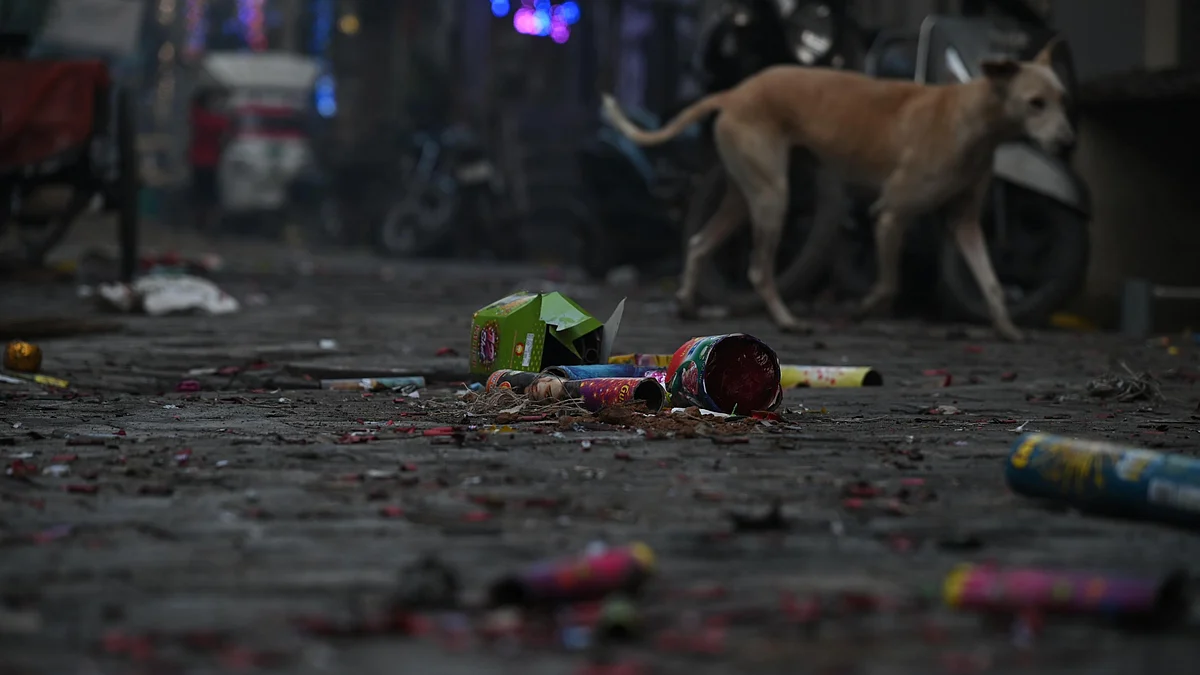


Firecrackers contributed 71.1 per cent of Delhi's PM2.5 concentration between 1 am and 9 am on 9 November, a day after Diwali, according to a source-apportionment assessment by the Indian Institute of Tropical Meteorology (IITM).
A separate IITM estimate put the contribution of fireworks at more than 80 per cent of the capital's pollution load that day. The assessment points to a sharp change in the composition of Delhi's pollution around Diwali, even as the city was already experiencing poor air quality.
Firecrackers accounted for 43.4 per cent of PM2.5 during the corresponding hours on 8 November, compared with 5.6 per cent on 7 November. Their contribution stood at 5.6 per cent on 5 November and 9.3 per cent on 6 November.
Vehicular emissions accounted for 6.9 per cent of PM2.5 during the 9 November assessment window. Secondary inorganic aerosols contributed 5 per cent, while secondary organic aerosols accounted for 4.5 per cent.
The spike was also reflected in pollution-monitoring data. PM2.5 concentrations in Jahangirpuri reportedly reached 4,985 micrograms per cubic metre at 3 am on 9 November, while Nehru Nagar recorded 2,808 micrograms per cubic metre.
However, the Jahangirpuri reading was subsequently revised to 776 micrograms per cubic metre by the Delhi Pollution Control Committee (DPCC).
Weather conditions and air quality
Low wind speeds contributed to pollutants remaining suspended in the atmosphere for longer, prolonging the impact of the post-Diwali emissions. Wind speed, direction, temperature and humidity influence how pollutants disperse, according to the India Meteorological Department.
Delhi's average Air Quality Index (AQI) stood at 376 on Diwali, 8 November, placing it in the 'very poor' category. It improved to 299 at 4 pm on 10 November, entering the 'poor' category, before rising to 302 by 6 pm.
The AQI stood at 308 on Wednesday morning, remaining in the 'very poor' category. A further improvement was expected over the next few days as wind speeds were likely to increase.
Trade body questions findings
The IITM assessment has been questioned by the Chamber of Trade and Industry (CTI), whose chairman Brijesh Goyal said firecrackers were being unfairly blamed for Delhi's pollution.
Goyal acknowledged that fireworks cause smoke but argued that their impact is temporary. He said pollution levels remained high between October and January, even before Diwali, and called for attention to stubble burning and other sources.
The trade body pointed out that Delhi's AQI was between 350 and 400 on 5, 6 and 7 November, before firecrackers were burst on 8 November.
Pollution and cardiovascular health
Doctors have also warned that prolonged exposure to polluted air can affect cardiovascular health, in addition to causing respiratory problems such as coughing, wheezing, breathlessness and worsening asthma.
Pulmonologist Dr Arvind Kumar told NDTV that extended periods of poor air quality can increase the risk of cardiovascular emergencies, including heart attacks, strokes and dangerously elevated blood pressure.
He said there was evidence linking spikes in air pollution to an increase in the number of people reporting to hospitals with heart attacks in the following days.
A 2025 study cited in the report analysed 41,436 hospital admissions in Delhi, including 11,494 cardiovascular events. It found that cardiovascular events increased during months with higher pollution levels.
Join our official telegram channel (@nationalherald) and stay updated with the latest headlines