


From world’s largest iceberg to melting fragments: Final days of A23a amid global warming
Once the largest iceberg on Earth, the Antarctic giant has rapidly disintegrated in warmer Atlantic waters and may disappear within weeks
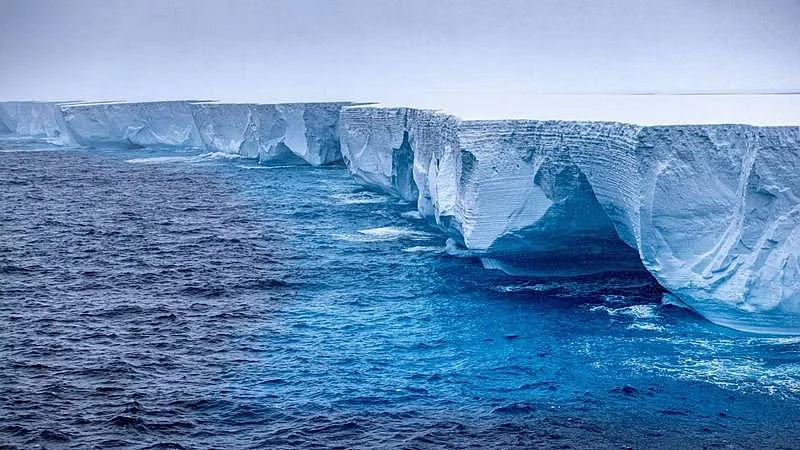


Far from the upheavals the middle east, scientists tracking one of the world’s most famous Antarctic icebergs say the giant mass known as A23a is now approaching the end of its life, thanks to the global warming.
The iceberg has drifted across the Southern Ocean for nearly four decades.
Once the largest iceberg on Earth, the massive block of ice has rapidly weakened and fragmented over the past year as it moved into warmer waters far north of Antarctica. Researchers told BBC that the remaining pieces are now melting quickly in the South Atlantic and could disappear within weeks.
At its peak, A23a covered more than 4,000 square kilometres, making it larger than many cities and more than twice the size of Greater London. Over the past year, satellite imagery has shown the iceberg breaking apart and shrinking as warmer ocean temperatures eroded it from both above and below. Scientists studying the iceberg say its final stages offer a rare chance to understand how large Antarctic ice structures behave as they drift into warmer seas.
Origins in Antarctica
The iceberg’s story began in 1986, when a large section of the Filchner Ice Shelf in Antarctica broke away in a process known as calving. At the time, the newly formed iceberg measured around 4,000 square kilometres.
Soon after breaking off, the iceberg became grounded in the Weddell Sea, where it remained stuck on the seabed for more than 30 years. During that time it barely moved, effectively remaining in the same region until scientists noticed signs in 2020 that it had finally begun drifting again.
Once freed, ocean currents slowly pushed A23a northwards along a route often referred to by researchers as “Iceberg Alley”, a pathway commonly followed by Antarctic icebergs moving into the South Atlantic.
Long and unusual journey
The iceberg’s movement proved unpredictable. At one stage it became trapped in a rotating ocean current known as a Taylor Column, spinning slowly in place for nearly eight months.
It later drifted toward South Georgia Island, where many Antarctic icebergs eventually melt. A23a again appeared stuck for several months before breaking free once more and continuing north.
Scientists say the iceberg’s longevity alone made it remarkable. Although other icebergs have travelled farther, few have survived for such long periods while remaining large enough to track.
hristopher Shuman, a retired glaciologist formerly with the University of Maryland, said following A23a’s path over the years had been unpredictable.
“Its journey is really pretty impressive, just for sheer longevity,” he said, comparing tracking the iceberg to watching a drama where the outcome remained uncertain.
Rapid decline in recent months
Despite remaining stable for decades, A23a’s condition changed rapidly during 2025. At the start of that year the iceberg still measured around 3,600 square kilometres, meaning it remained enormous even after nearly 40 years.
But as it drifted further north into warmer waters, the iceberg began losing mass quickly. Large pieces broke away while ocean water gradually eroded the base and sides of the ice.
Aerial observations — including Royal Air Force training flights — captured images of smaller icebergs splitting away from the main block.
Later in August and September, the iceberg moved across the North-west Georgia Rise, an underwater feature about 1,500 kilometres east of the Falkland Islands. Scientists believe ocean currents interacting with this raised seabed placed additional stress on the already weakened iceberg.
Soon afterwards, several large fragments separated from A23a. These pieces were significant enough to receive their own names — A23g, A23h and A23i — continuing the naming system used for Antarctic icebergs.
Melting from above and below
In December, during the Southern Hemisphere summer, warmer air temperatures caused pools of bright blue meltwater to form on the iceberg’s surface. These pools became trapped within raised edges of ice known as ramparts.
Scientists say the weight of this water likely triggered a process called hydrofracturing, where water seeps into cracks and forces them to widen.
Catherine Walker of the Woods Hole Oceanographic Institution said this process can rapidly weaken an iceberg once water begins penetrating its internal fractures.
Satellite images later showed a chaotic mixture of broken ice fragments surrounding the iceberg — evidence of what scientists believe was a sudden drainage of meltwater that caused parts of the ice to collapse.
Final weeks expected
Over the 11 days leading up to 22 February, the now weakened iceberg travelled more than 700 kilometres northeast across the South Atlantic as ocean currents carried it further into warmer waters.
Surface temperatures in these waters approach 10°C, dramatically accelerating melting.
“Every day, all day, it’s in warmer and warmer water,” Shuman said. “It’s just like ice in your drink. It doesn’t take all that long to disappear.”
By 5 March, A23a had shrunk to around 180 square kilometres, a small fraction of its original size.
Scientists say once the iceberg reduces to roughly 70 square kilometres, it will no longer be tracked. Researchers believe that point may be reached soon.
Adrian Luckman of Swansea University said the remaining fragments are unlikely to last long.
“All traces will probably have disappeared in a matter of weeks now, at most,” he said.
While the melting of large icebergs is a natural process, researchers say studying A23a’s disintegration offers valuable clues about how Antarctic ice shelves — which help stabilise glaciers — might respond to rising ocean temperatures in the future.
Join our official telegram channel (@nationalherald) and stay updated with the latest headlines