


Ken-Betwa project: tribals paying the price for a river-linking misadventure
Thousands of tribal and rural families in Madhya Pradesh stand to lose not only their property but also a vital part of their cultural identity as they battle a ruthless state administration
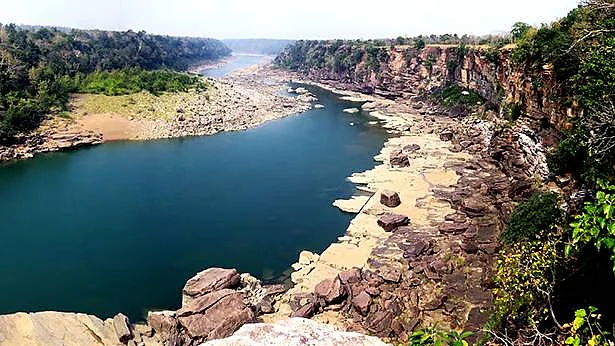


The flattened hillocks of Dodhan village, nestled deep within the core area of Panna National Park in Madhya Pradesh's Chhatarpur district, have been transformed into a modern-day Kurukshetra.
It has indeed become a dharmyudh. On one side are the displaced villagers of Dodhan and nearby Palkuwan who, like the Pandavas, are asking only for what is rightfully theirs—a home for a home, zameen ke badle zameen (land in exchange for land).
Against them stand, akin to the Kauravas, the allied forces of a double-engine BJP government, a ruthless state and local administration and a weaponised police force. This administration appears to have little regard for justice. It seeks to take everything—the villagers' right to live peacefully, their homes, fields, livelihoods, culture, traditions and, above all, their self-respect and dignity.
Similar to a chakravyuh designed to break their spirit, these villages have been isolated and virtually cut off from the rest of the world.
As someone who has closely monitored this administrative misconduct on the ground, it is heartbreaking to witness innocent, largely illiterate tribal communities and farmers being treated as enemies on their own land. Their relatives cannot reach them. The sick cannot leave to seek medical treatment.
With ration supplies running dangerously low, families are being forced to boil wheat simply to feed themselves and their children. In the scorching summer heat, electricity has remained disconnected for weeks. Deep trenches have been dug around the villages and roads have been blocked, leaving tribal residents trapped like hostages on their ancestral land and forced to drink contaminated water. This is indeed a Mahabharata-like battle—between right and wrong, between justice and injustice.
The Ken-Betwa River Linking Project (KBLP) is being projected as a "curtain raiser" for river-linking projects across India. It is an ambitious Central government initiative with a staggering budget of Rs 44,605 crore. In its first phase alone, the project directly affects 22 villages—eight in Panna district and 14 in Chhatarpur district—impacting approximately 7,193 families.
All at stake
Thousands of tribal and rural families are surrendering their ancestral land and homes in the name of the "public interest". Their existence is inseparably linked to jal, jangal, zameen—water, forest and land. Through this project, they stand to lose not only their property but also a vital part of their cultural identity. These villagers are not opposed to development. Their grievance is that the interests of indigenous communities are being systematically ignored in the process.
The project is being implemented in an unjust and coercive manner. One would expect the administration to adopt a compassionate and humane approach towards tribal communities facing displacement. Instead, a policy of repression has been unleashed.
As of April 2026, most affected families have outright rejected the rehabilitation package they have been offered. A complete lack of transparency in the displacement process, combined with glaring discrepancies in land surveys and instances of unpaid or partially paid compensation, has created deep distrust towards the government.
Villagers allege they are being evicted and their homes demolished without prior notice or compensation.
Many have been protesting for months, demanding only what they consider basic and legitimate rights—genuine gram sabha consultations, transparent surveys, compensation based on prevailing market rates and the provision of land in exchange for land to secure their future livelihood.
Yet this humanitarian crisis is merely the tip of the iceberg. The structural design of the Ken-Betwa Link Project reveals what many perceive as a deeper regional imbalance.
Also Read: An idea delinked from commonsense
While the government presents it as a boon for the entire Bundelkhand region, critics argue that Madhya Pradesh is bearing the overwhelming ecological and human cost while a substantial share of the irrigation and water benefits will flow into neighbouring Uttar Pradesh.
To build the Daudhan Dam, Madhya Pradesh is sacrificing a significant portion of its natural wealth. The submergence area will inundate nearly 9,000 hectares of land, including approximately 5,800 hectares within the core zone of the Panna Tiger Reserve. In addition, between 18 lakh and 23 lakh trees are expected to be felled to make way for canals, offices, roads and associated infrastructure.
Even the Supreme Court-appointed Central Empowered Committee (CEC) had earlier raised concerns warning that the irreversible environmental damage to one of India's premier tiger habitats and wildlife ecosystems could outweigh the projected developmental gains of the project.
Critics further argue that the Madhya Pradesh government has effectively surrendered the state's natural resources and long-term water security, permitting extensive ecological destruction while downstream regions outside the state's borders stand to benefit.
Why is a project facing such significant environmental concerns and local resistance being pursued with such determination? Many activists point to the role of the corporate-political nexus.
Questions have also been raised about the transparency of the bidding process. NCC Limited, the company awarded the construction contract, donated electoral bonds worth Rs 60 crore to the ruling BJP in October 2022. It subsequently secured the Rs 3,389.49 crore Daudhan dam contract, with the Letter of Award issued on 28 November 2024.
Critics argue that the sequence of events creates the perception that tribal homes, ancient forests and the rights of Madhya Pradesh are being sacrificed in favour of corporate interests.
To ensure that opposition to the project does not impede its progress, the administration has allegedly sought to weaken local resistance by targeting grassroots leadership. When local activists attempted to raise concerns about the plight of affected villages, criminal cases were allegedly filed against them. Critics contend that by silencing those demanding accountability, the administration hopes to suppress dissent altogether.
A government that promises Sabka Saath, Sabka Vikas, Sabka Vishwas should be judged by its actions rather than its words.
A project that leaves tribal children without electricity in peak summer, pushes families towards hunger, surrounds villages with trenches, destroys millions of trees despite expert warnings and redistributes a state's natural resources amid allegations of political favouritism cannot automatically be described as development. To many affected communities, it resembles state-sponsored exploitation.
One cannot remain a silent spectator while people are treated as collateral damage. The administration must immediately halt repressive measures, withdraw politically motivated cases against local activists, remove physical blockades around Dodhan and Palkuwan, conduct fresh gram sabha consultations based on free and informed consent, undertake transparent surveys, and uphold the constitutional principle of zameen ke badle zameen. Compensation and rehabilitation must precede displacement.
Development should first ensure dignity and justice for local communities; otherwise, it risks being perceived not as public welfare, but as a corporate land acquisition project disguised as development.
(The writer is MPCC general secretary)
Also Read: The irreversible course of damage
Join our official telegram channel (@nationalherald) and stay updated with the latest headlines