


Rajasthan: Captive-bred great Indian bustard killed by desert fox 4 days after release
The 6-month-old bird was attacked while drinking water at a pond in Jaisalmer’s Desert National Park, raising questions about release protocols
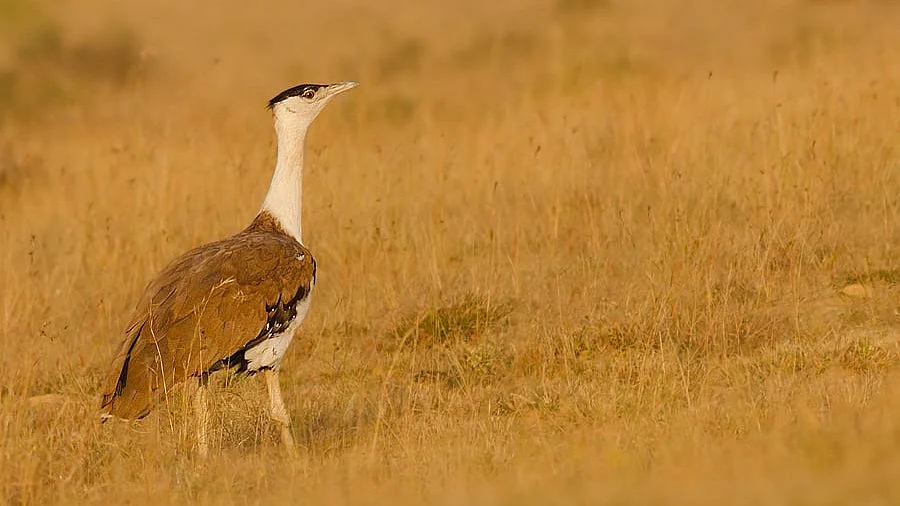


A six-month-old male Great Indian Bustard (GIB), a critically endangered species, was killed by a desert fox just four days after being released into the wild at the Desert National Park in Rajasthan’s Jaisalmer district, officials said on Wednesday.
The bird was released on 14 October as part of the government’s conservation programme, under which 11 captive-bred bustards have been identified for release. The Wildlife Institute of India (WII) is reviewing its protocols and safety measures but officials said the incident would not affect the programme.
According to officials, the bird was attacked on 18 October while drinking water at a pond in the Sam area. A fox hiding in nearby bushes reportedly carried out the attack.
WII director Gobind Sagar Bhardwaj said scientists detected the incident after the bird’s satellite-tracking signal stopped transmitting. A field team reached the location and found feathers and other remains, but the fox had fled.
The team recovered the satellite-tracking device, while blood samples collected from the site were sent to a laboratory for examination.
Union environment minister Bhupender Yadav released two captive-bred bustards on 4 October, followed by two more males on 14 October. Of the four birds released so far, one has died and the other three remain safe, officials said.
Bhardwaj said predation was a natural occurrence in the wild and that foxes were a normal part of the birds’ habitat. Field teams are continuing to monitor the surviving bustards. No final decision has been taken on releasing the remaining seven birds.
The Great Indian Bustard (Ardeotis nigriceps) is a large, ground-dwelling bird native to the Indian subcontinent. It can stand up to 1.2 metres tall and weigh as much as 15 kg, making it one of the world’s heaviest flying birds.
The species is listed as critically endangered on the International Union for Conservation of Nature’s Red List. Its population is estimated at 130 (±21), according to a WII report released on 9 July. The report said the population had remained broadly stable since the previous estimate of 128 (±19) in 2017-18.
The bird is also protected under Schedule I of India’s Wildlife (Protection) Act, 1972, and Appendix I of both the Convention on International Trade in Endangered Species of Wild Fauna and Flora and the Convention on Migratory Species.
Join our official telegram channel (@nationalherald) and stay updated with the latest headlines