


Messi and Argentina: When a second coming provided the turning point
The glorious journey after a shortlived retirement following 2016 Copa America final has silenced the doubters for ever
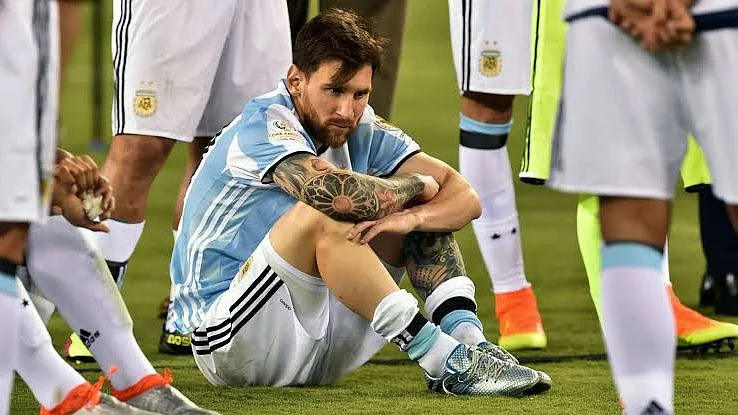


Almost an entire day has passed since Lionel Messi called time, albeit expectedly, on his two-decade long stellar international career. With our paens of praise all exhausted after his stellar show in Qatar as well the US for last four years, it’s difficult to find out what is left at all to be said.
What came back to me was a solitary frame of Messi, teary-eyed, though not from the 19th July night after missing out on what could have been his second World Cup in a row. It was from 10 years back in 2016 when the master announced his international retirement after seeing the Copa America elude his grasp to Chile, of all things, in a penalty shootout in the final – incidentally on the US soil in New Jersey.
The disappointment was too much as Messi, then 29, had already spent a decade in Argentine stripes and didn’t have any major piece of silverware to show except the Olympics gold. ‘’For me, the national team is over,’’ said Messi. ‘’I’ve done all I can. It hurts not to be a champion,’’ he famously lamented. The depths of despair was understandable – and what must have been even more galling was that it fuelled the murmurs whether Messi was always at his best in Barcelona colours but as much for La Albiceleste.
Just ponder over how many so-near-yet-so-far cases Messi had endured in the first decade in the white-and-blue. They reached the 2014 World Cup final in Brazil, only for Messi to see them go down via a Mario Gotze strike to Germany after extra time. A year later, Messi and Argentina were back in a major final, this time at the centenary edition of America but lost out to Chile.
The final finished goalless after extra time before Chile prevailed in the penalty shootout. Messi, of all people, missed Argentina’s first penalty and the defeat became the fourth major final he had lost with the national team following 2007 Copa, 2014 World Cup and 2015 Copa as well. Messi rescinded his 2016 retirement after just six weeks and went on to win his first major senior trophy with Argentina in 2021 and then completed the ultimate mission by lifting the World Cup in 2022.
Messi's decade-long redemption story transformed his place in Argentina's football history as arguably their best - and I am ready to stick my neck out on this, you know why. For all the genius that he has been blessed with, I feel his resilience and willpower to rise against the odds had often gone under the radar. Unlike his career with Barcelona which bred an interrupted run of success with trophies, goals galore and the Ballon d’Or success in Argentina colours didn’t come overnight.
His second coming in 2016 marked the turning point alright, but the return did not instantly solve Argentina’s problems. At the 2018 World Cup in Russia, Argentina struggled in the group stage before Messi scored against Nigeria to help them reach the knockout rounds. However, their campaign ended in the last 16 with a 4-3 defeat to eventual champions France.
Then came another setback at the 2019 Copa America when they lost to Brazil in the semi-finals and eventually finished third after beating Chile. Messi’s international comeback was again beginning to get sour but an interesting facet was quietly taking place with new coach Lionel Scaloni and Messi drawing up the blueprint of a new Argentina.
The unheralded Scaloni initially took charge as caretaker after the 2018 World Cup and was subsequently given the permanent job. Under Scaloni, they gradually became a more balanced and cohesive team with Messi no longer carrying the entire burden himself with the emergence of Angel Di Maria, Rodrigo De Paul, Lautaro Martinez and Emiliano Martinez.
Messi’s breakthrough moment finally arrived in the form of the 2021 Copa America in Brazil, exactly five years after he announced his retirement following defeat in the final of the same tournament. The final against Brazil was played at the Maracana, a venue where Argentina had endured so many painful memories in previous years. This time, there was no shootout and no late heartbreak.
Di Maria scored the only goal of that final and Messi shook off the albatross around his neck to become a senior international champion. After nearly 15 years of trying with the senior national team, he could finally lay his hands on the first major trophy with Argentina. As Messi fell to his knees at the final whistle, his teammates surrounded him and the significance of the moment was not lost on anyone.
It galvanised the squad and the Finalissima followed in 2022, the big prize in Qatar and another Copa in 2024. Their journey in the last World Cup was no less exhilarating as they lived dangerously and despite losing the final in an anti-climactic fashion, it surely capped a surreal 10 years of Messi on his second coming.
It seemed almost like a game of two halves for him!
Join our official telegram channel (@nationalherald) and stay updated with the latest headlines