


108,000 US troops in 160 countries, defence officials tell senators
Officials from the United States Marine Corps stressed their role as a rapid-response force ready for global crises
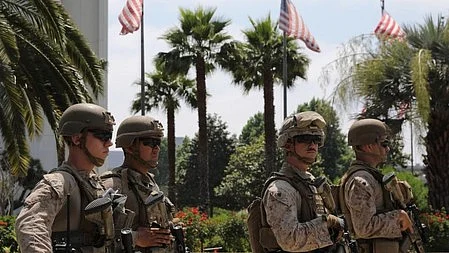


In testimony that underscored the vast reach of American military power, senior US defence officials revealed that more than 108,000 US soldiers are currently deployed or forward-positioned across 160 countries, reflecting the global scale of Washington’s security commitments even as it confronts a volatile conflict with Iran and intensifying strategic competition with China and Russia.
Appearing before the Senate Armed Services Subcommittee on Readiness, top Pentagon leaders described a military stretched across continents yet determined to sustain its worldwide posture. Among those testifying was Christopher LaNeve, Vice-Chief of Staff of the United States Army, who told lawmakers that American forces continue to operate across multiple theatres simultaneously.
“Today, over 108,000 soldiers are deployed or forward postured across 160 countries, securing our interests in the Western Hemisphere, deterring aggression in the Indo-Pacific, and responding to threats worldwide,” LaNeve said, portraying a military presence that spans the globe like an intricate web of deterrence and defence.
He noted that American troops in the Middle East are navigating what he described as a “complex and dangerous environment,” particularly amid tensions involving Iran and its regional proxies.
According to LaNeve, US forces are intercepting missiles and drones, safeguarding critical infrastructure, and ensuring the safety of American personnel and partners in the region. Behind the scenes, soldiers are also sustaining the logistical backbone of military operations, transporting fuel and munitions, coordinating intelligence, and preparing rapid responses to emerging threats.
Leaders of the United States Navy painted a similar picture of a force spread across strategic waterways. James Kilby, Vice-Chief of Naval Operations, told senators that American naval forces have carried out combat missions and supported joint operations across multiple regions over the past year. From launching strikes against adversaries to shielding allies in the Middle East, the Navy, he said, continues to anchor US military presence at sea.
Kilby added that American sailors remain deeply engaged across the Indo-Pacific, where maritime patrols and partnerships are aimed at deterring China and reinforcing regional stability. Efforts are also underway to improve readiness, he noted, including modernising shipyards, reducing maintenance delays, and striving to ensure that 80 percent of ships, aircraft, and submarines remain combat surge-ready.
Officials from the United States Marine Corps emphasised their role as the nation’s rapid-response force, capable of deploying swiftly to crises around the globe. Marine units, they said, are particularly focused on the Indo-Pacific theatre, where tensions with China have sharpened strategic calculations.
Meanwhile, the United States Air Force is balancing operational readiness with sweeping modernisation efforts. Vice-Chief of Staff James LaMontagne told lawmakers that the service’s fundamental mission remains ensuring aircraft are ready to fly whenever the nation calls. The Air Force is currently training roughly 1,500 pilots annually while advancing next-generation platforms such as the B-21 Raider and collaborative combat aircraft designed to operate alongside piloted jets.
Beyond the skies, the United States Space Force highlighted the growing importance of space in modern warfare. Vice-Chief of Space Operations Michael Guetlein said recent global conflicts have underscored how vital satellite networks are for missile warnings, navigation systems, and space domain awareness.
Yet even as commanders described a military capable of projecting power across the globe, watchdog officials warned that deep-rooted challenges persist. Government Accountability Office representative Diana Maurer cautioned lawmakers that readiness issues continue to shadow America’s formidable armed forces.
While the United States remains home to the world’s most powerful military, she said, service members often meet demanding missions despite ageing equipment, maintenance backlogs, and shortages of spare parts — structural hurdles that could weigh on readiness in the years ahead.
Together, the testimony offered a sweeping portrait of a military that remains omnipresent across continents and oceans — guarding allies, deterring rivals, and sustaining an intricate architecture of power in an increasingly turbulent world.
With IANS inputs
Join our official telegram channel (@nationalherald) and stay updated with the latest headlines