


‘AI at runaway speed’: United Nations launches first global AI dialogue
UN chief António Guterres posed a defining question: "Will we shape this transformation together — or let it shape us?"
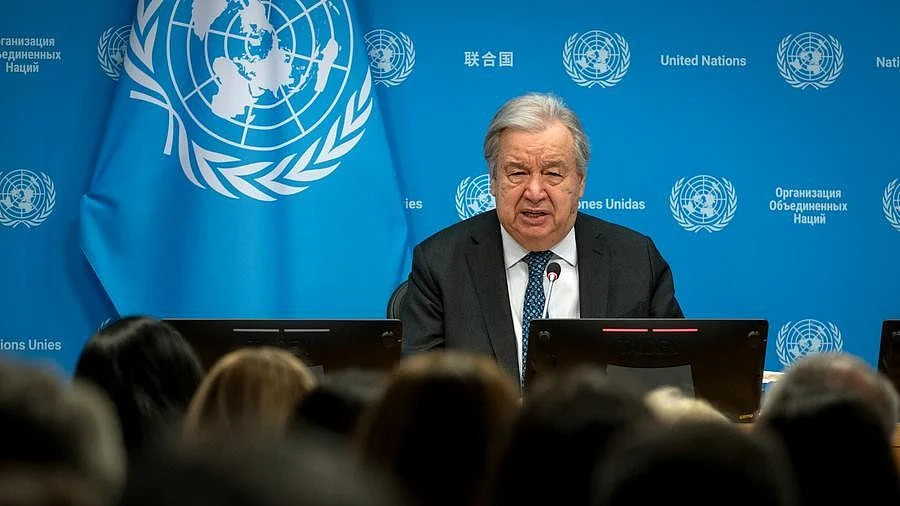


As artificial intelligence surges ahead at what the United Nations describes as "runaway speed", world leaders, policymakers, technology giants and scientists gathered in Geneva on Monday for the first-ever Global Dialogue on AI Governance, an ambitious attempt to ensure that humanity — not machines — remains in control of the next technological revolution.
Opening the landmark meeting, UN secretary-general António Guterres posed a defining question for the AI age: "Will we shape this transformation together — or let it shape us?"
"Today, that question has an answer — right here, at this Global Dialogue on AI Governance," Guterres declared. "For the first time, every country has a seat at the table, and we have a shared base of evidence."
Warning that the world is approaching irreversible technological thresholds, he cautioned, "Some lines, once crossed, cannot be uncrossed," underscoring the urgent need for coordinated global action before AI outpaces human oversight.
The Geneva gathering brings together governments, leading technology companies, researchers and global experts to chart a common framework for governing AI responsibly. It is backed by the Independent International Scientific Panel on AI (IISPAI), whose preliminary report released last week forms the foundation for the discussions.
Highlighting the unprecedented pace of AI's evolution, Guterres noted that while the internet took 15 years to reach one billion users, AI achieved the milestone in just two years.
"AI systems are no longer tools awaiting instruction," he said. "They are writing code, acting online and making choices with less and less human oversight."
He warned that human institutions are ill-equipped for a future in which machines increasingly make decisions that affect people's lives.
The UN chief also sounded the alarm over the concentration of AI power, noting that the computing capacity, data and talent behind the world's most advanced AI systems remain concentrated in a handful of companies and countries, leaving much of the world excluded from decisions that will shape its future.
"When power imbalances are hard-wired into technology, inequality becomes part of the code," he said.
Guterres further warned that AI poses an unprecedented challenge to truth itself.
"A machine-enabled lie can now persuade as effectively as the truth—and authentic evidence can be dismissed as fake," he said, cautioning that such developments threaten the integrity of the global information ecosystem.
Rejecting the notion that the debate is about embracing or fearing AI, Guterres said the real choice is between governing the technology responsibly or allowing it to evolve unchecked.
"The choice before us is not between faith in AI and fear of it. It is between governing by design — and drifting by default," he said.
Calling for collective responsibility, he urged governments to act with urgency, technology companies to match their immense power with accountability, and scientists to continue providing independent evidence to guide policymaking.
Earlier, UN under-secretary-general and special envoy for digital and emerging technologies Amandeep Singh Gill described the gathering as "a turning point — not just for AI governance, but for how the international community responds to transformative technology".
Gill said the Global Digital Compact, adopted by the UN General Assembly in 2024, together with the IISPAI, has created two unprecedented global mechanisms—an independent scientific panel to assess AI's risks and opportunities, and a worldwide dialogue where every government has an equal voice.
General Assembly president Annalena Baerbock echoed the call for a human-centric approach to AI, saying the dialogue is about much more than regulating technology.
"This Global Dialogue is not merely about regulating a technology," she said. "It is about defining a shared vision in which technological progress goes hand in hand with human dignity, equity and sustainable development."
Over the coming days, delegates will deliberate on narrowing the global AI divide, strengthening international cooperation and ensuring robust human oversight of increasingly autonomous AI systems, as the UN seeks to build a governance framework that keeps one of history's most powerful technologies aligned with humanity's collective interests.
With IANS inputs
Join our official telegram channel (@nationalherald) and stay updated with the latest headlines