


As Trump touts peace, Israeli strikes leave 19 dead in Gaza
Palestinian officials say Sunday's strikes mark Gaza's deadliest day in weeks, deepening doubts over peace efforts
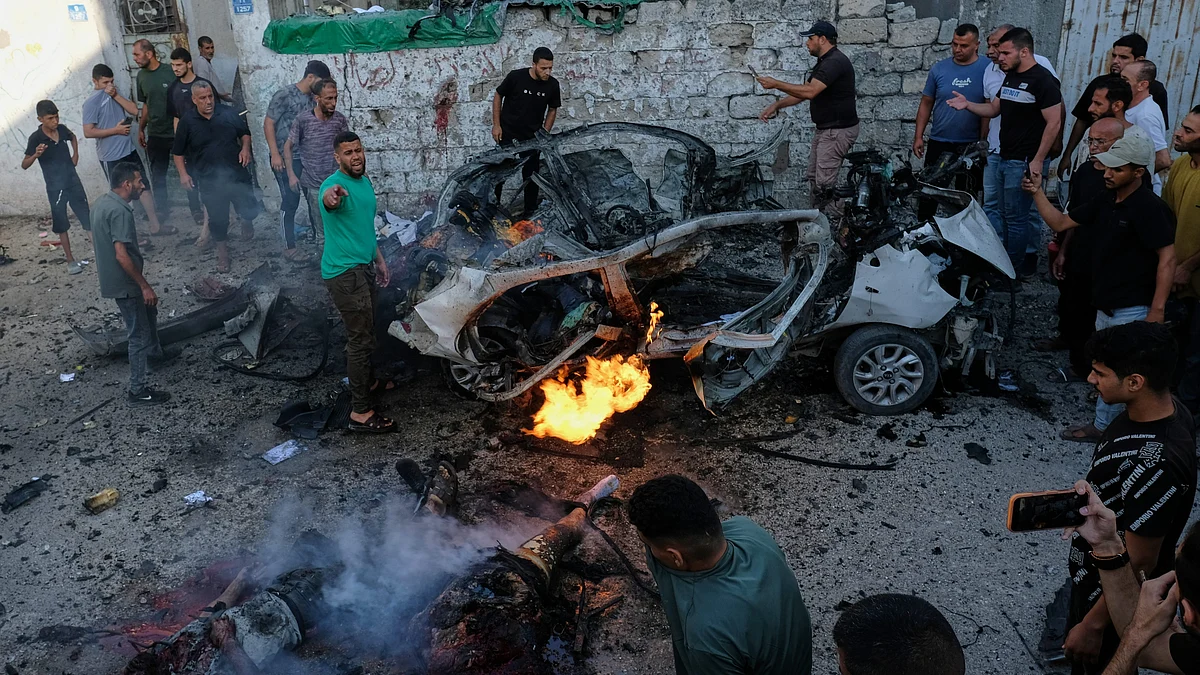


Even as US President Donald Trump hailed a new Gaza peace initiative as a "monumental step" towards security and stability, the skies over the besieged enclave once again echoed with explosions, as Israeli airstrikes killed at least 19 Palestinians on Sunday, casting a long shadow over the fragile diplomatic momentum.
The dead included entire families whose lives were extinguished within moments. In western Gaza City, an Israeli strike on an apartment in Al-Sousi Tower killed 33-year-old Abdullah Abu Taif, his pregnant wife Abeer Anan, 29, and their five-year-old son, Azzam, medical sources at Al-Shifa Hospital told Al Jazeera.
Further south, in al-Qarara near Khan Younis, another air raid reduced a family home to rubble, killing Mahmoud Al-Hams, 38, his wife Fatima, 37, and their young daughter. Three others were injured, hospital officials told Al Jazeera.
The violence swept across the Strip. In central Gaza, Kamu Abu Muailiq, 68, and his wife Huda, 59, died when their home near Deir el-Balah was struck. Elsewhere in the same area, two brothers riding a motorbike were killed in another attack.
In northern Gaza's Jabalia refugee camp, one Palestinian was killed in what witnesses described as a direct strike. In al-Mawasi, west of Khan Younis, another attack on a displacement tent claimed one life and wounded five others. Israeli drone strikes later targeted tents sheltering displaced families in Gaza City's Remal neighbourhood, killing two people, while a separate strike on a vehicle claimed four more lives.
Palestinian health officials described Sunday's bombardment as the deadliest single day in weeks, underscoring the widening gap between diplomatic declarations and the grim realities unfolding on the ground.
The attacks came just a day after Israeli strikes hit medicine warehouses attached to Al-Aqsa Martyrs Hospital in Deir el-Balah, dealing another blow to Gaza's collapsing healthcare system.
Gaza health ministry director-general Munir al-Bursh accused Israel of turning healthcare into a battlefield.
"Destroying medical supplies turns medicine and illness itself into a tool of war," he said, adding that two storage facilities were destroyed while two others suffered severe damage.
Journalists at the site described scenes of devastation. A massive crater scarred the area after the strike, which reportedly came only 15 minutes after an evacuation order, leaving little time for displaced families sheltering nearby to escape. The attack triggered yet another wave of displacement across the enclave.
Residents and reporters said Israeli warplanes had flown at low altitude over Gaza for nearly two days, launching repeated strikes without prior warning. Most of the targets were residential buildings, apartment blocks and civilian gatherings. Israel has maintained that such sites are legitimate military targets because they allegedly house Hamas operatives or infrastructure.
The latest escalation unfolded even as Washington unveiled the next phase of its 20-point Gaza peace roadmap. The Board of Peace and the International Stabilization Force, created under the US-backed initiative, announced that Hamas had accepted a detailed implementation framework for the proposed ceasefire. Israel has yet to formally endorse the plan.
For many Palestinians, however, the ceasefire exists only in name.
They argue that relentless bombardment, coupled with severe restrictions on humanitarian aid, has rendered the truce little more than an illusion, deepening an already catastrophic humanitarian crisis.
The current violence mirrors previous ceasefire agreements in Gaza and Lebanon that repeatedly unravelled amid continued military operations. Since the October 2025 ceasefire brokered by Qatar, Egypt and the United States, Gaza health authorities say at least 1,222 Palestinians have been killed and more than 4,000 wounded.
Analysts argue that Israel has consistently interpreted ceasefire provisions on its own terms.
Mohanad Mustafa, an expert on Israeli affairs, said Israel viewed such agreements as externally imposed rather than voluntarily accepted, allowing it to reinterpret key clauses and justify continued military action. According to Mustafa, sustained US pressure remains the only meaningful leverage capable of influencing Israeli policy.
Behind closed doors, Israel has reportedly raised multiple objections to the latest proposal, particularly provisions linking Hamas's disarmament to a phased Israeli withdrawal from Gaza.
Israeli officials have insisted that military forces will not withdraw until Hamas completely surrenders its weapons, expressing concern that the group could rebuild its military capabilities. They have also reportedly sought guarantees allowing Israeli operations to continue during implementation of the agreement, while objecting to oversight roles proposed for Qatar and Turkiye.
Israeli energy minister Eli Cohen reinforced that position, saying no agreement required Israel to halt military operations while negotiations continued. He also argued that Israel should assume full control of Gaza if the peace process collapsed.
Hamas, meanwhile, accused Israel of deliberately escalating attacks to undermine understandings reached with mediators and Washington. The group called on international guarantors to compel Israel to halt its offensive and abide by the ceasefire framework.
As diplomats race to salvage the agreement, the contrast between promises of peace and the mounting death toll in Gaza has rarely appeared more stark. For civilians trapped beneath the bombs, the language of diplomacy continues to ring hollow against the relentless sound of war.
Join our official telegram channel (@nationalherald) and stay updated with the latest headlines