


Trump claims he averted India-Pak war, defends tariffs in State of the Union address
US president also touched upon Middle East and European crises, projecting America as a key global leader in peace and prosperity
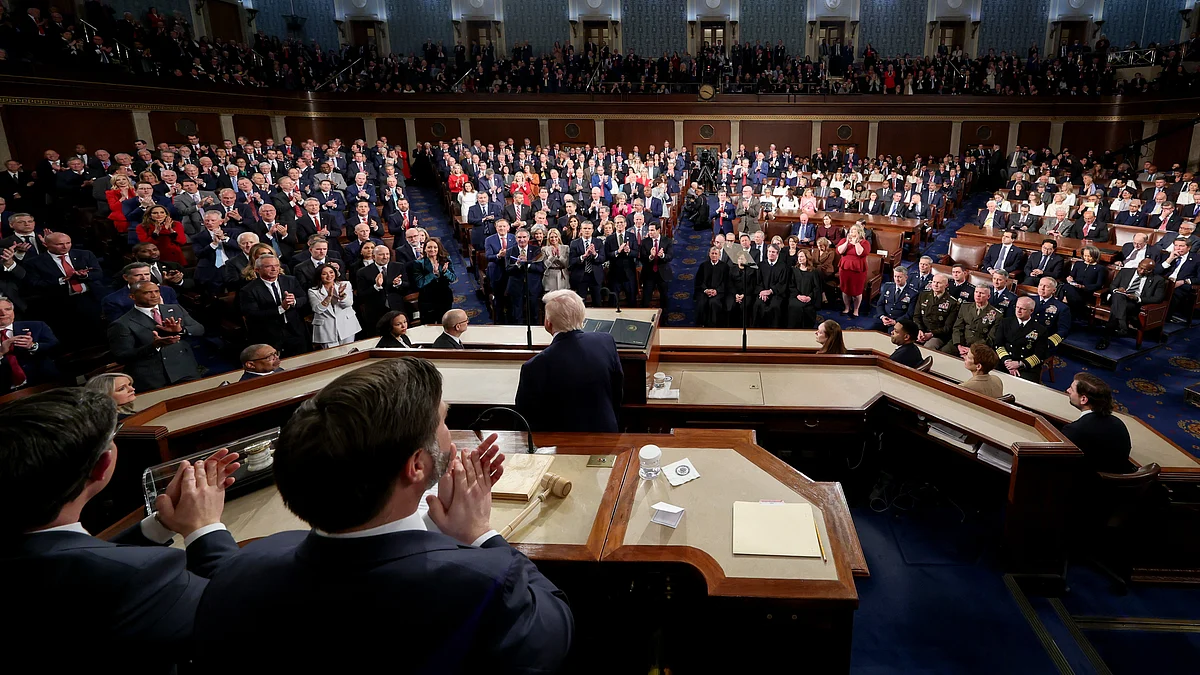


In a sweeping and dramatic State of the Union address, US President Donald Trump cast himself as both a global peacemaker and an economic crusader — weaving together claims of averting catastrophe abroad with bold declarations about America’s financial future.
Trump told a joint session of Congress that in his first 10 months in office he had “ended eight wars”, including what he described as a looming nuclear confrontation between India and Pakistan. Repeating a familiar refrain, he asserted that his intervention prevented the escalation — and even suggested that Pakistan’s Prime Minister Shehbaz Sharif told him “35 million people would have died” absent US involvement, and that the Pakistani leader’s life itself had been saved by his actions.
Trump’s remarks, delivered with characteristic bravado, revived the long-debated claim that US diplomacy was central to peace in South Asia — an assertion denied by Indian authorities.
Beyond geopolitics, Trump devoted significant portions of his nearly two-hour address to economic and trade policy. With palpable pride, he defended an aggressive tariff strategy, telling lawmakers that tariff revenues, paid by foreign nations, could one day “substantially replace” the modern income tax system and lift the financial burden on Americans. He described a recent Supreme Court ruling that struck down parts of his tariff regime as “very unfortunate” but insisted that many countries *still want to honour the trade deals negotiated under his watch.
Trump’s tariff agenda has been one of the most contentious pillars of his economic policy, drawing both applause from protectionist supporters and concern from trading partners around the world. The United States had moved to impose broad levies on imports — policies that reverberated through global markets and complicated talks with economic partners like India. While his rhetoric paints tariffs as a strategic boon, critics argue that the levies do not directly come from foreign governments but from importers and that such duties are unlikely to supplant income tax revenue.
For India, the tariff debate has already had real consequences: delayed trade negotiations and uncertainty over reciprocal duties have unsettled exporters, even as broader interim agreements have sought to stabilise duties on select Indian goods.
Trump also touched on other international flashpoints, from Middle East tensions to crises in Europe, underscoring his vision of the United States as an indispensable leader in both peace and prosperity. As his speech drew to a close, the president left Washington and the world to ponder a message of American strength — at home through economic defiance, and abroad through bold, if controversial, diplomatic claims.
With agency inputs
Join our official telegram channel (@nationalherald) and stay updated with the latest headlines