


Trump flies out of Beijing after ‘historic’ summit, Putin to fly in next week
US president left Beijing after a two-day visit marked by praise for Xi and a high-profile US delegation, with Russia’s president set to visit China on 20 May
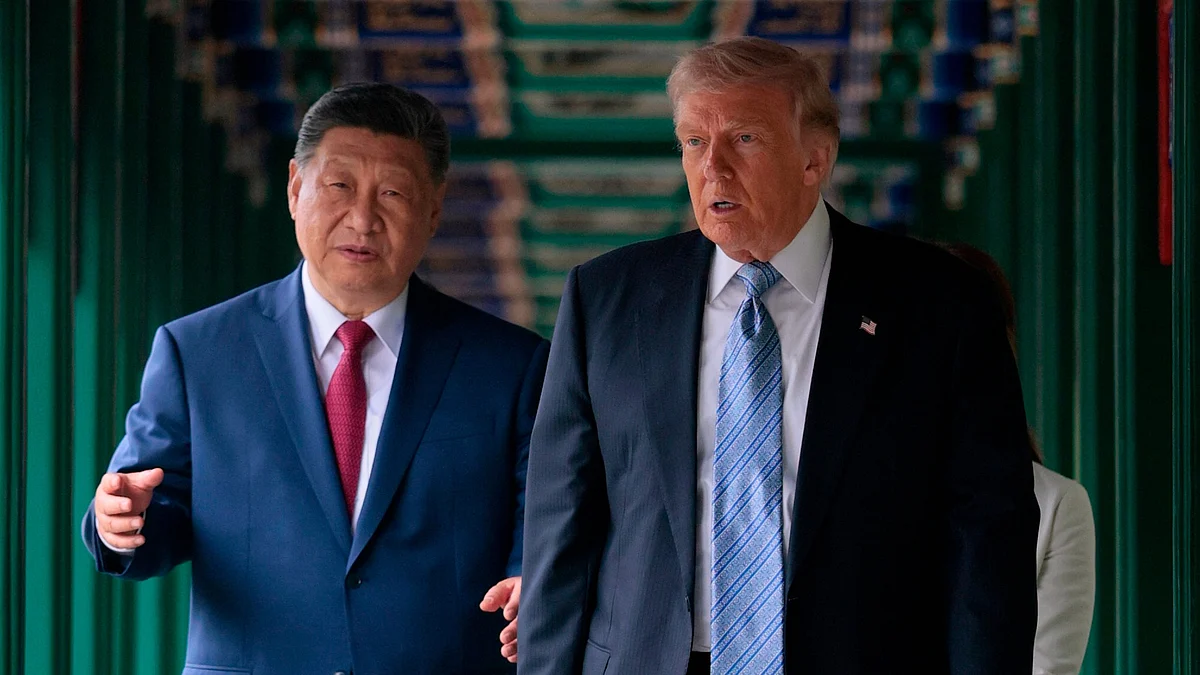


After a sustained spell of hostility during the last one year or so, both the US and China this week looked ready to reset their ties and forget the bitterness that had crept in. The Chinese president Xi Jinping pointedly repeated what he had told earlier US Presidents, that US and China should be partners and not rivals. The US President Donald Trump for once appeared to be in agreement, telling Xi that he had brought the top business and industry leaders to China to show their respect to the great country.
In an interview to Fox news before leaving Beijing on Friday, 15 May 2026 US President Donald Trump claimed that China had agreed to purchase as many as 200 Boeing jets, that the Chinese president “liked the idea” of potentially buying US oil. The US, he said, also expected China to buy “double-digit billions” worth of American agricultural products over the next three years.
The US Trade Representative Jamieson Greer confirmed on Friday that the two countries were also discussing establishing a “board of trade” to manage commerce in “non-critical, non-strategic areas”. The CNBC quoted Treasury Secretary Scott Bessent as confirming that a similar “board of investment” to steer outbound capital was also on the table. President Trump also suggested a possible breakthrough for the financial services sector, regarding credit-card access being expanded in China.
As a formal statement on the visit is still awaited, there is no confirmation about the deals finalised though. Tehran, Taiwan and Trade were on the agenda of the US president. China firmly drew a red line on the ‘Taiwan Question’ and told US that it was an internal issue for China. On Tehran and the Strait of Hormuz, the US president claimed that Beijing agreed with his view that the strait should remain free and that President Xi had indicated that China was not supplying military hardware to Iran.
The accent, however, was on trade and the US president said at the state banquet on Thursday evening that he had brought the top business leaders from the US to pay their respect to China and to Xi. Trump is said to be popular among the Chinese who have mockingly given him the nickname of “Chuan Jianguo” which translates to “Trump the Country Builder.” It is a mocking suggestion that the US leader's aggressive foreign policy has helped Beijing overtake Washington on the global stage. Most Chinese people believe Trump has contributed to making China great again, as his tariffs and aggression toward China spectacularly backfired, forcing China to accelerate innovation out of necessity.
Significantly, Moscow announced that President Vladimir Putin will be visiting China soon, hinting that it would be as early as later in May, in what will be his first foreign trip of 2026. Putin and Xi are expected to renew the Sino-Russian Treaty of Friendship signed in 2001 and might finally sign the Power of Siberia 2 pipeline deal - which would be one of the largest energy deals in history.
Xi invites Trump to tea at Zhongnanhai: Barring the Russian President Vladimir Putin, few visiting heads of state have been invited to Zhongnanhai, the seat of the Chinese government, in the heart of Beijing. President Xi told Trump on Friday that he chose to meet the US President there to reciprocate the hospitality extended to him in 2017 at Trump’s Mar-a-Lago resort in Florida. Trump asked Xi if other world leaders often visit Zhongnanhai. “Very rarely,” Xi replied, adding that it has not historically been used for diplomatic activities.
“This is the place where party and the central government leaders of China work and live including myself,” Xi says. He said informing that after the founding of the People’s Republic of China in 1949, the leadership moved here, including Mao Zedong, Zhou Enlai, Deng Xiaoping, Jiang Zemin and Hu Jintao. As they strolled through the Chinese leaders’ compound, Xi pointed out ancient trees, some of them a few hundred years old. “They live that long?” Trump asked; the Chinese president nodded and informed that some of the trees were over a thousand years old.
The menu for Trump and Xi’s lunch: The White House Press pool made Friday’s lunch menu public, reported the South China Morning Post. The two presidents, according to this report, dined on
· Minced codfish in seafood soup
· Crispy and stir-fried lobster balls
· Pan-seared beef fillet stuffed with morel mushrooms
· Kung Pao chicken and scallops
· Braised seasonal greens, bamboo shoots, mushrooms and beans
· Stewed beef in a bun
· Steamed pork and shrimp dumplings
· Chocolate brownies
· Fruit and ice cream
· Coffee and tea
Trump stresses historic ties: Proposing a toast at the state banquet on Thursday evening, the US President elaborated on the historic ties between the two countries and to the Chinese diaspora in the US. Chinese restaurants in the US outnumbered the top American fast-food giants, he pointed out. “It was president Theodore Roosevelt who provided the funds to establish President Xi’s alma mater, Tsinghua University,” Trump said. Tsinghua was established in 1911 after the US decided to return indemnity funds following the 1901 Boxer rebellion. Acknowledging that the reparations exceeded actual damages, Washington agreed to redirect the capital into educational help.
“Benjamin Franklin published the sayings of Confucius in his colonial newspaper,” Trump noted, adding that a sculpture of the sage was “carved into the face of the United States Supreme Court”. In 1737, Franklin had published excerpts from The Morals of Confucius in his newspaper The Pennsylvania Gazette and hailed its philosophy on personal virtue. Confucius, alongside Moses and Solon, features on the US Supreme Court’s eastern pediment, completed between 1932 and 1935, representing three great civilisations that shaped the Western legal system.
Join our official telegram channel (@nationalherald) and stay updated with the latest headlines