


Trump launches ‘Gold Card’ to woo and retain top global talent in US
At a White House roundtable with tech titans, Trump blasts a system that drives top global graduates — many from India — out of the US
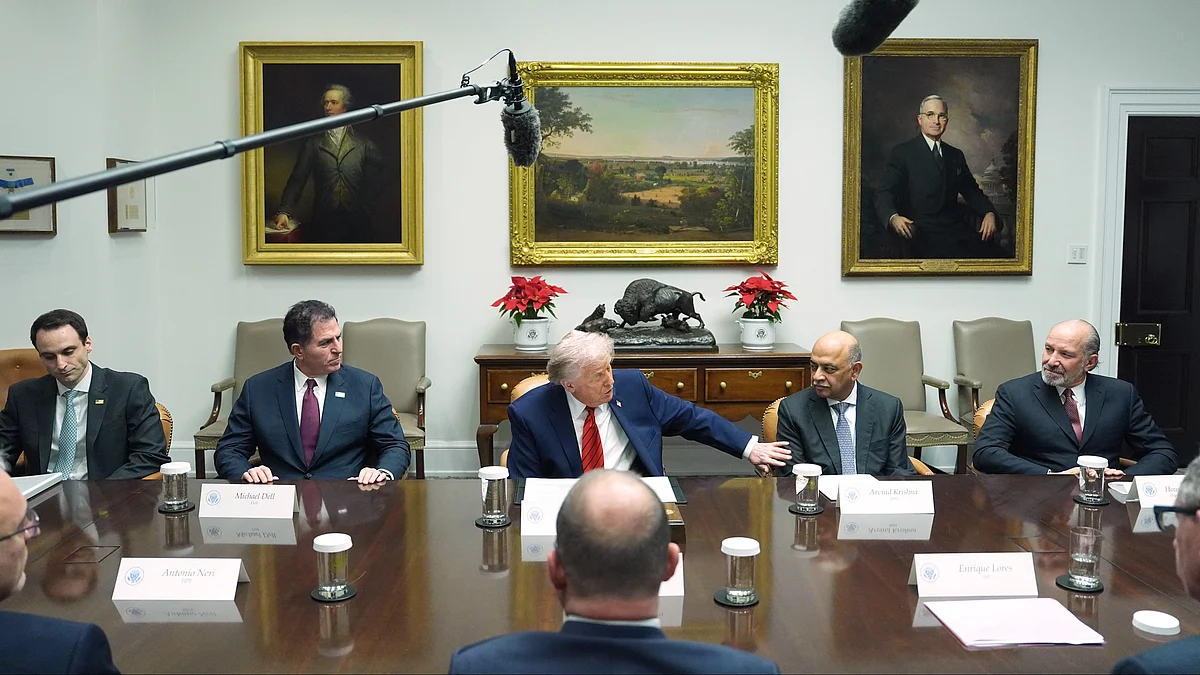


In a sweeping bid to reshape America’s high-skilled immigration landscape, US President Donald Trump on Wednesday unveiled the “Trump Gold Card” — a gleaming new pathway designed to keep the nation’s brightest international graduates from slipping through its fingers.
At a White House roundtable studded with the titans of the tech world, Trump railed against what he called a “ridiculous” system that forces the crème de la crème of American universities — many of them young engineers and scientists from India — to pack their bags and leave the country just as they are ready to contribute.
“You graduate number one in your class, and there’s no guarantee you can stay,” Trump said, calling the status quo “a shame” for a nation vying for global technological supremacy. The new Gold Card, he declared, would replace uncertainty with “certainty”, enabling US companies to hold on to their most exceptional international minds.
Howard Lutnick, invited by Trump to unveil the architecture of the programme, described the Gold Card as an elite, premium-tier route into the American talent pool. Individuals could acquire it for $1 million, while corporations could obtain one for $2 million — a golden key that allows firms to keep a fully vetted, long-term foreign employee on American soil. After five years, Gold Card holders would have a pathway to citizenship, and companies could then rotate new talent onto the same card, creating a renewable pipeline of global expertise.
The vetting process — priced at $15,000 — would be the toughest the government has ever undertaken, Lutnick said, ensuring that only the most qualified, impeccably screened individuals enter through this gilded door. “It’s a gift to the United States,” he declared, framing the programme as a patriotic boost for American innovation.
Trump emphasised the financial windfall the scheme could deliver, predicting “many billions of dollars” flowing into the US Treasury. He pointed out that companies once pushed top employees to Canada and other countries due to visa uncertainty — a practice he claimed the Gold Card would now render unnecessary. “The companies are going to be very happy,” he smiled.
Seated around him were some of the most powerful voices in global technology — Michael Dell, Arvind Krishna, Cristiano Amon, and leaders from HP and HPE — gathered as the administration spotlighted its grand narrative of immigration reform fueling America’s quest for technological “dominance.”
The CEOs echoed the need for a reliable workforce and abundant, low-cost energy to power colossal AI and semiconductor investments. Dell noted that cutting-edge chips and artificial intelligence “consume a great deal of power,” while IBM’s Krishna urged the strengthening of the entire AI “stack” — from raw silicon to software sophistication.
For India, the unveiling of the Trump Gold Card marks one of the most consequential shifts in US immigration policy in more than a decade. Indian students — the second-largest cohort in the United States — and Indian professionals, who dominate the H-1B visa category, stand to be profoundly affected.
For years, both Republican and Democratic administrations struggled to modernise employment-based pathways as congressional gridlock kept reform frozen. But with one dramatic announcement, Trump signaled a tectonic policy pivot — one aimed at ensuring that America not only attracts the world’s brightest minds, but keeps them firmly planted on American soil.
With IANS inputs
Join our official telegram channel (@nationalherald) and stay updated with the latest headlines