


Explained: Why Caribbean buildup limits US military options against Iran
Naval strike groups, air power, Marines and special forces surround Iran, but force dispersal narrows escalation options
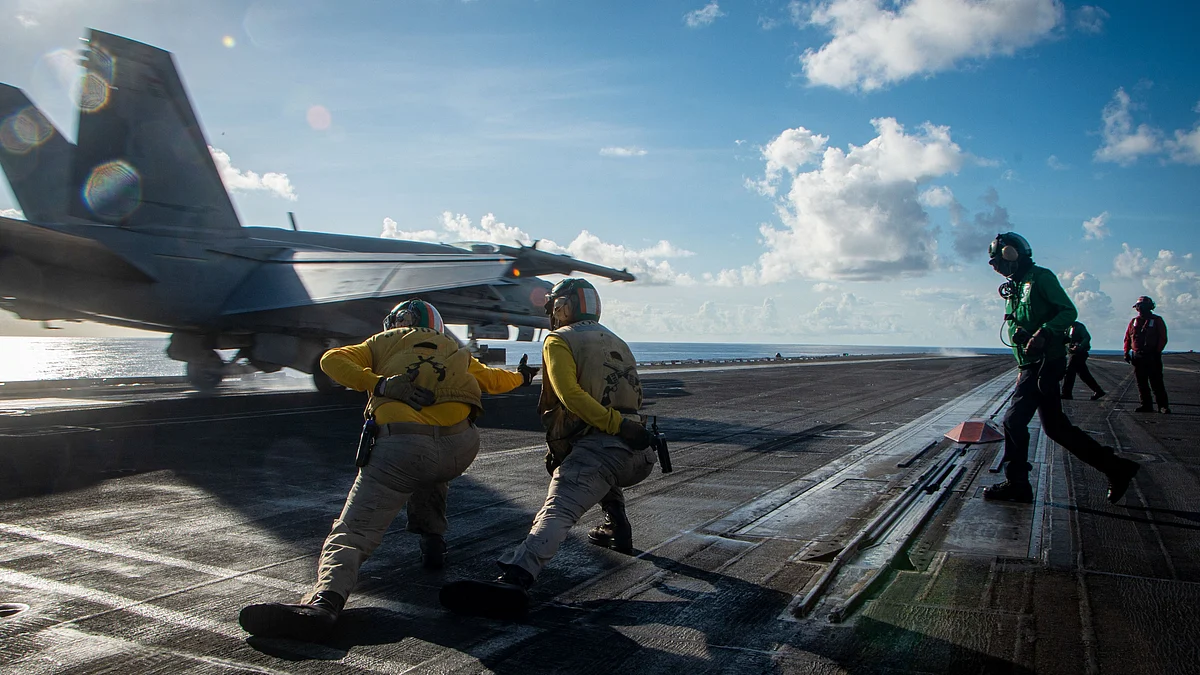


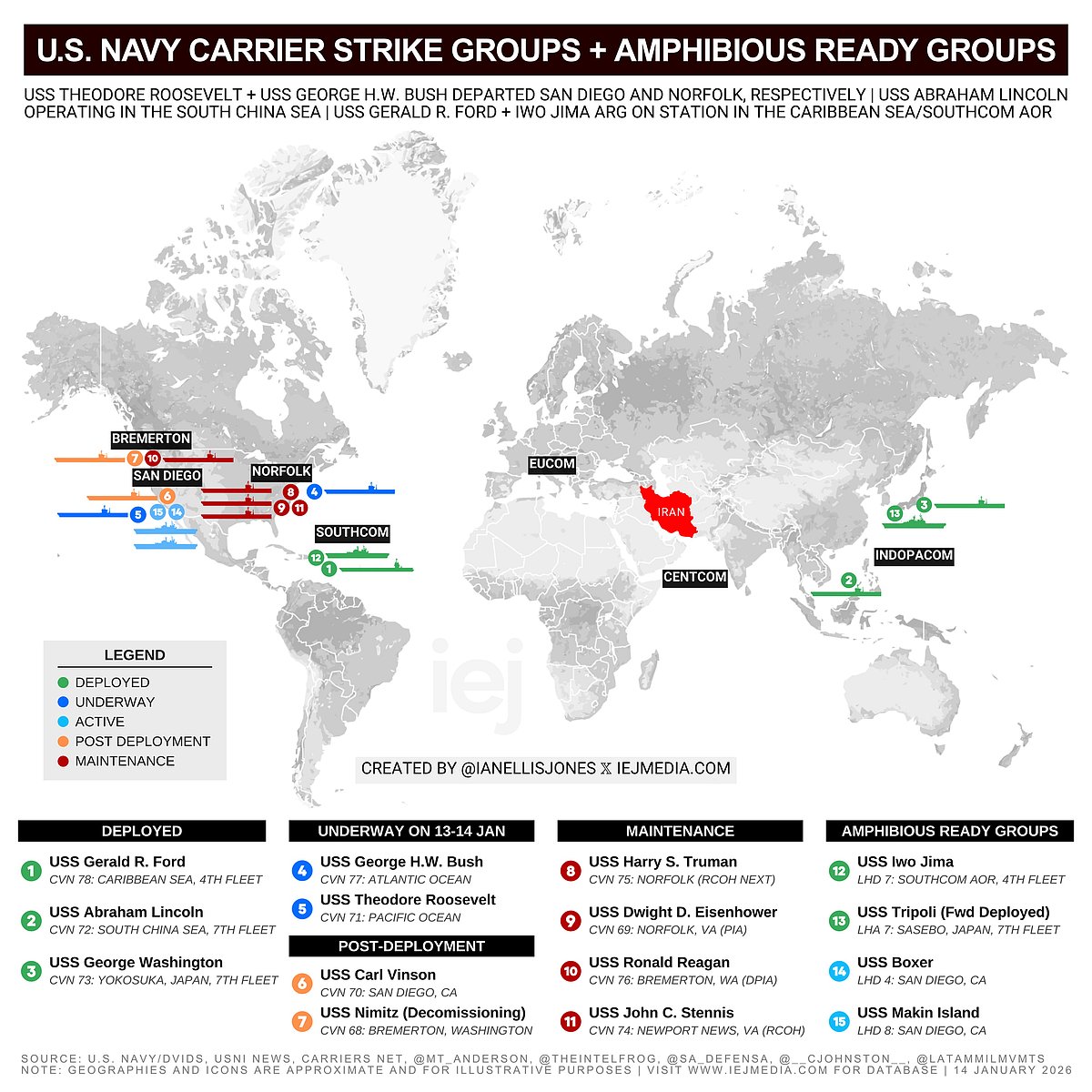
While United States continues to maintain a dense and sophisticated military posture around Iran, a parallel US military buildup in the Caribbean has constrained Washington’s ability to concentrate additional high-end assets in the Middle East, according to a recent report.
The assessment by The Wall Street Journal noted that US military power in the region remains overwhelming by most conventional measures. However, the dispersal of finite assets — particularly aircraft carriers, surface escorts, intelligence platforms and aerial refuelling aircraft — across multiple theatres has narrowed the range of military options available to Washington in the event of a sharp escalation with Tehran.
All US forces around Iran operate under CENTCOM (United States Central Command), which oversees American military operations across the Middle East and adjacent regions. Within this framework, the US relies primarily on naval and air power, backed by forward-deployed ground forces, to deter Iran, protect regional partners and secure critical sea lanes.
Impact of the Caribbean deployment
The report highlights that the US military buildup in the Caribbean has drawn on the same pool of high-demand assets required for Middle East contingencies. Aircraft carriers, surface escorts, intelligence platforms and refuelling aircraft are finite resources, and their deployment elsewhere reduces the speed and scale with which forces can be reinforced around Iran.
Analysts quoted in the assessment stress that this does not reflect a loss of US military superiority, but rather a strategic trade-off. Maintaining credible deterrence in multiple regions simultaneously limits the ability to concentrate overwhelming force in any single theatre without increasing risk elsewhere.
Here's an overview of American troop deployment around Iran:
Naval forces: strike, deterrence and sea control
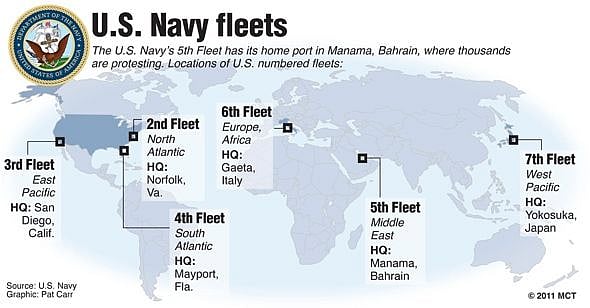
The core of the US military presence near Iran is maritime. Operations are led by the US Fifth Fleet (United States Fifth Fleet), headquartered in Bahrain, with responsibility for the Persian Gulf, the Strait of Hormuz, the Gulf of Oman and parts of the Arabian Sea.
US naval deployments typically include carrier strike groups built around nuclear-powered aircraft carriers. Each carrier strike group brings together an aircraft carrier, an embarked air wing, guided-missile cruisers, guided-missile destroyers and, frequently, a nuclear-powered attack submarine.
The carrier strike group's air wing includes multirole fighter aircraft, electronic warfare platforms, airborne early warning aircraft and helicopters for anti-submarine and logistics missions.
These formations equip the US with the ability to conduct sustained air operations, precision strikes deep inside Iranian territory, maritime interdiction and sea control operations close to Iran’s coastline.
Guided-missile destroyers and cruisers deployed with the strike groups are equipped with advanced air and missile defence systems and are capable of launching long-range land-attack cruise missiles, while submarines provide stealth strike and intelligence-gathering capabilities.
In addition to major combatants, smaller naval elements focused on maritime security operate from Bahrain to patrol shipping routes, monitor Iranian naval activity and support interdiction operations in the Gulf.
Air power: reach, persistence and precision
US air power around Iran is anchored at a network of air bases across the Gulf region, allowing sustained operations without the need for large permanent ground formations near Iranian borders.
Key installations include Al Udeid Air Base (Qatar), which hosts the forward headquarters of CENTCOM and supports bomber, tanker, transport and intelligence aircraft, and Al Dhafra Air Base (United Arab Emirates), which supports fighter and surveillance operations. Additional facilities in Saudi Arabia, Kuwait, Jordan and Iraq provide basing, logistics and dispersal options.
From these locations, the US deploys a mix of fighter aircraft for air superiority and strike missions, strategic bombers capable of long-range conventional attacks, aerial refuelling tankers that extend the reach of combat aircraft, and intelligence, surveillance and reconnaissance platforms that provide real-time targeting and battlefield awareness.
Strategic bombers are not permanently stationed in the region but are periodically deployed as part of deterrence signalling, allowing Washington to demonstrate its ability to strike high-value targets from long distances without committing to sustained escalation.
Ground forces and missile defence
US ground forces in the Middle East are structured primarily for defence, force protection and support roles rather than for offensive ground operations against Iran.
Army units deployed across Kuwait, Iraq, Jordan and the Gulf states are tasked with securing bases, maintaining logistics networks, coordinating with partner forces and operating missile defence systems. These include Patriot air and missile defence batteries positioned to protect US troops and critical infrastructure from Iranian ballistic missile and drone threats.
Military officials note that the current ground posture is not designed for a land invasion of Iran. Any such operation would require a far larger mobilisation of troops, equipment and political commitment than is reflected in current deployments.
Marines and expeditionary forces
The USMC (United States Marine Corps) plays a key role in the regional posture through expeditionary forces embarked on amphibious assault ships and naval task groups operating in nearby waters.
Marine units are organised to deploy rapidly as combined air-ground task forces, integrating infantry, aviation, artillery and logistics elements. In the context of Iran, Marines provide capabilities for forward base defence, maritime security, limited raids, evacuation operations and reinforcement of US facilities under threat.
Amphibious forces also give Washington flexible response options short of major combat operations, allowing for visible military presence and rapid crisis response without committing large land formations.
Special operations forces
Alongside conventional forces, US special operations units maintain a discreet but significant presence in the region under USSOCOM (United States Special Operations Command), working in coordination with CENTCOM.
These forces include Army Special Forces, Navy SEALs, Air Force special tactics units and Marine Raiders. Their roles encompass intelligence collection, reconnaissance, direct action missions, targeting support for air and naval strikes, counter-terrorism operations and liaison with regional partner forces.
Special operations units are valued for their ability to operate with a small footprint, gather intelligence in contested environments and support high-precision military actions without broad escalation.
Key capabilities deployed around Iran
Naval and air strike power: Aircraft carriers, destroyers, submarines and combat aircraft capable of precision strikes, air superiority and maritime control.
Integrated air and missile defence: Patriot systems, ship-based missile defences and early warning networks to counter Iranian missiles and drones.
Expeditionary and special operations forces: Marines and special forces providing rapid response, reconnaissance and limited strike options.
Iran relies on missiles, drones and proxy network
Despite the scale of US deployments, Iran remains a complex and high-risk military target. Its missile forces are dispersed and hardened, its air defences are layered, and its regional network of allied militias extends the potential battlefield beyond Iran’s borders.
US planners view naval and air strikes as effective tools for deterrence and punishment, but acknowledge that they are unlikely to decisively neutralise Iran’s military capabilities without triggering broader regional escalation.
Iran is relying on a layered mix of missiles, drones, naval harassment and regional proxy forces to counter the extensive US military posture around its borders, seeking to deter escalation by raising the costs of any direct confrontation, according to a recent assessment.
Iran’s primary deterrent rests on its large inventory of ballistic and cruise missiles, capable of striking US bases and allied facilities across the Middle East. These systems, operated largely by the IRGC (Islamic Revolutionary Guard Corps), are dispersed across hardened and underground sites to reduce vulnerability to pre-emptive strikes.
Tehran has also expanded its drone warfare capabilities, including long-range unmanned aerial vehicles and swarm tactics designed to saturate air defences and threaten naval formations.
At sea, Iran relies on fast attack craft, small submarines and coastal anti-ship missiles to harass superior naval forces and threaten traffic through the Strait of Hormuz, a critical global energy chokepoint.
Beyond its own forces, Iran leverages allied militias across the region, coordinated by the IRGC’s external operations wing, to open multiple fronts and pressure US partners. Analysts say this asymmetric strategy aims not to defeat US forces outright, but to complicate planning, deter attack and impose political and economic costs.
Join our official telegram channel (@nationalherald) and stay updated with the latest headlines