


Gaza’s fishermen hold on to the sea as their last horizon of freedom
Israel’s ongoing military campaign and blockade have devastated the fishing community, once a vital source of food and income for tens of thousands
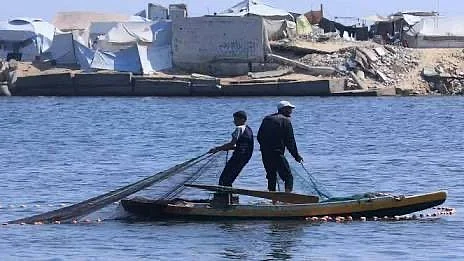


Surrounded by shattered buildings and encircled by walls, Gaza’s fishermen continue to cling to the sea, the only expanse still open to them amid relentless Israeli bombardment. For many in the besieged enclave, the Mediterranean represents both sustenance and the last semblance of freedom.
For generations, Gaza’s waters have fed families and offered a modest escape from isolation. But Israel’s ongoing military campaign and blockade have devastated the fishing community, once a vital source of food and income for tens of thousands.
Among those still venturing into the water is Salem Abu Amira, known locally as “The Beast”. He earned the nickname after hauling in a rare catch more than a metre and a half long. “People call me ‘The Beast’ because I once caught a very big fish. But I’ve caught many large ones,” he says with quiet pride, speaking from Gaza City.
Fishing is a tradition deeply rooted in Abu Amira’s family. He learned free diving from his father as a boy, a skill passed down through generations and now a lifeline in times of war.
Before the current conflict, fishermen could sail far from the coast, where the sea brimmed with life. A 2020 World Bank report estimated that around 18,000 Gazans relied directly on fishing for their livelihoods, supporting more than 110,000 dependents.
That industry has since been decimated. “We can no longer reach the deep waters,” Abu Amira says. “Now we only fish close to the shore, where there are no big catches. Restrictions have been in place since the war began, but I have no other source of income. I cannot just sit and wait for help.”
Before the escalation, Gaza’s annual fish haul exceeded 4,600 tonnes, despite frequent arrests and attacks on fishermen by Israeli forces. Since the war began over two years ago, most fishing boats have been destroyed.
According to the Ministry of Agriculture, as reported by the United Nations, by December 2024, the Israeli military had killed 200 people involved in the fishing sector out of about 6,000 registered workers.
Those who still dare to cast their nets just metres from the shoreline face gunfire. In January this year, Israel declared Gaza’s coastal waters a “no-go zone,” banning all fishing, swimming, and sea access.
The consequences have been catastrophic. Gaza has lost nearly 94 per cent of its fish catch, erasing one of its last remaining food sources. “Fishermen are among the most at risk,” says Zakaria Bakr, head of the Fishermen’s Committees in Gaza. “The occupation often prevents them from going to sea, and divers cannot access their gear, this paralyses their work for days.”
After months of displacement, Abu Amira has returned home, preparing his small boat for another risky trip into the sea. For him, the sea remains more than a workplace, it is a lifeline and a legacy. “I will pass this profession on to my children,” he says. “Fishing brings peace of mind and helps us survive.”
After hours underwater, “The Beast” surfaces with a small but precious catch — several fish and an octopus — enough to feed his family and sell a few at the market.
For Gaza’s fishermen, survival is no longer just about food or livelihood. It is about holding on to a centuries-old bond with the sea and to the last glimmer of freedom that remains.
Join our official telegram channel (@nationalherald) and stay updated with the latest headlines