


Independent studies put Gaza death toll above 75,000, verifying scale of loss
The number stands nearly 35 per cent higher than the 49,090 violent deaths reported by Gaza’s Ministry of Health (MoH) over the same period
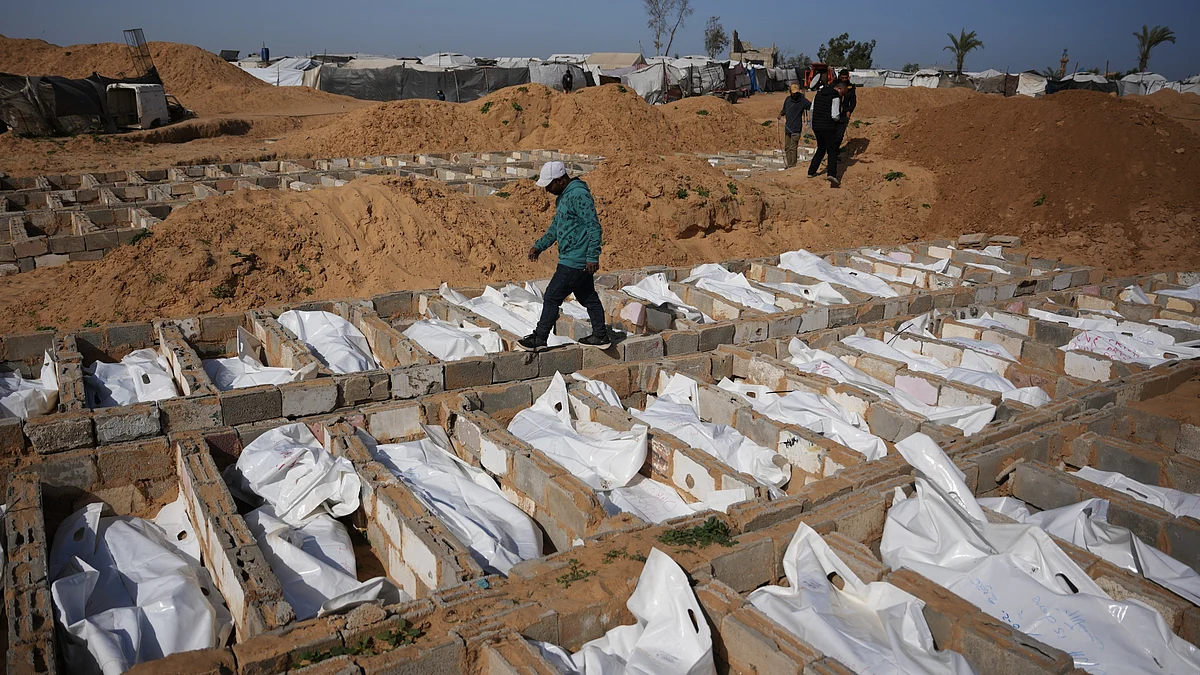


The true human toll of Israel’s war on the Gaza Strip is emerging from the shadows of rubble and ruin, and it is far grimmer than earlier official tallies suggested. A series of landmark scientific studies published in leading medical journals now place the number of “violent deaths” by early 2025 at more than 75,000 — a figure that transforms statistics into an ocean of extinguished lives, the Al Jazeera reported.
At the heart of this reckoning is the Gaza Mortality Survey (GMS), a population-representative household study published in The Lancet Global Health. Drawing on interviews with 2,000 households representing 9,729 individuals, researchers estimated 75,200 violent deaths between 7 October 2023, and 5 January 2025 — roughly 3.4 per cent of Gaza’s pre-war population of 2.2 million. The number stands nearly 35 per cent higher than the 49,090 violent deaths reported by Gaza’s Ministry of Health (MoH) over the same period.
Yet rather than discrediting official Palestinian figures, the study reinforces them. Researchers describe the MoH’s administrative records not as exaggerations but as a conservative “floor” — a baseline constrained by the very collapse of the institutions tasked with counting the dead. Michael Spagat, the study’s lead author and a professor at Royal Holloway University of London, concluded that the ministry’s reporting remains broadly reliable, even under conditions of systemic devastation.
The findings build upon earlier work published in The Lancet in January 2025, which used statistical “capture-recapture” modelling to estimate 64,260 deaths during the war’s first nine months. Where that study relied on mathematical inference, the GMS advances to empirical verification through direct household testimony, extending the timeline into 2025 and quantifying not only violent deaths but also the more elusive burden of “non-violent excess mortality”.
Beyond bombs and bullets, the survey identified 16,300 non-violent deaths, including 8,540 excess fatalities linked directly to collapsing living conditions and the blockade-induced breakdown of medical care. In the pages of The Lancet Global Health, commentators described a “central paradox”: the more thoroughly a health system is shattered, the harder it becomes to measure the human cost of its destruction. Bodies remain buried beneath concrete; others lie mutilated beyond recognition. Documentation itself becomes another casualty of war.
Even Israel’s own military officials have, in private briefings, acknowledged that approximately 70,000 people may have been killed — a tacit convergence with the higher estimates. The demographic pattern of loss is strikingly consistent: women, children, and the elderly account for 56.2 percent of those killed, mirroring official Palestinian reporting and dispelling claims of systematic inflation.
Yet death tells only part of the story. Survivors carry a burden of injury so vast it threatens to define a generation. A predictive, multi-source model published in eClinicalMedicine estimated 116,020 cumulative injuries by 30 April 2025. Between 29,000 and 46,000 of these cases require complex reconstructive surgery — a staggering backlog in a territory that, before the war, had just eight board-certified plastic and reconstructive surgeons.
Ash Patel, a co-author of the injury study, warned that even if Gaza’s surgical capacity were miraculously restored to pre-war levels, it would take a decade to address the accumulated cases. More than 80 percent of injuries stem from explosions — air strikes and shelling in densely packed urban neighbourhoods — leaving behind shattered limbs, severe burns, and blast trauma that demand specialised expertise now largely absent.
By May 2025, only 12 of Gaza’s 36 hospitals remained capable of delivering care beyond emergency triage. Hospital bed capacity had fallen from over 3,000 to roughly 2,000 for the entire population. Researchers describe the destruction of medical infrastructure as systematic, with advanced capabilities such as microsurgery virtually extinguished. Incendiary weapons have compounded the devastation, inflicting complex burns that intertwine with fractures and tissue loss.
For thousands, delayed treatment has meant infections, sepsis, renal failure, and lifelong disability. Belal Aldabbour and Bilal Irfan, writing in The Lancet Global Health, describe a growing “grey zone” in mortality — where deaths from sepsis months after a blast, or from untreated chronic injury amid water scarcity, blur the line between direct and indirect violence. The ledger of war becomes more diffuse, yet no less lethal.
Conditions have deteriorated further since data collection concluded. By late 2025, forced evacuations encompassed more than 80 percent of Gaza’s territory. Northern Gaza and Rafah faced widespread destruction, while famine was declared in the north in August 2025 — compounding malnutrition and diminishing survivors’ capacity to heal.
Taken together, these independent studies form a grim mosaic of loss: tens of thousands dead, tens of thousands more maimed, and a health system reduced to fragments. Researchers issue a stark warning — that without an immediate cessation of hostilities and a massive international expansion of medical support, the burden of reconstructive need will only deepen.
In the end, the numbers are not abstractions. They are names unrecorded, limbs unhealed, futures deferred. And as the rubble settles, the scientific record now stands as both testimony and indictment — a meticulous accounting of lives altered beyond repair.
Join our official telegram channel (@nationalherald) and stay updated with the latest headlines