


‘Islamabad talks’ stuck between Iran’s pre-conditions and Trump’s desperate posts
Iranian and the US delegations on Saturday met Pakistan’s prime minister separately and are unlikely to come face-to-face until decks are cleared and trust restored


"The World’s most powerful reset," posted US President Donald Trump on Saturday, hours after he declared on Truth Social that Iran had “no cards left” going into the Islamabad talks, except for its temporary leverage over the Strait of Hormuz.
He accused Tehran of “short-term extortion of the world by using international waterways” and added: “The only reason they are alive today is to negotiate!”
Iran, in turn, delayed the departure of its delegation from Tehran and insisted that there should be a simultaneous ceasefire in Lebanon.
OIThe tension and suspense in Islamabad were reflected in a commentary published on Time.com. The ceasefire with Iran appears more like a halt in hostilities, a pause, and not a coordinated ceasefire within a political framework, the commentary stated. It went on to add, “that distinction matters. A war paused without a political framework is not a conflict resolved. It is a conflict deferred”.
The commentary pointed out that any long-term arrangement that leaves Iran with significant leverage over the Strait of Hormuz, preserves its missile capabilities, and allows it to recover economically would be politically untenable in not only Washington, but also in Israel and among key Gulf allies hosting US military bases.
The Iranian delegation is also clear about its deep distrust of the US. The Speaker of Iranian Parliament, G.B. Ghalibaf was quoted by Iranian media outlets as saying, “our experience with negotiations with the Americans has always been accompanied by failure and breach of commitments.
Twice within less than a year, in the middle of negotiations-despite the goodwill of the Iranian side-they attacked us and committed numerous war crimes. We have goodwill, but we do not have trust.”
Reports emanating from Islamabad on Saturday seemed to rule out any direct talk between the two delegations on Saturday, unless they meet at a state dinner later in the evening.
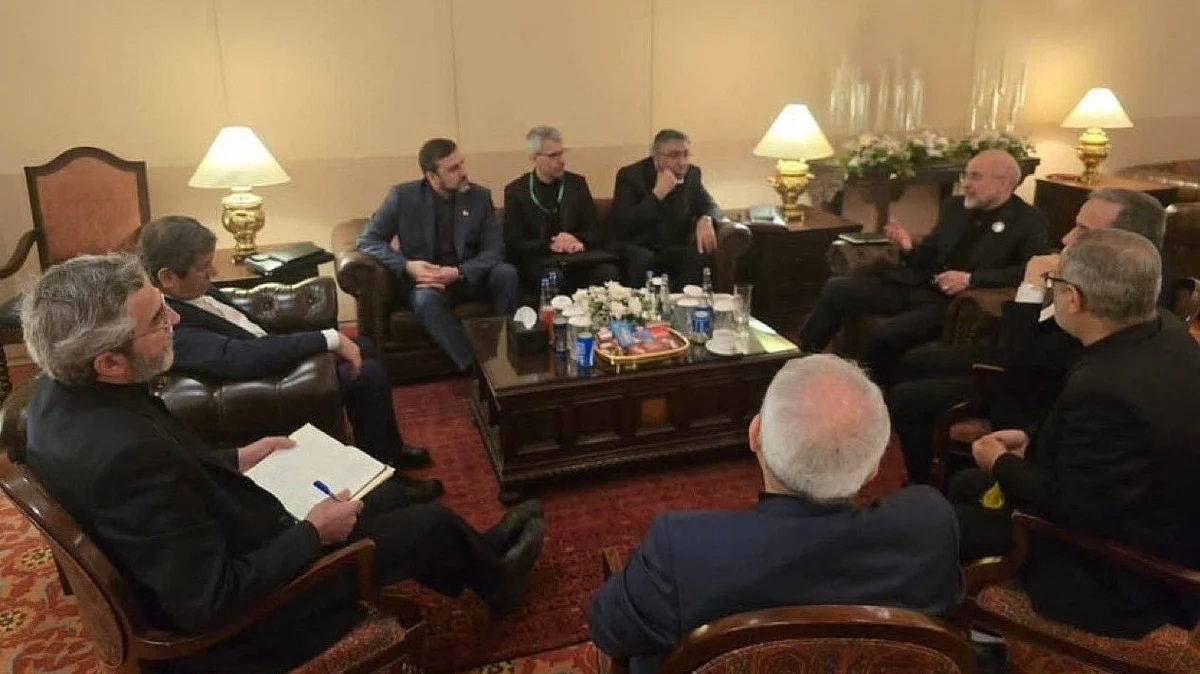
The Iranian delegation, which had a meeting with Pakistan’s Field Marshal Asim Munir on Friday night, called on Pakistan’s prime minister Shahbaz Sharif on Saturday afternoon.
Both the delegations are expected to have separate meetings with the prime minister of Pakistan before ‘indirect negotiations’ begin when both sides exchange their demands and their position on various issues with Pakistan as the intermediary.
Only if constructive progress is made and differences narrowed down with both sides confirming concessions they are be ready to offer, would the talks move to face-to-face, in-person negotiations.
Mahdi Khanalizadeh, an Iranian international relations professor and former head of Press TV’s website, posted from Islamabad that the US had agreed to four of Iran’s key preconditions.
If he were to be believed, the US had agreed to release Iran’s frozen assets, assured a ceasefire in Lebanon, a cap of 15 vessels per day passing through the Strait of Hormuz after paying transit fees and a ban on any redeployment of U.S. forces and equipment. The unverified claims, experts felt, are too facile to be true though and could have been meant for a domestic audience.
A formal announcement on a ceasefire in Lebanon was still awaited on Saturday afternoon and there is no official confirmation yet that any pre-condition for talks has been agreed to by the US or for that matter Iran.
Maritime traffic through the Strait of Hormuz remains disrupted, and there is little indication from Iranian messaging that this pressure will be eased in the near term. A statement from the Khatam al-Anbiya central headquarters of the Revolutionary Guards emphasized that the Iranian armed forces remained fully prepared and ready to respond if hostilities resume.
Iranian armed forces have also continued to signal that Hezbollah remains part of a unified strategic framework, warning that further Israeli escalation could trigger a broader response. Reports of contacts between the Lebanese government and Israel, facilitated by the United States, are being interpreted as an attempt to sideline Iran and limit its influence over any eventual arrangement.
Observers have taken note of the unusually large size of the Iranian delegation and its depth. Barring President Pezeshkian, virtually the entire top leadership of Iran have turned up in Islamabad, and they include security, political, military, economic, and legal experts, besides nuclear scientists.
Besides Ghalibaf and the Iranian foreign minister Abbas Araghchi, Ali Akbar Ahmadian, representative of Iran’s Leader in the Supreme National Security Council and the central bank governor Abdolnaser Hemmati, several deputy foreign ministers and members of the Iranian parliament make up the Iranian delegation.
Enrichment of uranium by Iran and the Strait of Hormuz remain the foremost sticky points even as Iran insists on withdrawal of all sanctions, unfreezing of its assets and its territorial right over the Strait of Hormuz along with Oman. The US delegation and the UAE have argued that the Strait of Hormuz is an international strait. Under UN Convention on the Law of the Sea (UNCLOS), ships and aircraft enjoy freedom of navigation & overflight. Rights are not subject to any negotiation and no country can suspend the right, they have argued.
However, UNCLOS was never ratified by Iran, which argues that the Strait is within Iranian and Omani territorial waters. Even under UNCLOS Part III (Arts. 37-44), the applicable regime is "transit passage," not "freedom of navigation."
Transit passage gives coastal states regulatory authority over sea lanes.
An American who was held hostage in Iran by the students for a year in the US embassy was quoted by Time.com as saying, “Negotiations in Pakistan may produce nothing. The talks could collapse before they get started. I've seen American diplomacy with Iran fail more times than I can count, and usually for the same reasons — too much pride, too little patience, and Israel holding a match in the corner of the room. But here's what I know in my bones: another war won't break Iran…Iran doesn't break — it absorbs, it adapts, and it waits….”
Join our official telegram channel (@nationalherald) and stay updated with the latest headlines