


Israeli strike hits Gaza shelter as US-led talks on ceasefire’s next phase unfold
The incident is among hundreds of ceasefire violations reported since the US-brokered truce began in October
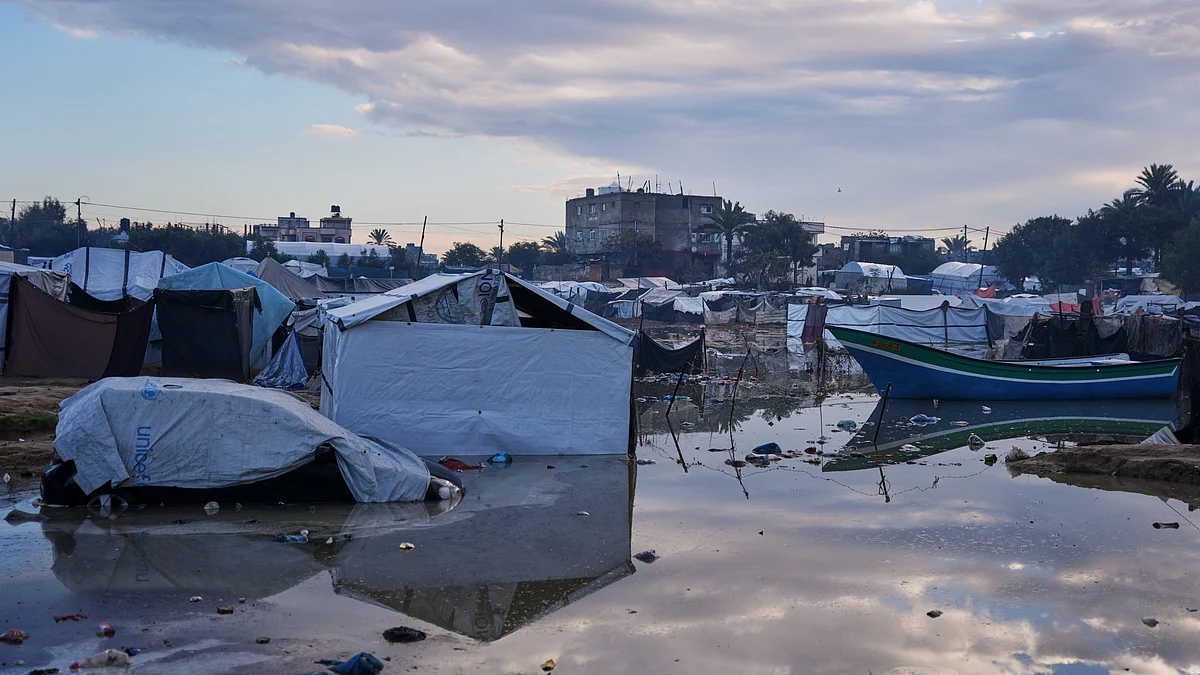


A deadly shadow has once again fallen over Gaza, as the Israeli military struck a shelter in Gaza City on Friday, claiming the lives of at least six Palestinians and wounding several others, even as senior officials from Qatar, Egypt, and Turkiye gathered in the United States to discuss the next phase of the fragile ceasefire, the Al Jazeera reported.
Local sources told Al Jazeera that Israeli tank shells tore through the second floor of a school-turned-shelter in the Tuffah neighbourhood, where displaced Palestinian families had gathered to attend a wedding. The tragedy marks yet another grim episode in what the Gaza Government Media Office describes as hundreds of ceasefire violations since the US-brokered truce took effect in October.
The attack comes against the backdrop of high-stakes diplomacy unfolding in Miami, Florida. US President Donald Trump’s special envoy for the Middle East, Steve Witkoff, joined by senior US officials, has convened talks with representatives from Qatar, Turkiye, Egypt, and the United Arab Emirates, while US Secretary of State Marco Rubio confirmed that he may participate in the discussions.
Rubio emphasised that Washington’s priority is to fully implement the first phase of the ceasefire agreement: establishing a Palestinian technocratic committee to govern Gaza, creating the foreign-led “Board of Peace”, and deploying an international policing force. “No one is arguing that the status quo is sustainable in the long term, nor desirable, and that’s why we have a sense of urgency about bringing phase one to its full completion,” Rubio told reporters at a state department briefing.
The US diplomat expressed confidence that the completion of phase one would unlock international funding for long-term humanitarian support and reconstruction, paving the way for phases two and three of the agreement.
The Miami talks, according to Axios, include Qatari Prime Minister and foreign minister Sheikh Mohammed bin Abdulrahman bin Jassim Al Thani, Turkish foreign minister Hakan Fidan, and Egyptian Foreign Minister Badr Abdelatty, the Al Jazeera reported.
Meanwhile, Israel’s public broadcaster reported that Prime Minister Benjamin Netanyahu is convening a restricted security consultation to consider the second phase of the ceasefire, exploring potential scenarios including a renewed military campaign to disarm Hamas — though such action is unlikely as the US seeks to preserve calm in the enclave.
Despite Washington’s insistence that the truce remains intact, Israeli attacks against Palestinians have continued almost without pause since October 10. Humanitarian access to Gaza has been severely restricted, exacerbating the suffering of a population already reeling from a devastating two-year war.
On the ground, Israeli airstrikes, artillery shelling, and heavy gunfire have battered eastern Khan Younis in southern Gaza, while areas under Israeli control in southern Gaza City were also struck. Shelling hit Bani Suheila, east of Khan Younis, within the so-called “yellow line” — territory Israel was obliged to withdraw from under the ceasefire. Al-Aqsa TV reported that Israeli artillery fire killed at least three Palestinians, including a woman, while naval vessels opened fire on fishing boats off Gaza’s coast. Further bombardments targeted Deir el-Balah in central Gaza and Shujayea in Gaza City, where plumes of smoke rose over the devastated neighborhoods.
Against this backdrop of violence, Hamas officials stressed the urgency of the Miami talks. “Our people expect these talks to result in an agreement to put an end to ongoing Israeli lawlessness, halt all violations, and compel the occupation to abide by the Sharm El-Sheikh agreement,” Basem Naim, a member of Hamas’s political bureau, told the Al Jazeera.
He added that the discussions should focus on ensuring steady deliveries of humanitarian aid, opening the Rafah crossing in both directions, and implementing the remaining elements of the Trump plan to achieve sustainable stability, enable comprehensive reconstruction, and lay the groundwork for Palestinian self-governance and eventual statehood.
Earlier this week, Sheikh Mohammed of Qatar warned that repeated Israeli violations threaten the very fabric of the ceasefire. Speaking after talks with Rubio in Washington, he stressed that “delays and ceasefire violations endanger the entire process and place mediators in a difficult position,” underscoring the fragility of peace and the urgent need for progress.
As the diplomatic machinery hums in Miami, Gaza remains under siege — a tragic tableau of lives lost, homes destroyed, and the haunting uncertainty of peace deferred. In this fragile moment, the world watches closely, hoping that the next phase of talks may finally turn the tide toward lasting stability and reconstruction in a region long scarred by conflict.
Join our official telegram channel (@nationalherald) and stay updated with the latest headlines