


Italy: Meloni tours disaster-hit Niscemi after massive landslide
Over 1,500 evacuated as Cyclone Harry triggers 4 km collapse and political fallout in Sicily
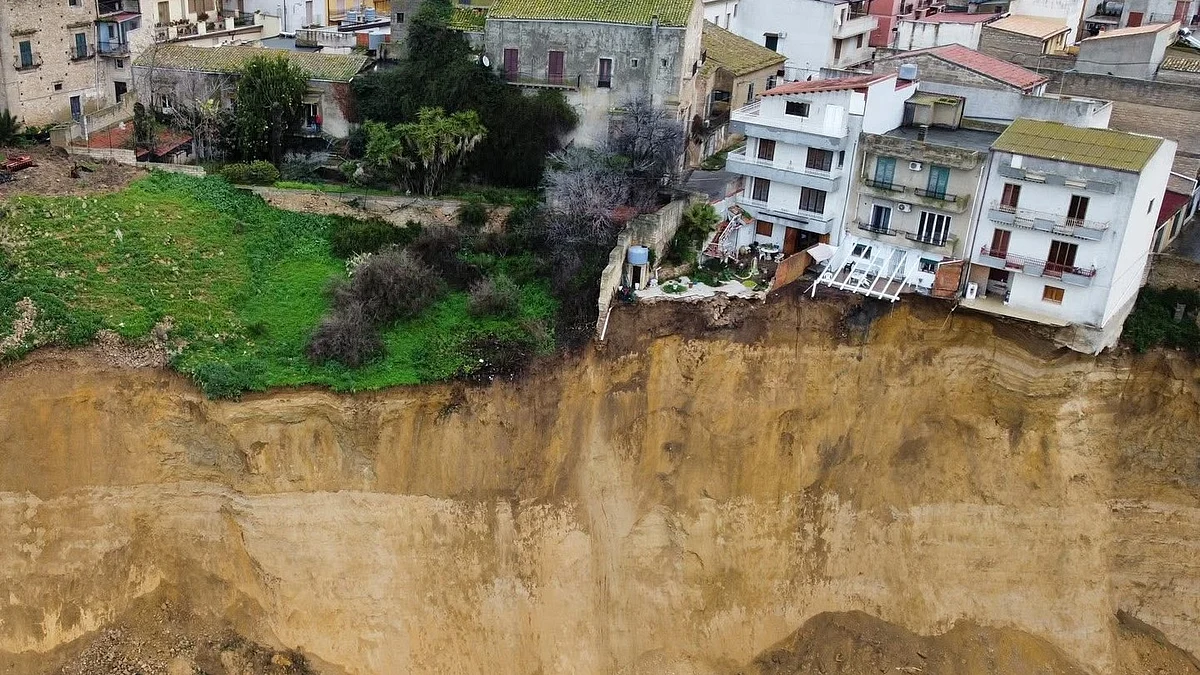


Italian Prime Minister Giorgia Meloni on Wednesday visited a town in southern Sicily that has been severely damaged by days of torrential rain linked to Cyclone Harry. The deluge triggered a huge landslide that sheared away part of the urban edge, destroyed homes and forced the removal of more than 1,500 residents.
The landslide stretched roughly 4 km (2.5 miles), prompting civil protection authorities to cordon off a 150-m-wide exclusion zone. On the outskirts of Niscemi, several cars and buildings had already fallen around 20 m down the slope, while other properties sat dangerously close to ground that was still moving.
Officials warned that residents with homes in the affected zone, which overlooks the coastal city of Gela on Sicily’s southwest, would not be able to return in the foreseeable future owing to the instability caused by water-logged soil.
“The entire hill is collapsing onto the plain of Gela,” said civil protection chief Fabio Ciciliano. “To be honest, there are houses located on the edge of the landslide that obviously can no longer be inhabited, so we need to work with the mayor to find a permanent relocation for these families.”
Rome included Sicily in a broader state of emergency declared on Monday for several southern regions, setting aside an initial €100 million (USD 120 million). However, Sicilian officials on Wednesday estimated total losses at closer to €2 billion (USD 2.4 billion).
Meloni surveyed the area from a helicopter and held talks with local and regional authorities at the town hall, though she offered no immediate public remarks.
Niscemi, just inland from Gela, has a long history of geological instability. The town sits on layers of clay and sand that absorb rainwater easily and have collapsed before. One major landslide in 1997 forced around 400 people to leave their homes, geologists noted.
“Today, the situation is repeating itself with even more significant characteristics: the landslide front extends for about 4 km and directly affects the houses facing the slope,” said Giovanna Pappalardo, professor of applied geology at the University of Catania.
The latest collapse, which began on Sunday as Cyclone Harry battered southern Italy, has revived political debate over why construction was permitted on terrain known to be highly susceptible to landslides.
Renato Schifani, the centre-right president of Sicily, conceded such concerns were legitimate, but stressed that he had only been in office a few years and that the priority now was ensuring a coordinated institutional response for displaced residents.
Meanwhile, Elly Schlein, leader of the centre-left Democratic Party, urged Meloni’s administration to reconsider its €1 billion allocation for a controversial bridge project linking Sicily to the mainland and instead redirect those funds to storm-affected areas, given that the bridge plan is currently mired in legal challenges.
With AP/PTI inputs
Join our official telegram channel (@nationalherald) and stay updated with the latest headlines