


Japan seeks record defence budget to expand drones, AI and long-range weapons
Tokyo plans to expand its use of attack drones, long-range weapons and AI-powered military systems as it seeks to strengthen deterrence amid growing regional security concerns
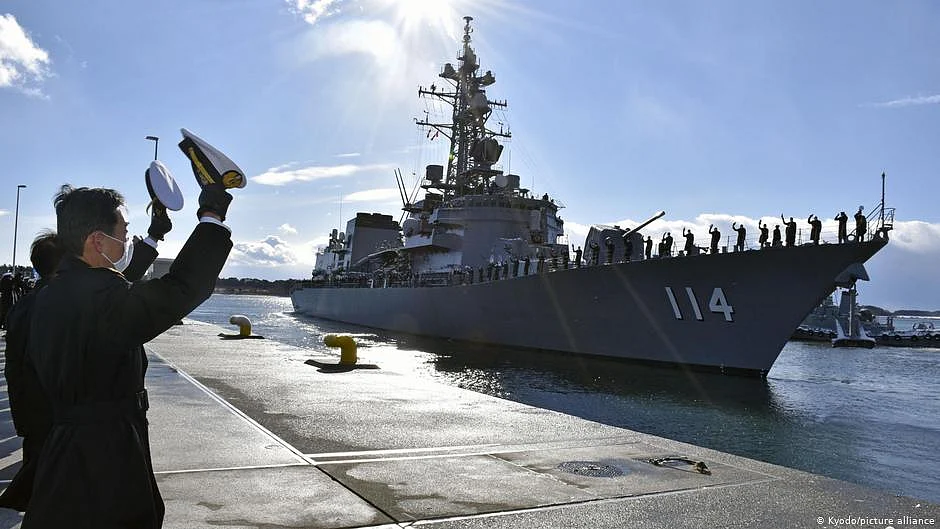


Japan is seeking an initial defence budget of $55.6 billion for the fiscal year beginning April 2027, as the government moves to reshape its military capabilities around drones, artificial intelligence and new methods of warfare amid growing regional security concerns.
The preliminary request, unveiled by the Defence Ministry on Monday, is only slightly higher than the ¥8.8 trillion sought for the current fiscal year. The final allocation is expected to be significantly higher, with further details due later this year after Prime Minister Sanae Takaichi’s government approves a new security and defence strategy.
The planned strategy is expected to strengthen Japan’s counterstrike capabilities and further expand the role of its Self-Defence Forces.
Drones to play bigger role
The Defence Ministry said warfare was changing rapidly, pointing in particular to the extensive use of drones in the war in Ukraine.
It plans to develop and mass-produce relatively inexpensive uncrewed weapons that could be deployed in large numbers, reducing costs and potentially limiting risks to military personnel.
Japan is seeking funding to acquire attack drones that could be launched from both above and underwater. The ministry intends to integrate these systems with long-range missiles to carry out counterstrikes more efficiently.
Officials also believe uncrewed systems could help address Japan’s shrinking military manpower pool as the country faces an ageing and declining population.
However, developing a domestic drone industry could prove difficult. Japan's commercial drone market is heavily dependent on imported systems, particularly from China.
Long-range and hypersonic weapons
Japan has already been strengthening its military presence in the country’s southwestern region by deploying longer-range missiles and air-defence interceptors.
The new strategy is expected to take this capability further.
The Defence Ministry is seeking to develop hypersonic missiles capable of being launched from submarines as part of efforts to strengthen Japan’s counterstrike capability.
The shift marks a significant evolution from Japan’s traditionally defensive military posture, although Tokyo continues to frame the expansion as necessary to strengthen deterrence and respond to a changing security environment.
Under the five-year defence strategy adopted in 2022, Japan committed to roughly doubling defence spending to around 2% of GDP.
China has criticised Japan’s military expansion, describing it as a return to “new militarism”.
AI to assist military decision-making
Artificial intelligence is another major focus of the proposed defence buildup.
The Defence Ministry plans to introduce an integrated AI platform for command and control, with the technology intended to improve the speed and accuracy of military decision-making.
The proposed system could assist with battlefield assessment and target selection.
Japan is considering using existing foreign AI technologies, including systems developed in the United States, alongside domestically developed technology. Officials are also examining ways of combining different AI systems.
A proposed next-generation platform, described as an “AI orchestrator”, would integrate multiple AI systems and enable their coordinated use.
The ministry also plans to establish a secure “Defence Ministry cloud” to facilitate the transmission of sensitive information and maintain communications during emergencies and disasters.
The government has not yet disclosed the expected cost of these AI and cloud initiatives.
Government moves to strengthen defence industry
The defence buildup is also expected to bring greater government involvement in Japan’s domestic arms industry.
Defence officials have warned that production could be disrupted if private suppliers withdraw from the market, potentially creating shortages of critical equipment.
To address this, the ministry is seeking funding for a state-owned, contractor-operated system under which the government could acquire factories and outsource their operation to private companies.
Additional funding would support defence-related research and development, as well as restructuring efforts aimed at improving production capacity and efficiency.
Major Japanese defence suppliers, including Mitsubishi Heavy Industries, Kawasaki Heavy Industries and IHI Corp., have seen profits rise as Tokyo increases military spending and expands defence exports.
However, Japan’s defence industry has struggled historically with low profitability and an uncertain business environment. Dozens of companies have withdrawn from the sector over the years, with some citing reputational concerns surrounding the production of weapons, particularly lethal systems.
A broader shift in Japan’s defence policy
The proposed budget reflects Japan’s broader effort to adapt its military to what it sees as a rapidly changing security environment.
Tokyo is increasingly focusing on long-range strike capabilities, unmanned weapons, AI-enabled decision-making and resilient domestic defence production.
The final size and scope of the defence budget will depend on the new security and defence strategy expected to be approved later this year.
Join our official telegram channel (@nationalherald) and stay updated with the latest headlines