


Kagan, Soai win Nobel Chemistry Prize for solving century-old molecular mystery
Scientists honoured for solving a century-old mystery of how molecular handedness can emerge spontaneously
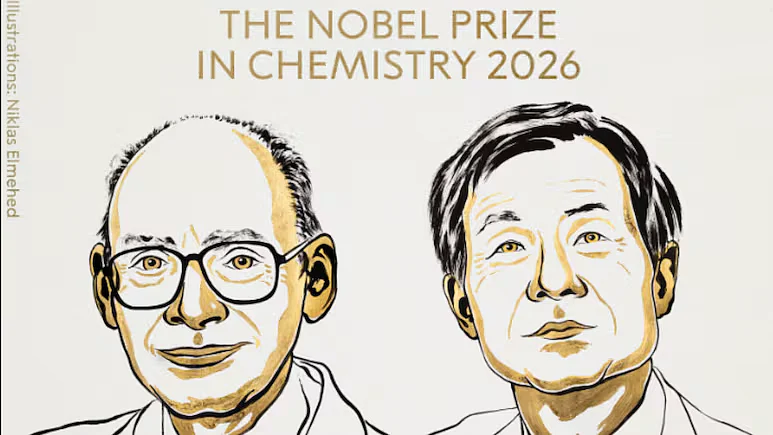


Henri B Kagan and Kenso Soai won the Nobel Prize in Chemistry on Wednesday for their work resolving a long-standing mystery over how mirror-image forms of chemical molecules can emerge spontaneously.
“Henri Kagan and Kenso Soai have provided a solution to a chemical mystery that is over a century old: how homochirality can emerge spontaneously,” Heiner Linke, chair of the Nobel Committee for Chemistry, said in a news release. He described the chemical reactions developed by the scientists as “spectacular”.
Kagan, 95, was born in France and is affiliated with Université Paris-Sud in Orsay, France while Soai, who was born in Japan, is affiliated with the Tokyo University of Science.
Many biological molecules are chiral. The two mirror-image versions can behave very differently in the human body — one may have the desired effect while the other can be less effective or have different biological effects.
Their work could therefore help with:
Drug development: producing predominantly one desired mirror-image form of a drug rather than a mixture of both.
More efficient chemical synthesis: creating chiral molecules with greater selectivity and less chemical waste.
Understanding how life began: one of the major mysteries of biology is why life uses predominantly one “handedness” of amino acids and sugars. Their work provides insight into how such asymmetry could arise spontaneously.
Catalysis: Soai-type reactions demonstrate how a tiny initial imbalance can be amplified into a strongly asymmetric chemical outcome, an important principle in asymmetric synthesis.
New materials and chemicals: Better control over molecular handedness can be useful in developing specialised chemicals, materials and other biologically active compound
The Royal Swedish Academy of Sciences announced the award in Stockholm.
Last year, the Nobel Chemistry Prize was awarded to three scientists for developing new molecular structures capable of trapping large quantities of gas, work that could potentially help remove greenhouse gases from the atmosphere or harvest moisture in arid regions.
The 2026 Nobel prizes began with the medicine award on Monday, which recognised three scientists whose work led to a tool using light to help scientists understand how the brain works. Tuesday’s physics prize honoured a scientist for work involving a rare group of neutrinos.
The Nobel Prize in Literature will be announced on Thursday, followed by the Peace Prize on Friday. The Nobel Memorial Prize in Economic Sciences will be announced on Monday.
The prize money this year is 12 million Swedish kronor, or about USD 1.2 million, for an individual, group of laureates or organisation.
Join our official telegram channel (@nationalherald) and stay updated with the latest headlines