


US-China AI race heats up over alleged model ‘distillation’
Washington accuses Chinese firms of extracting capabilities from frontier US models; Beijing rejects charges as baseless


China on Wednesday, 9 September rejected US allegations that Chinese artificial intelligence (AI) companies are engaged in "aggressive, malicious" and industrial-scale efforts to extract capabilities from leading American AI models, calling the accusations unfounded and urging Washington to cooperate with Beijing on AI development.
The rebuke came a day after the FBI, National Security Agency and Cybersecurity and Infrastructure Security Agency issued a joint advisory accusing Chinese AI developers of extracting, or 'distilling', capabilities from US frontier models including Anthropic's Claude, OpenAI's GPT, Google's Gemini and xAI's Grok since at least late 2024.
The advisory named Chinese companies DeepSeek, Alibaba, Moonshot AI and Z.ai, and said the activity was 'likely with Chinese government awareness'. It alleged that the companies had routed distillation requests through multiple channels to gain unauthorised access to US AI systems, in violation of their terms of use.
AI model distillation involves using a more capable model to generate outputs that are then used to train another model, allowing developers to reproduce some of the capabilities of the larger system at substantially lower cost and computing requirements. It is a common technique in AI development, but using it to circumvent restrictions or extract proprietary capabilities can violate a company's terms of service.
In Beijing, Chinese foreign ministry spokesperson Mao Ning urged the US to "refrain from making unfounded accusations or smears" against China, while calling for greater cooperation between the two countries.
"China's AI development is the result of high-level technological self-reliance and strength," Mao said at a regular press conference. "We maintain that all parties should strengthen cooperation to promote AI development that is open, inclusive, universally beneficial and oriented toward the common good."
The US advisory said Chinese companies were also cutting the cost of their alleged distillation operations by bulk-buying premium subscriptions to US AI services and sharing them among teams of developers.
The latest allegations come as Chinese AI models make growing inroads in global markets. Models developed by companies such as Moonshot AI are increasingly being seen as cheaper and more computationally efficient alternatives to some US systems, even as US export controls restrict China's access to some advanced semiconductors and other technologies needed to develop cutting-edge AI.
The US has previously accused Chinese AI companies of using American models to accelerate their own development. Anthropic and OpenAI have also alleged that Chinese developers used their systems to distil capabilities. Beijing has consistently rejected such accusations as groundless.
The latest joint advisory provides more technical detail than previous US allegations and comes amid an intensifying race between Washington and Beijing for leadership in artificial intelligence.
US treasury secretary Scott Bessent on Tuesday said China would "never get ahead" of the US in AI, citing what he described as Chinese efforts to distil American models. "The Chinese distil our models, and they can never get ahead of us," Bessent said at an event at Southern Methodist University's Cox School of Business in Dallas.
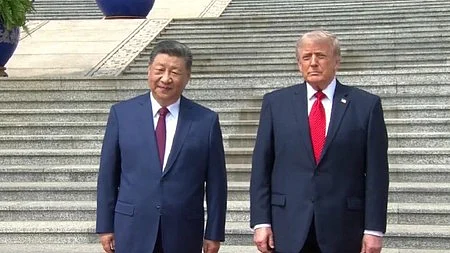
AI governance is also expected to feature in planned talks later this month between US President Donald Trump and Chinese President Xi Jinping, adding another potentially contentious issue to the broader US-China technology rivalry.
DeepSeek, Alibaba, Moonshot AI and Z.ai did not immediately respond to requests for comment.
With AP/PTI inputs
Join our official telegram channel (@nationalherald) and stay updated with the latest headlines