


Zelenskyy, Trump signal near deal on ending Ukraine war
US president strikes cautious optimism, says sides are “getting very close” after high-stakes talks
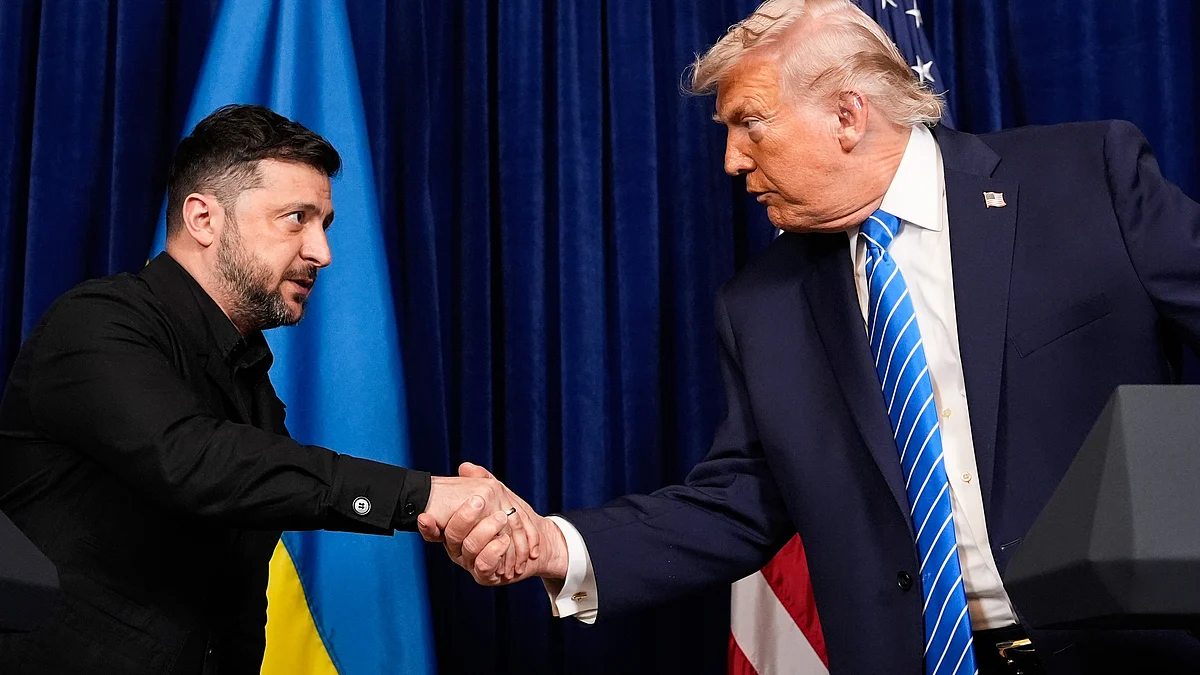


Hope flickered cautiously on Sunday as Ukraine’s President Volodymyr Zelenskyy declared that a peace plan to end the grinding war was “90 per cent” complete, while US President Donald Trump struck a more tentative note of optimism, saying the sides were “getting a lot closer — maybe very close” after their high-stakes meeting aimed at ending a four-year conflict.
Yet the promise of peace stood in stark contrast to the violence that preceded their talks. Hours before the meeting, Russia unleashed massive air strikes on Ukrainian cities, while Kyiv retaliated by hitting Moscow’s oil refinery — a grim reminder of how fragile and elusive Trump’s peace initiative remains.
Even as he hosted Zelenskyy at his Mar-a-Lago estate in Florida, Trump cautioned against premature expectations. “It’s possible it doesn’t happen,” he told reporters, adding that within weeks, “we’ll know one way or another.” Still, all sides agreed that negotiations would continue.
Zelenskyy later wrote on X that US and Ukrainian teams would meet “as early as next week” to finalise the contours of what has been discussed, while Trump is expected to convene Ukrainian and European leaders in Washington next month.
From Moscow, Kremlin spokesperson Yury Ushakov said Washington would carry forward talks through two working groups — one on security and the other on economic issues — with their mandates likely to be finalised in early January.
Arriving with a 20-point peace proposal, Zelenskyy said the meeting yielded “significant results”. “We discussed all aspects of the peace framework and agreed on the sequence of further actions,” he wrote, underlining that security guarantees were central to any lasting settlement.
Trump and Zelenskyy also looped in European leaders during a conference call, including European Commission President Ursula von der Leyen and British Prime Minister Keir Starmer, underscoring Europe’s deep stake in the outcome.
Ukraine continues to enjoy firm backing from Western Europe and Canada — allies whose pressure weighs heavily on Trump’s diplomacy. Von der Leyen welcomed what she described as “good progress,” stressing that “ironclad security guarantees” were paramount to any peace deal.
Such guarantees would likely involve sustained military support from Western European nations, with Ukraine seeking a bilateral agreement underwritten by the United States. Anchoring this security framework, Kyiv insists, would be its eventual membership in the European Union.
Trump endorsed the concept, though not its details. “There will be a security agreement. It will be a strong agreement,” he said, noting Europe’s central role in shaping it.
Before meeting Zelenskyy, Trump had spoken for over an hour with Russian President Vladimir Putin, who launched the war. “He wants to see it happen,” Trump said of Putin’s attitude toward peace. “I believe him.”
Ushakov said Putin told Trump that ending the conflict would require “a bold and responsible political decision from Kyiv,” aligned with Russia’s stated positions in its talks with Washington. Trump, he added, acknowledged to Putin that the Ukraine war had become his “most formidable foreign policy challenge.”
During last year’s election campaign, Trump famously promised to end the war within 24 hours of taking office. Yet nearly a year later — after a summit with Putin, multiple meetings with Zelenskyy, and months of back-channel diplomacy led by his son-in-law Jared Kushner and special envoy Steve Witkoff — the war continues to rage.
Following the collapse of the much-touted Anchorage summit with Putin in August, Trump toughened his posture toward Moscow, imposing sanctions directly on Russian oil companies — the financial arteries of the Kremlin.
Among the thorniest obstacles to peace, alongside security guarantees short of NATO membership, is the future of Ukraine’s Donbas region, parts of which remain under Russian occupation. Moscow insists on control over the entire region, including territory it has yet to seize.
Trump had at one point floated conceding Donbas to Russia, but Zelenskyy countered with a proposal to turn it into a demilitarised zone. Putin, however, appears unwavering in his pursuit of total control through military force.
Ushakov issued a stark warning: “Given the evolving situation on the front lines, it would be in the Ukrainian regime’s interest to make a decision on Donbas without further delay.”
As diplomats trade words and armies trade fire, the path to peace remains narrow — edged with hope, shadowed by violence, and burdened by history.
With IANS inputs
Join our official telegram channel (@nationalherald) and stay updated with the latest headlines