


What a Bangladesh without the Awami League spells for India
Polls show BNP, Jamaat ahead as voters face twin choices: new leadership and the July Charter reforms
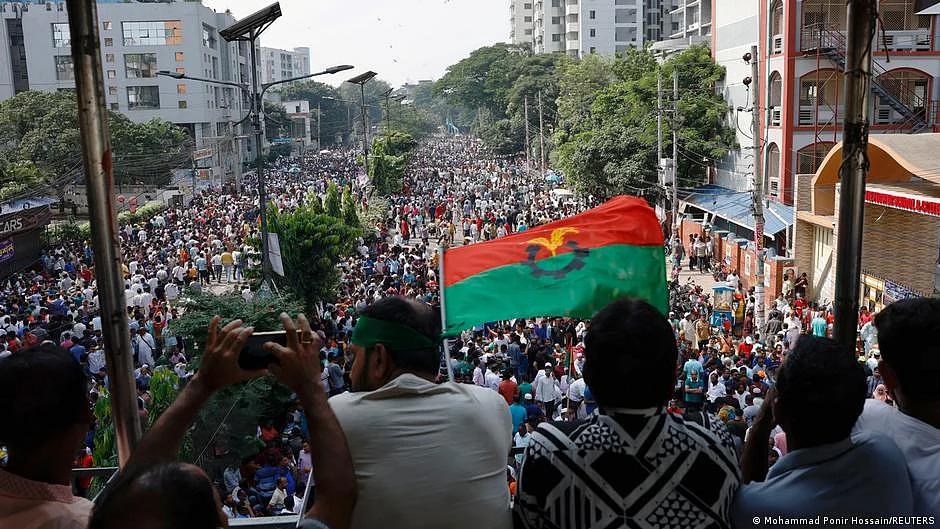


Bangladesh is due to elect its 350-member Jatiya Sansad (parliament) in February 2026 and two parties have emerged as frontrunners: the Bangladesh Nationalist Party (BNP) and the Jamaat-e-Islami. The poll conducted by leading newspaper Prothom Aalo also indicates that ailing BNP leader Khaleda Zia and her son are the top two choices for the next prime minister.
A referendum on the July Charter — the political declaration based on the consensus of 30 political parties and the interim government over constitutional, electoral and administrative reforms — will also be held alongside the general election.
The possibility of a BNP- or Jamaat-led government in Bangladesh has introduced new anxieties among Indian and South Asian watchers and policymakers. A survey carried out by the US-based think tank International Republican Institute in September–October has 33 per cent of respondents saying they would ‘very likely’ vote for the BNP, while 29 per cent favoured the Jamaat. The survey also noted that 53 per cent of the respondents ‘liked’ Jamaat while 51 per cent favoured BNP. Only six per cent were for the NCP.
With the BNP retaining its edge. and the NCP and independents making up a third pole, it is becoming increasingly clear that the Awami League (AL) will have to sit it out. Banned from contesting elections or carrying out political activities, the party’s leader-in-exile Sheikh Hasina interestingly had seven per cent of poll respondents plumping for her as their next PM.
In this emerging scenario, by providing shelter to the deposed Hasina, Delhi has become a stakeholder, instead of an observer as in the past. Now, with the AL reportedly under pressure, the Government of India risks losing strategic and diplomatic leverage over its eastern neighbour at a time of deteriorating regional security and rising bilateral concerns.
Observers in Bangladesh say the ban on the AL has not generated public sympathy. On the contrary, public anger against the party’s activities over the past 15 years has eroded its political base.
“There is no domestic demand to include the Awami League in the elections. This is our impression after our recent travels in the districts, when we tried to engage with all the political parties. We hardly found any AL functionary. Even cultural and civil society organisations seem to have moved away from the party,” confided a researcher associated with a think tank in Dhaka.
Before the July uprising, it was the Jamaat that was a banned party (courtesy Sheikh Hasina’s administration). On 6 August 2024, the party reopened its central office in Dhaka and, on 28 August 2024, the interim government lifted the ban on both the party and its student wing, the Islamic Chhatra Shibir (ICS). On 15 December 2024, Jamaat secretary-general Mia Golam Parwar declared that his party would like to establish an Islamic welfare state in Bangladesh.
In September 2025, the ICS swept the Dhaka University Central Students’ Union election. (The BNP said the elections were rigged.) The Jamaat wave did not stop there. The ICS went on to dominate student union elections at Jahangirnagar, Rajshahi and Chittagong universities, securing majorities across student bodies and hall unions.
***
There’s another reason for New Delhi’s uneasiness. Soon after 5 August 2024—the day the Sheikh Hasina government fell—the Yunus administration acquitted or released on bail many radical and extremist elements.
According to the South Asia Terrorism Portal (SATP), at least 144 militants belonging to Ansarullah Bangla Team (ABT), Jama’atul Mujahideen Bangladesh (JMB), Hizb-ut-Tahrir, Hefazat-e-Islam (HeI) and others were released from jail. SATP also reported heightened militant activity out of Rohingya refugee camps in Bangladesh, with 11 militant groups operating, which include the Rohingya Solidarity Organisation (RSO), Arakan Rohingya Salvation Army (ARSA) and Arakan Rohingya Army (ARA).
Muhammad Yunus also made it clear that he wanted to improve Bangladesh’s military-to-military ties with Pakistan. In October and November 2024, four high-level Pakistani military delegations visited Bangladesh. Lieutenant General Tabassum Habib, Pakistan’s Director General of the Joint Staff, led a high-level military delegation to Dhaka and met with senior Bangladeshi military and intelligence officials over four days (6-9 October) to discuss intelligence sharing and security cooperation.
Against the unfolding scenario, the GoI has toned down its explicit support to the AL, hoping it will ease the way to reengaging with Bangladesh’s future rulers.
“After August 2024, although there was economic interaction, the political interaction between Bangladesh and India was strained,” said Ambassador M. Humayun Kabir, retired diplomat and president of the Bangladesh Enterprise Institute. “National Security Advisor Khalilur Rahman’s meeting with Indian NSA Ajit Doval on 19 November 2025 has possibly reopened that door.”
In the run-up to the elections, while the BNP is emerging as the dominant political force, the Government of India is seeking ways to persuade Sheikh Hasina to adopt a more conciliatory stance, while also engaging with the Jamaat. This concern stems from Jamaat’s quiet infiltration of Bangladesh’s institutions—including the Awami League itself—effectively turning it into a ‘closet Jamaat’.
The success of Jamaat-backed ICS candidates in Dhaka University student elections is largely attributed to a mass shift of Chhatra League (AL’s student wing) votes to ICS. India fears a similar realignment could influence the February general elections.
Will elections in Bangladesh sans the Awami League be inclusive? Observers in Bangladesh say there are two ways in which the question of inclusiveness can be addressed. One refers to the Indian perspective which links inclusiveness to political parties. The second is to ensure the participation of as many people as possible, which, in Ambassador Humayun Kabir’s reckoning, is the prevailing impression in the EU and among international organisations like the United Nations.
Foreign policy experts in India and Bangladesh also rule out any reset of the US–Bangladesh relationship in favour of the Awami League. They point out India’s diminished ability to shape US perceptions of Bangladesh from an Indian perspective.
“The people of Bangladesh have moved beyond the Awami League. A large section of voters are young, with very different aspirations,” says Professor Sreeradha Datta, an expert on Bangladesh affairs. She argues that any future dispensation in Bangladesh will encourage movement of people, normal trade and commercial activities between India and Bangladesh. “But they will tightly control critical areas like energy and infrastructure,” Datta adds.
Datta’s optimism is borne out by Bangladesh clearing its arrears to the Adani Group for power supplied from its plant in Godda, Jharkhand. Bangladesh is also reported to have approved an expansion of the plant’s output to meet 10 per cent of its energy needs.
Sourabh Sen is a Kolkata-based independent writer and commentator on politics, human rights and foreign affairs
Join our official telegram channel (@nationalherald) and stay updated with the latest headlines