


The school across the river Kiul
In this Adivasi hamlet in Bihar’s Jamui district, it takes much more than a desire to study to make it to school
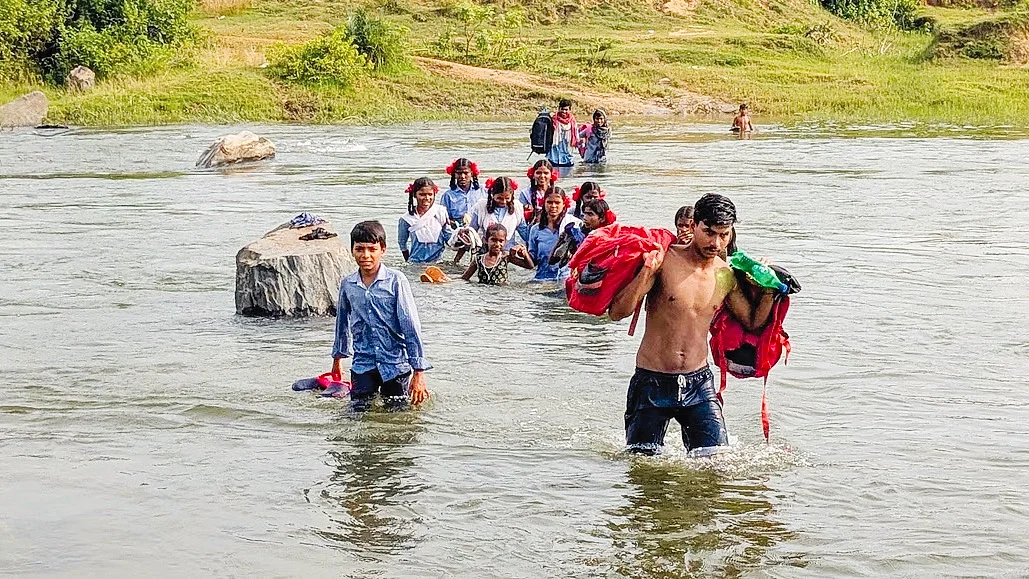


I’ve fallen into the river several times,” Sarojini Baske says. “My books would get wet, and I couldn’t go to school.”
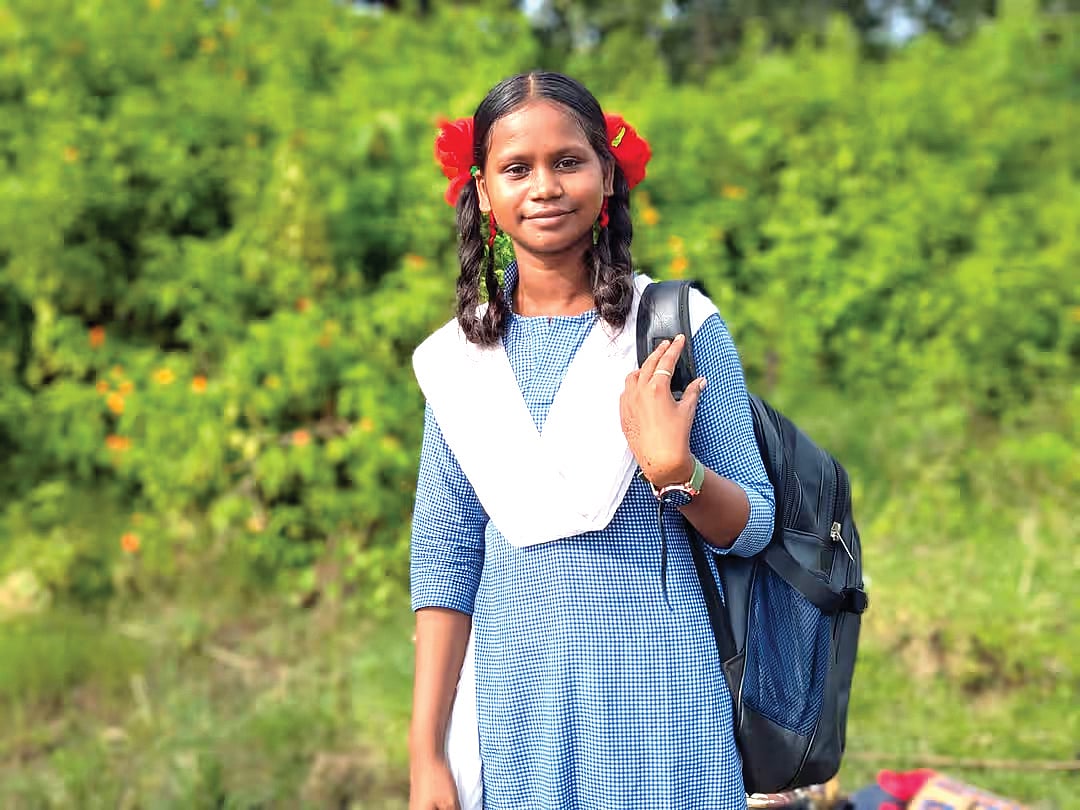
It’s September, and Sarojini, a student of Class 9, is returning home from school. A school bag loaded with books is tied to her back, and she is carrying her shoes in her hands. She stumbles briefly in the middle of the fast-flowing Kiul river but quickly regains her balance.
“I fell a couple of times, but then I got a sense of where the stones were,” says her schoolmate and neighbour, Srishti Kujur, walking alongside. She now carries a spare set of clothes. “We cross the river in our home clothes; once across, we put the wet clothes in a plastic bag and change into our school uniforms,” explains Srishti as the girls walk off towards their home in the Santhal Adivasi hamlet of Jathar, in Bihar’s Jamui district. The bright red ribbons tied in their hair look like red flowers, bobbing up and down.
When Srishti was younger, her stepmother Reshmi Devi would carry the young child across. “I used to sling the bag over my shoulder and carry Srishti in my arms and cross. I did this for five years,” she recalls. “Duio time ka ye kaam tha (it was a twice-daily routine).”
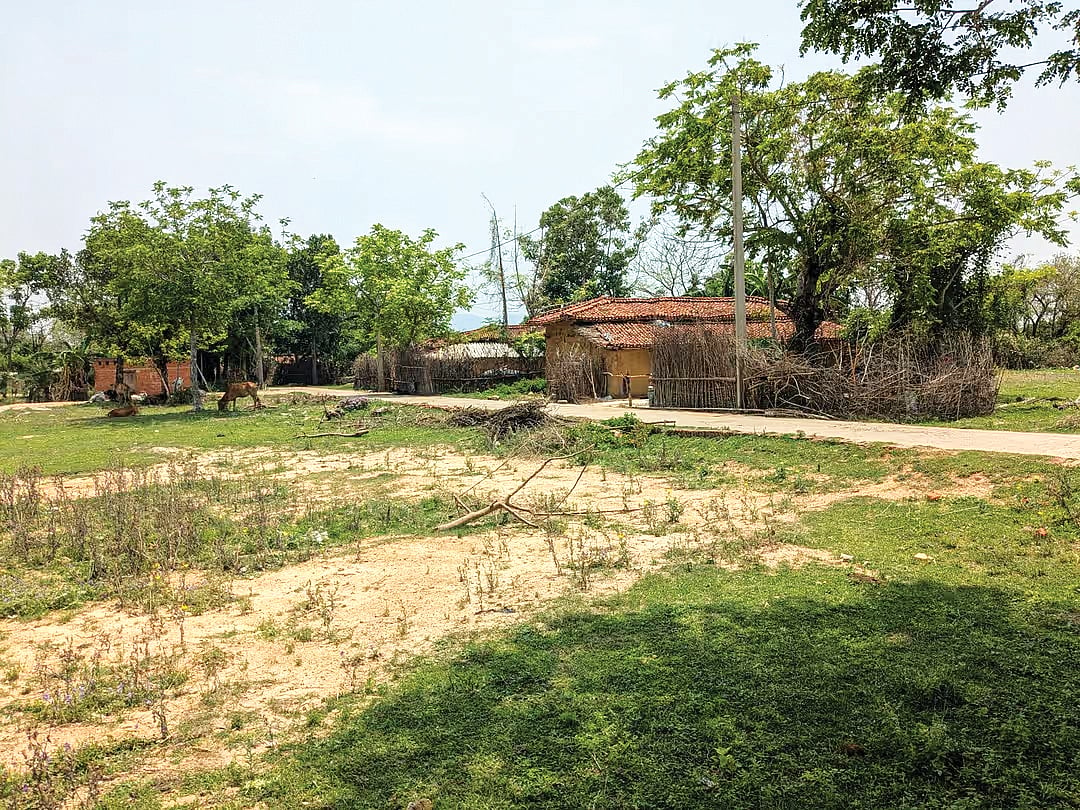
Jathar is a hamlet of Santhal Adivasis in Harni panchayat, cut off by the flowing waters of the Kiul in Jamui district of Bihar. Of the roughly 200 households, half are Adivasis and the rest from the scheduled caste Ravidas community.
“We [mothers] walk to the river together in the morning, and when school lets out, we wait at the bank to check if they have made it over safely,” says Reshmi Devi, who worries her stepdaughter might fall while crossing the river. “Padhna zaroori hai, isse dimag khulta hai, isliye bhejte hain (education is essential; it broadens the mind, which is why we send them),” says Reshmi, who never went to school.
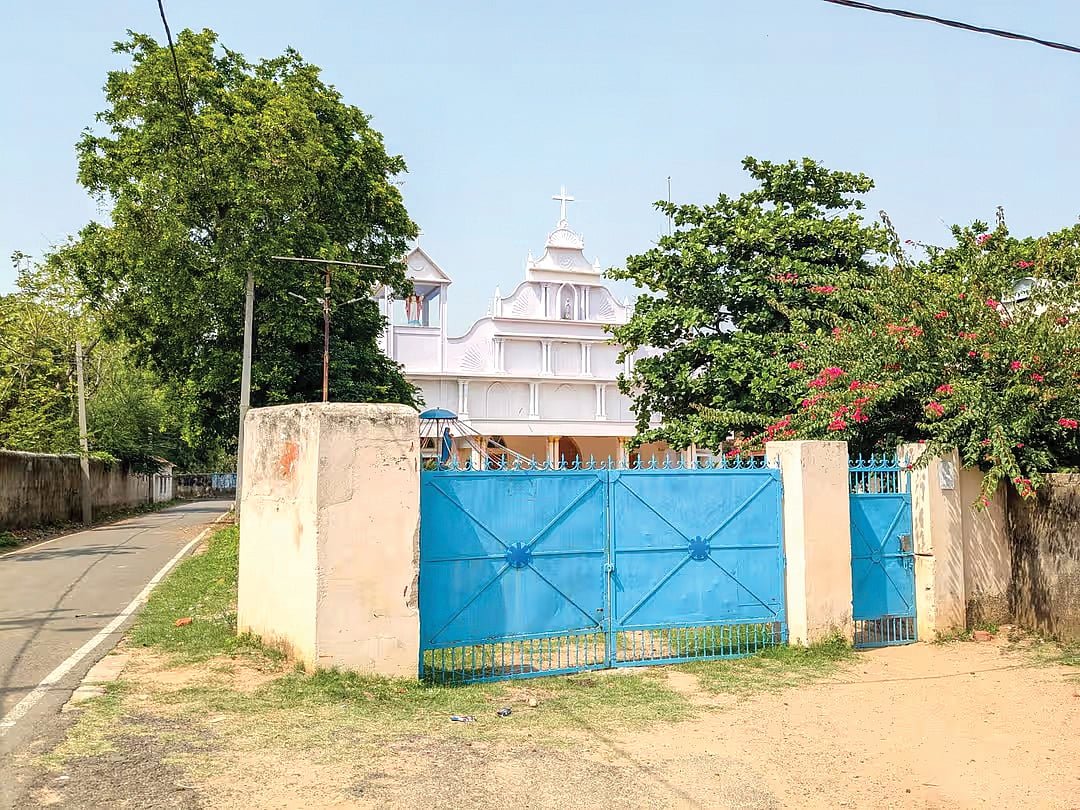
Around 20-25 Adivasi children from Jathar who can afford the annual fees of Rs 4,000-5,000, attend the missionary school across the river, 1.5 km away. Families here survive on seasonal tendu leaf collection and daily wages, and can barely afford the fees.
Reshmi’s husband Deepak Kujur works as a tractor driver for a daily wage of Rs 500 with which he manages his household of nine people. Most parents of these school-going children depend on minor forest produce like tendu leaves or they migrate for labour work. Sarojini’s father Vijay Baske (50), works in a factory in Tamil Nadu; her mother Rajeena Soren (45) manages the household and collects tendu leaves for sale.
Young father Ruben Soren carries his son Ivan, aged 9, on his shoulders. “If we [parents] aren’t around, my father takes him to school. Someone always has to be present at the riverbank,” says the 30-year-old, who relies on local wage work and also migrates. “This is a dangerous river; if your feet hit a stone, you could get swept away, and your head could strike a rock,” he adds.
Not too long ago, Ruben too crossed the river to attend the missionary school. “Once, I slipped and fell into the river myself. I was in Class 6 at the time. My bag and school uniform got soaked, so I didn’t go to school that day,” he recalls laughing. Ruben has a graduate degree and has tried for state jobs, but now works as a labourer.
The village had a government primary school, an old lime-and-brick structure that collapsed 15 years ago. A community centre was built around that time, and the government school shifted there. “There were two teachers, but the quality of education didn’t match the missionary schools. Only four or five children would go and the school was later merged with the one in Kervatari village,” Ruben explains.
However, the school with which the Jathar school was merged is 2 km away, across a deep ravine. “It is so deep that we can drown in it. How can children be expected to make it across?” he asks. Among Adivasis in the state, only 13 per cent finish high school and 3.5 per cent are graduates (Bihar caste survey 2022-2023).
Bihar merged around 2,600 schools, reported Dainik Bhaskar on 8 August 2024. Across the country, schools have been closed and others merged to ‘improve the quality of school education’, as per a 2023 Niti Aayog report. But these mergers have put the new schools out of physical reach for many families and out of financial reach where private options exist.
In Jathar village, it’s not just school-children who must cross the Kiul; the village folk have to cross the river even for basic provisions. There is no bridge over the river. Locals have been demanding a bridge for at least a decade-and-a-half. “We have submitted petitions to ministers, MLAs and government officials. But all we’ve got is assurances,” says Ruben.
The Kiul originates at Khajuri on the Chota Nagpur Plateau in the Giridih district of Jharkhand and flows eastward into Bihar. Passing through Jamui district, the river reaches Lakhisarai and then joins the Harohar river near Surajgarha; the Harohar later merges into the Ganga.
The Upper Kiul Dam (also known as the Garhi dam for the village it is located in), was built at a cost of Rs 160 crore. It was meant to irrigate 4,141 acres of land in the hilly areas of Jamui’s three blocks — Sikandara, Jamui and Khaira. Construction started in 1978 about 7 km from Jathar village.
“All our problems started after the dam was constructed [in 2004],” says Ruben. The irrigation scheme displaced 427 families. For the residents of Jathar, the dam made river crossings a challenge because it deepened the riverbed.
Deepak Kujur was around six years old in 1978 when construction started on the dam. “Before the dam was built, the bed was entirely sandy. The river flowed at a higher elevation relative to our village. Back then, no matter how high the floodwaters rose, we could easily cross the river,” says Deepak.
“When the dam was built, river sand started accumulating on the other side of the sluice gates. When water was suddenly released from the dam, the river’s swift current swept the sand away exposing the underlying stones,” adds Ruben.
One of the first jobs for Rafail Kharwar of Jathar village was working at the dam site. “I built six of the 12 gates of the dam, earning a daily wage of Rs 150 at the time,” says Rafail. He had no idea that the dam he and other tribal villagers were building would one day create problems for them.
There’s still no bridge across the Kiul and the villagers are done with petitions — they have decided to build one. Bamboo or concrete, they don’t know yet, but they have begun collecting donations.
“We could only study till the third grade, but we want to educate our children because education is the only way to move up in life,” says Deepak.
Srishti wants to become a doctor. “It is hard to attend school, but I will try my best to become a doctor.”
Young Sarojini enjoys reading Hindi and aspires to become a nurse. “There may be difficulties, but I will complete my education,” she says with quiet assurance.
Article courtesy: People’s Archive of Rural India
Join our official telegram channel (@nationalherald) and stay updated with the latest headlines