


Bengal SIR: Publish list of ‘suspicious’ voters and Bangladeshis, TMC dares ECI
The Election Commission of India had claimed that there were 1 crore Rohingyas and Bangladeshis in West Bengal


Trinamool Congress (TMC) MP and national general-secretary Abhishek Banerjee has alleged that the Election Commission of India (ECI) circulated a figure of 1.36 crore West Bengal voters with ‘logical inconsistencies’ on WhatsApp to select people and media. This figure was shared on 16 December itself when the ECI released the draft list, he pointed out. How is that even possible, he wondered aloud, and dared the ECI to publish the list on its website.
“On the day the draft electoral rolls were published, the EC said 1.36 crore voters had logical discrepancies in their forms. Where is this list? Why is the EC not publishing this list? If it wants to clean the list then why are they (sic) hiding the list? They had also alleged that there were one crore Rohingya and Bangladeshis in Bengal. Then they should release the list of illegal immigrants,” he added.
“Across districts, people who breathe, work, and vote are being erased on paper. Why should FIRs not be lodged against a Commission that has the audacity to kill citizens administratively? And if this full, fabricated list is not made public immediately, we will gherao the Election Commission headquarters in Delhi. If the Commission believes it can blindly follow BJP’s orders, destroy lives, and then dodge questions raised on behalf of the people, it is dangerously mistaken,” the official TMC handle posted on X.
A TMC delegation, Banerjee said, would be meeting the chief election commissioner in New Delhi on 31 December with the demand that the list of such voters be published, failing which the party would launch an agitation, he warned.
A state civil services officers’ association, meanwhile has flagged concerns about the ‘system-driven’ deletion of voters without the knowledge of electoral registration officers (EROs). Such deletions, they pointed out, are against the law and have been made by computer apps with the help of AI and big data analytics.
The law gives the authority of deletions to the ERO, it was pointed out. What is more, the law lays down that no deletion would take place without giving the voter sufficient notice and a reasonable opportunity to represent their case against deletion. The ‘system-generated’ deletions by the Commission were unlawful, they pointed out, and failed to follow the law and the ECI’s own guidelines.
The ’logical inconsistencies’ too are said to be ‘system generated’ and relate to spelling mistakes, anomalies in age or year of birth etc. In the first phase, however, the ECI has identified 32 lakh voters of the 1.36 crore ‘suspicious voters’ as ‘unmapped’, or those who failed to provide evidence of themselves or their parents figuring in the 2002 voters’ list.
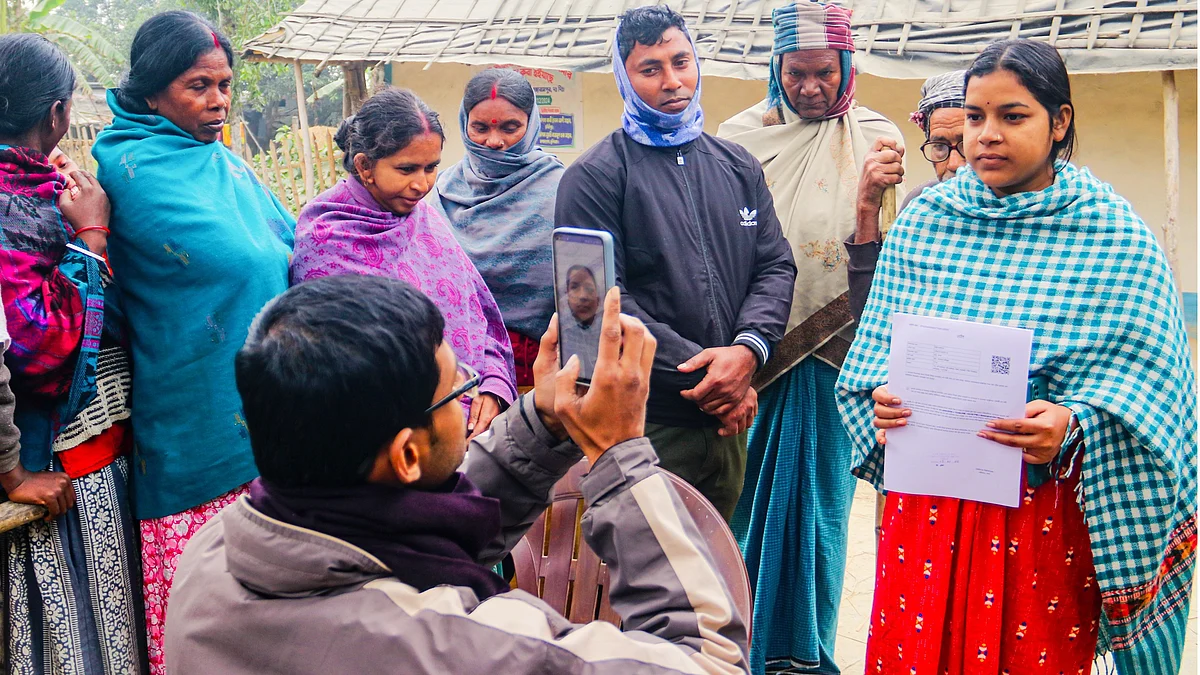
Hearing commenced on Saturday, 27 December, for this unmapped category of voters. The exercise on the very first day highlighted the harassment faced by voters, many of whom arrived in ambulances. Fishermen and other daily-wage earners complained of having missed out on wages to appear before the EROs.
One of the voters, Manu Mitra (28) was asked to produce her father's death certificate. Her own name figures in the 2025 draft voters’ list and her mother’s name figured in the 2002 electoral rolls. However, since documents produced by her carried the name of her late father whose name was not traced to the 2002 voters’ list, she has been asked to produce the death certificate. Mitra told the media that her parents separated even before she was born; that her father remarried and it was her mother who raised her.
Kadambini Naskar, similarly, is listed as a voter in the draft list but in the 2002 electoral rolls, she was named as Kamala Naskar. Her son Gurupada Naskar (52) says she is 72 and bedridden but has been voting for 50 years. He is not sure if she would be able to vote in 2026 but anxiety over the SIR drove him to attend the hearing and bring documents to prove her bona fides.
Bidhubhushan Mondol (62) and his wife Renuka (52) also figure in the 2025 list, but they have been issued notices because neither they nor their parents figure in the 2002 electoral roll — the legacy base list used as a reference for the current exercise. Their eldest son is in Tamil Nadu and may not be able to return in time for the SIR process, they are afraid. “A lot of voters have different names and spellings in different documents,” said an ERO. “There are also spelling differences in the 2002 and the 2025 voter list”.
One of the logical inconsistencies flagged by the ‘system’ in West Bengal — though such cases are yet to be taken up for hearing — is the absurdity of a father and son born in the same year. The error-prone electoral rolls have a large number of such discrepancies, when father and son both have been shown to have been born in 1985 — whereas it was the son who was born in that year and the father was born in 1955.
The ECI appears to be spending an enormous amount of time and resources to correct the anomalies. As more instances of harassment are highlighted, there is tension and resentment brewing. The conflict between state and Central government officials is also evident.
Join our official telegram channel (@nationalherald) and stay updated with the latest headlines