


Courts not experts in faith, says seers' body, seeks to intervene in Sabarimala
Umbrella body of Sanatan Dharma sects argues equality cannot override religious autonomy under Article 25
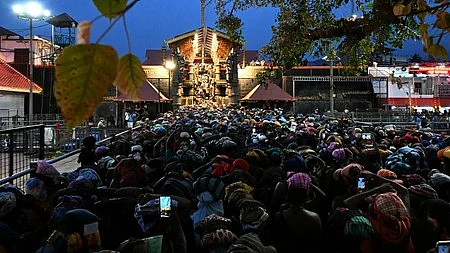


Courts should not determine what constitutes essential religious practices, as these are matters of faith held sacred by followers, the Akhil Bharatiya Sant Samiti has told the Supreme Court in an intervention plea ahead of the Sabarimala review proceedings.
A nine-judge bench headed by Chief Justice of India Surya Kant is scheduled to begin final hearings on 7 April on petitions concerning alleged discrimination against women at places of worship, including the Sabarimala temple in Kerala, and the broader scope of religious freedom across faiths.
In September 2018, a five-judge Constitution bench, by a 4:1 majority, struck down the ban on entry of women aged between 10 and 50 years at the Ayyappa shrine in Sabarimala, holding the centuries-old practice unconstitutional.
The Akhil Bharatiya Sant Samiti, in a plea filed through advocate Atulesh Kumar, has sought permission to intervene in the review proceedings. The organisation describes itself as an umbrella body representing 127 sects of Sanatan Dharma, comprising around 18.5 lakh priests and 12 lakh seers.
The plea argues that courts are not equipped to act as “experts” in religious matters and should intervene only where a practice directly violates public order, morality or health.
It contends that the fundamental right to equality under Article 14 should not override the right to freely profess and practise religion guaranteed under Article 25.
“Religion is a matter of faith and religious beliefs are held to be sacred by those who share the same faith. Thought, faith and belief are internal, while expression and worship are external manifestations thereof … the phrase ‘equally entitled to’, as it occurs in Article 25(1), must mean that each devotee is equally entitled to profess, practise and propagate his religion, as per the tenets of that religion,” the plea states.
“The courts should not determine the essential religious practices because the court is not an expert in religious matters/practice. The courts should step in only when such religious practice violates public order, morality or health,” it adds.
Justifying the restrictions at Sabarimala, the plea says certain shrines follow specific purity rituals rooted in long-standing tradition.
“This is based on the belief that the deity is a Naishtika Brahmachari (celibate) and worshippers must observe 41 days of strict purification, which the tradition believes is difficult for women during this phase,” the plea says.
It argues that the practice is protected under Article 25 and does not amount to an absolute prohibition on women, as it applies only to a specific age group and therefore does not violate Article 14.
The plea also notes that more than 1,000 other temples dedicated to Lord Ayyappa do not impose similar age-based restrictions, suggesting that the Sabarimala tradition is site-specific and rooted in what it describes as the shrine’s “essential practice”.
With PTI inputs
Join our official telegram channel (@nationalherald) and stay updated with the latest headlines